
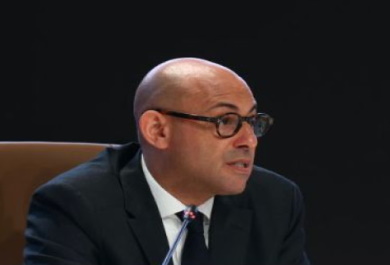
BAKU, Azerbaijan, Nov 18, CMC – The United Nations Climate Change Executive Secretary, Simon Stiell, Monday urged countries to “wrap up less contentious issues as early as possible this week”, so there is enough time for the major political decisions.
”We’ve worked closely with the Presidency, who have just laid out a clear approach to get us to the finish line. We can’t lose sight of the forest because we’re tussling over individual trees,” said Stiell as the United Nations Climate Change Conference (COP29) moves towards its end here on Friday.
”Nor can we afford an outbreak of ‘you-first-ism’. Where groups of parties dig in and refuse to move on one issue, until others move elsewhere. This is a recipe for going literally nowhere. And could set global climate efforts back at a time when we simply must be moving forward,” said Stiell, a former senior Grenada government minister.
He told the conference that “we will only get the job done if parties are prepared to step forward in parallel, bringing us closer to common ground.
”Bluffing, brinksmanship, and pre-mediated playbooks burn up precious time and run down the goodwill needed for an ambitious package. So let’s cut the theatrics and get down to real business.
”Yes, there are headwinds, everyone knows that, but lamenting them won’t make them go away. Now is the time to focus on solutions. I know we can get this done. The Presidency is working round the clock, with diligence, determination and even-handedness.”
He said that the secretariat will continue to be the steady guide by their side, while also supporting parties, with a focus on inclusivity.
“So I urge everyone – now’s the time to get to work.”
Stiell said that National Adaptation Plans (NAP) are more necessary than ever, insisting that they “are truly vital.
”This year, we saw how every bit of preparation, every policy, every plan, is the difference between life and death for millions of people around the world. Prudence demands we plan for the worst.”
Stiell said that he is aware that these plans are not easy to put together, noting that resources are scarce, both funding and capacity especially for the most vulnerable, in least developed countries and Small Island Developing States (SIDS).
He said that people, communities, nations want to act, to protect themselves and their loved ones, to strengthen their businesses and economies, but they do not have the means to do it.
”And when nations can’t climate-proof their links in global supply chains, every nation in an interconnected global economy pays the price. And I mean literally pays the price, in the form of higher inflation, especially in food prices, as savage droughts, wildfires and floods rip through food production.
”We must flip this script. Business-as-usual won’t get us there. We need urgent action. We need transformation.”
Stiell said solutions, born out of the wealth of information and progress already made through existing adaptation efforts.
“We need data and engaged consultation. But we also need to build on the experience of communities around the world. Their lessons must serve as a strong foundation for comprehensive National Adaptation Plans.
”Of course, we cannot ignore the adaptation elephant in the room: there is a stark financial gap we must bridge.”
Stiell said adaptation costs are skyrocketing for everyone, especially developing countries. He said their costs could rise to US$340 billion per year by 2030, reaching as much as US$565 billion per year by 2050.
”It’s easy to become slightly anaesthetized by all these numbers, especially at this finance-focused COP. But let’s never allow ourselves to forget: these figures are the difference between safety and life-wrecking disasters for billions of people.”
He said the Intergovernmental Panel on Climate Change (IPCC) Working Group Two report informed that almost half the human population live in climate vulnerable hotspots, where people are 15 times more likely to die from climate impacts.
“Personally, I find this deeply disturbing, and highly offensive. It certainly keeps me up at night, and I’m guessing it also does so for many of you also. I also want to talk about another aspect of flipping the script. Let’s talk about the massive transformational power of adaptation, beyond its risk mitigation functions.”
Stiell said that iIt’s clear that adaptation investments, at the right scale and pace, can be truly transformative “not only protecting people and economies, but also driving forward much more opportunity, equality, and prosperity minimizing losses and damages on lives and livelihoods.
“We can no longer rely on small streams of finance. We need torrents of funding. They need to be easier to access, especially for the most vulnerable countries that often face the biggest barriers.
“We must explore innovative financing mechanisms, and provide the technical assistance countries need to formulate their NAPs,” he said, adding that just a few months ago, at the NAP Expo, he launched the NAPs 3.0 initiative.
He said one of its main goals is precisely to promote innovative adaptation financing, tailored specifically to the needs of Least Developed Countries and SIDS.
He said the global financial system must evolve to meet these needs, urging multilateral development banks to think beyond traditional grants and loans.
“Philanthropies, the private sector, and bilateral donors must step up with the urgency that this crisis demands, without increasing the debt burden of vulnerable countries. We must also work to minimize bureaucratic hurdles that so often stand in the way.
“The people that receive these investments will not disappoint. They want to adapt. Often, they know better than we do just how to adapt and what adaptation looks like to them on the ground,” he said, adding that “every country can and must submit their National Adaptation Plans by 2025.
”This is not just a timeline, it is a lifeline. More than that it’s a fast-track to the stronger economies and societies that all countries want and deserve. And that is in every nation’s interest, in these turbulent times.”
CMC/ag/ir/2024