
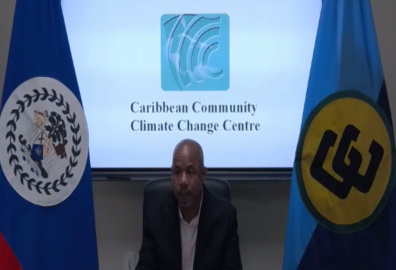
BELMOPAN, Belize, Aug 16, CMC – Five years after the historic Paris Agreement on climate change, Caribbean Community (CARICOM) countries are much more vulnerable to climate change, a senior official of the Belize-based Caribbean Community Climate Change Centre (CCCCC) said on Monday.
CCCCC executive director, Dr. Colin Young, told a news conference that the global community “was going in the wrong direction” after signing the Paris Agreement that was adopted by every nation in 2015 and includes commitments from all major emitting countries to cut their climate pollution and to strengthen those commitments over time.
“Global greenhouse emissions are increasing rather than decreasing and obviously temperatures are increasing. Five years later, the national determined contributions, those pledges and targets set by nations…to reduce emissions to keep temperature goals within reach have the world on a trajectory to reach three degrees by 2100.”
Young told reporters that the just released sixth report of the Intergovernmental Panel on Climate Change (IPCC) that assesses climate change science, is a warning sign for policy makers all over the world.
He said that the report indicates that global temperatures will reach 1.5 degrees within 20 years even under the lowest emission scenario.
“Five years later developed countries have not delivered the US$100 billion per year, they promised in Paris. Rather access to finance has become more challenging and the bureaucracy to access has become even more difficult to navigate, slowing down even more the trickle of finance and thus our ability to adapt to climate change”.
The CCCCC official said five years after Paris, the developing countries, including those in the Caribbean “are still not seeing the type of climate ambition from the biggest emitters, those in the G7 and G20 that is necessary to meet the temperate goal of the Paris Agreement.
“Action speaks louder than words and right now bold climate actions and bold commitments are not at the scale they need to be nor do they reflect the urgency that is required to keep the 1.5 degrees…within reach”.
Young said five years later, the Caribbean is even more vulnerable to climate change, noting that since 1950 over 324 natural disasters have struck the Caribbean, killing over 250,000 people and affecting more than 24 million others.
He said between 1970 and 2020, at least 91.5 per cent of Caribbean disasters are climate change related, including hurricanes, floods and droughts.
Young said the combined losses and damage from hurricanes are estimated at more than US$137 billion and that between 2010 and 2020, the region has been impacted by over 150 disasters that directly impacted over 22 million people.
“Today, the Caribbean on average experiences four significant events …that causes losses of 20 per cent of GDP (gross domestic products) or more per year. Annually, the region suffered losses equivalent of two to three per cent of its entire GDP. For many of our countries, the annual loss from climate related disasters exceed the GDP growth of our countries.”
The IPCC’ s Sixth Assessment Report (AR6) comes ahead of the 26th UN Climate Change Conference of the Parties (COP26) in Glasgow from October 31 to November 12 this year and will bring parties together to accelerate action towards the goals of the Paris Agreement and the UN Framework Convention on Climate Change.
Young said that the CCCCC has revised the regional framework for achieving development resilience to climate change, highlighting the significant economic costs of climate impacts, estimating the annual average cost to be in the vicinity of US$350 to US$500 million due to hurricane damages alone.
“Agricultural losses for some countries are very venerable to climate change and losses in these areas can reach up to 50 per cent of GDP,” he said, adding that the CCCCC in the regional framework warned that “without resilience building through effective adaptation, damages from hurricanes, losses from declines in tourism and damage to infrastructure due to sea level rise are projected to total US$22 billion a year by 2050 and US$46 billion annually by 2100.”
He said this would represent between 10 and 22 per cent of the Caribbean GDP.
‘These numbers are hardly surprising when one considers that almost 60 per cent of the Caribbean’s GDP is derived from sectors such as tourism, agriculture and other natural resource based industries that are vulnerable to the effects of climate change.
“It is because of these contents that our leaders continue to make the point that climate change for us in the Caribbean is an existential threat. The Caribbean in the words of the Prime Minister of Dominica (Roosevelt Skerrit) is on the front line in the war on climate change. A war that we are on pace to lose and lose badly unless the world significantly ramps up its climate ambition. The science on this has never been clearer,” Young said.
CMC/pr/ir/2021