
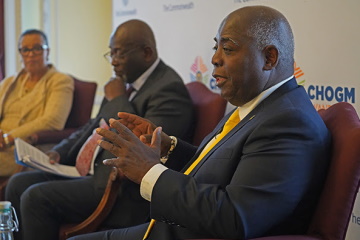
LONDON, May 10, CMC – Bahamas Prime Minister Phillip Davis Tuesday urged the Commonwealth to “lend its voice” on matters relating to climate change calling also for access to climate funding./
“We cannot do this alone. We are in an inequitable position on climate change so it is important that the Commonwealth lends its voice. And the time has come that the voice is turned up to ensure that we get the proper response from the world on this existential threat,” Davis told the third Marlborough Dialogue organised by the London-based Commonwealth Secretariat.
“One area we need to tackle vigorously is access to climate funding. The process for accessing climate financing is so tortuous that many small island states like ours have not been able to access funds we need,” Davis told the event that brought together political leaders and thinkers from across the Commonwealth.
“So, the voice of the Commonwealth of Nations needs to be a loud voice sufficient to bring awareness and the need for action not tomorrow but today,” he said as the Commonwealth gears up for the Commonwealth Heads of Government Meeting (CHOGM) in Kigali, Rwanda next month and the COP27 in Egypt.
The event was held under the theme “Commonwealth Leadership in Accelerating Climate Action for SIDS: including for Sustainability and Tourism,” and the Secretariat said that Small Island Developing States (SIDS) continue to face the most devastating impacts of climate change, resulting in limited economic space to protect themselves and bolster their resilience efforts.
It said the Commonwealth has been pushing for collective climate action since 1989, when leaders committed to protecting the environment in the Langkawi Declaration. This was one of the world’s first collective statements to name greenhouse gas emissions as one of the leading problems facing the planet.
The forum was moderated by Kenya’s High Commissioner to the United Kingdom, Manoah Esipisu and in her remarks , Commonwealth Secretary-General, Patricia Scotland said climate change is rightly understood as the “defining challenge of our times, both an existential threat and a multiplier of existing social and economic inequalities, which will bring forward the tipping point for conflict.
“The Commonwealth has led the way on climate change before and we must do so now. But it is only if we are united as a whole Commonwealth that we will meet the existential challenges we face. That is our task.”
Out of the Commonwealth’s 54 members, 32 are classified as ‘small states’, most of whom have a population of less than 1.5 million, including 25 small island developing states.
According to the latest report by the Intergovernmental Panel on Climate Change (IPCC), small island nations are increasingly affected by a range of climate change impacts, which are already detectable across both natural and human systems.
These include rises in temperature, the damaging effects of tropical cyclones, storm surges, droughts, changing rain patterns, sea-level rise, coral bleaching, and invasive species.
At CHOGM, Commonwealth countries will seek to build on outcomes from the United Nations Climate Change Conference COP26, towards achieving significant progress on issues such as climate finance at the forthcoming COP27 summit in Egypt this November.
CMC/js/ir/2022