
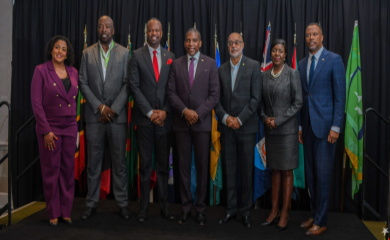
BASSETERRE, St. Kitts, Feb 4, CMC – Energy ministers from the Organisation of Eastern Caribbean States (OECS) Tuesday began a two-day meeting here with Prime Minister Dr. Terrance Drew calling for bold action and decisive implementation of the region’s transition to sustainable energy.
“Energy security is not a luxury; it is a necessity. Reducing our dependence on imported energy sources is an economic imperative that will stabilize costs, protect our economies from external shocks, and provide affordable, reliable electricity for our people,” Prime Minister Drew told delegates attending the Third Council of OECS Energy Ministers meeting being held under the theme ““Sustainable Energy: Creating Opportunities for Reinventing the Economy of the OECS”.
Prime Minister Drew said that there is the critical need for energy security, investment in renewable resources, and regional integration to drive economic transformation, highlighting the the urgent need to move beyond discussions and into full-scale implementation of renewable energy projects.
But he acknowledged that financing remains one of the biggest challenges, even as he called for increased access to concessional financing, public-private partnerships, and innovative funding mechanisms such as green bonds and blended finance models to accelerate
progress.
“The road to economic resilience in the OECS is paved with clean energy solutions. A robust green energy sector presents boundless opportunities for job creation, investment attraction, and technological advancement,” Prime Minister Drew said, pointing to regional integration as a game-changer, advocating for collaborative projects such as interconnection grids and submarine energy cables to facilitate electricity trade between OECS countries.
He told the conference that member states should adopt successful models, such as geothermal advancements in Guadeloupe and Martinique, and to expand initiatives like the Eastern Caribbean Solar Challenge to boost solar energy adoption.
“This meeting must not be just another conversation, it must be a platform for decisive action. Our citizens are looking to us to deliver on the promise of a sustainable energy future,” Prime Minister Drew said, reaffirming his administration’s commitment to regional energy collaboration.
A statement issued by the St. Lucia-based OECS Commission said that “the meeting’s centerpiece will be the presentation and endorsement of the development of the OECS Sustainable Energy Roadmap 2025-2035.
It said the ministers are expected to review ambitious but practical targets, including achieving 30 per cent renewable energy penetration across the OECS by 2030, with a minimum of 20 per cent in each member state, and 50 per cent penetration by 2035.
The OECS groups the islands of Antigua and Barbuda, Dominica, Grenada, St. Lucia, St. Vincent and the Grenadines, St. Kitts-Nevis, Anguilla and the British Virgin Islands.
St. Kitts-Nevis Energy Minister, Konris Maynard, who is chairing the meeting, said sustainable energy development can no longer be looked at simply as a mere goal, but rather as the pathway to unlocking new economic opportunities, driving innovation and building resilience for the small island developing states of the OECS.
“Transitioning our energy infrastructure to sustainable energy sources, characterised by being indigenous, clean and renewable presents a significant opportunity to reinvent our economies,” Maynard said, adding, “when combined with the energy efficiency measures this transition creates a multiplied effect”
He told the meeting that the OECS region is blessed with an abundance of natural resources—wind, solar, geothermal and the ocean—that can all be utilised to combat the challenges of climate change and sustainably power regional economies.
“Harnessing these resources requires vision, cooperation, and most importantly a commitment to long-term change that benefits our people and our planet,” said Maynard, adding that the objectives of this week’s meeting align with St. Kitts- Nevis own pursuit of its Sustainable Island State Agenda (SISA), which is a priority of the current administration.
“Our goal is to reduce our dependence on imported fossil fuel, strengthen energy security and create a robust economy based on renewable energy. Whether it’s through our efforts in expanding solar energy or our focus on tapping into geothermal potential on the island of Nevis, we are determined to ensure that our development is not at the expense of future generations but for their prosperity,” Maynard said.
In his address, OECS Director General, Dr. Didacus Jules, outlined the significant energy challenges facing the region, stressing the need for collective action to address these issues effectively and ensure a sustainable future for member states.
Jules also called for the urgent implementation of strategies to tackle the region’s energy concerns, warning that delays in action would only exacerbate the existing challenges.
“The global picture is one of stark contrast. On the one hand we see true climate leadership from nations like New Zealand, Britain and even Switzerland who have just submitted ambitious targets to the UN Framework Convention on Climate Change under the Paris Agreement.
“On the other hand, we face a significant set back with the United States announced intention to withdraw from the Paris Agreement, a decision that threatens to destablise the delicate balance the international community has worked so hard to achieve,” Jules said.
He said in the face of these challenges, the question is how will the OECS countries respond.
“I believe our path is clear. To forge ahead with unwavering determination, turning the global energy transition to a catalyst for economic re-invention and growth,” Jules added.
CMC/af/ir/2025