
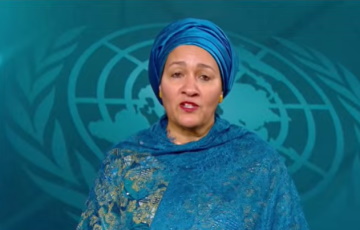
BRIDGETOWN, Barbados, Feb 6, CMC – The Deputy Secretary-General of the United Nations, Amina J. Mohammed, Monday appealed to governments, financial institutions, and civil society to provide early warning systems for all within the next five years.
Addressing the Caribbean launch of the United Nations Early Warning for All (EW4ALL) initiative, Mohammed said that while the global initiative would cost an estimated US$3.1 billion it “will save countless lives and economies.
“Today, we carry a clear message: every person in the Caribbean and Small Island Developing States, and the world, must be protected by an effective, multi-hazard, early warning system. This is not a privilege but a right that every person on earth should enjoy,” Mohammed told the regional launch here.
The EW4ALL is intended to drive coordinated political action towards strengthening multi-hazard early warning systems for hazards such as hurricanes, tropical storms, tsunamis, volcanoes, floods, landslides, and epidemics, among others.
It is also aimed at ensuring that every person on earth is covered by an early warning system by the year 2027.
In November last year, at the COP27 Climate Change Conference in Egypt, the United Nations Secretary-General, António Guterres, launched the Executive Action Plan for the implementation of the EW4ALL initiative. He asked the World Meteorological Organization (WMO) and United Nations Office for Disaster Risk Reduction (UNDRR), to co-lead its implementation.
“Early warning systems save lives, they protect livelihoods and deliver huge economic and social benefits. Just 24 hours’ notice of an impending hazardous event can cut damage by 30 per cent; yet vulnerable communities around the world have no way of knowing that hazardous weather is on its way.
“Nor do they have the means to act to save lives and livelihoods. Every third person in the world, primarily in small island developing states and least developed countries, is not covered by multi-hazard early warning systems. Sixty per cent of the African population is not covered; even less of local disaster-preparedness plans. “
Mohammed said countries with limited early warning coverage have disaster mortality rates that are eight times higher than countries with high coverage.
“Families and communities have a right to be warned of incoming hazards and to protect lives, livelihoods, and other assets. This is especially true for the Caribbean, which suffers from the large disasters relative to its size.
“Due to the effects of climate change, we know that climate and other disasters are set to increase, exposing small island developing states to greater vulnerabilities,” Mohammed said, adding that in order to provide early warning systems for all within the next five years, the United Nations system, governments, and partners, must work together to address gaps across the four key pillars of early warning systems.
She told the event the four gaps are understanding disaster risk, monitoring and forecasting, communication, and preparedness and response capacity.
According to a report released by the UNDRR and the WMO last year, less than half of the countries around the world are not protected by multi-hazard early warning systems. Less than half of the least developed countries and only one-third of Small Island Developing States have a multi-hazard early warning system. This, despite the role of early warning systems in reducing disaster mortality by a factor of eight.
Early warning systems are among the most proven, cost-effective climate adaptation measures that not only save lives but can also reduce economic losses in the wake of climate disasters. The Global Commission on Adaptation reported in 2019 that just 24 hours’ notice of an impending hazardous event can cut the ensuing damage by 30 per cent.
CMC/pr/ir/2023