
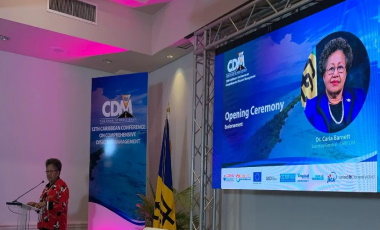
BRIDGETOWN, Barbados, Dec 7, CMC – The 12th Caribbean Conference on Comprehensive Disaster Management (CDM) began here on Wednesday with Caribbean Community (CARICOM) Secretary General, Dr. Carla Barnett identifying the strengthening of early warning systems, and investing in resilient public infrastructure among the measures that must be taken in the region’s climate crisis response.
She told the two-day conference being held under the theme “CDM Road to Resilience: Checkpoint 2022 – Advancing a Risk-based Multi-hazard Approach during COVID-19 & Beyond” that developing capacity in indigenous climate science for accurate regional models, forecasts and attribution of impacts as well as improving the relationship with nature and meaningfully engaging young people at all levels of resilience planning, were among the other areas the Secretary-General highlighted.
The conference is the premier event of the Barbados-based Caribbean Disaster Emergency Management Agency (CDEMA) and will focus on facilitating knowledge exchanges on pathways to resilience using a risk-based multi-hazard approach, highlighting progress towards the achievement of CDM results within the priority areas of Institutional Strengthening, Knowledge Management, Sector Mainstreaming and Community Resilience”
In her address, the CARICOM Secretary-General drew attention to the “staggering” and “deleterious” impacts of climate-related naturals disasters in the Caribbean.
She made reference to the 40 tropical cyclones, 12 of which attained hurricane strength, and eight of which were classified as major hurricanes that resulted in loss of life and property and damage to infrastructure.
She said six Caribbean states are ranked in the “top 10 most disaster-prone countries in the world and all are in the top 50” noting the economic impact of climate change on the region.
Barnett said this includes 100 per cent crop loss, 226 per cent gross domestic product (GDP) loss, 3.5 times GDP as various metrics of loss and damage are accounted for in the aftermath of a hurricane’s path through the region;
St. Vincent and the Grenadines is still recovering from the EC$0.6 billion (One EC dollar=US$0.37 cents) in losses and damages from the volcanic eruption and associated hazards in 2020.
“In addition to the natural disasters, several of our economic sectors continue to remain under threat from slow-onset climate impacts. Droughts and saltwater intrusion consequent to sea level rise threaten water resources, requiring significant investments to ensure a safe water supply in the Region. Higher temperatures, pests and more frequent droughts and flooding events are increasing crop loss and undermining the Region’s food security,” the Secretary-General said.
Barnett said according to recent reporting from the World Meteorological Organization (WMO), 88 per cent of disasters since 2020 in the Caribbean have been climate-related, adding that “the evidence of climate change is no longer only in the graphs and figures, but we now feel it in our lives worldwide.
“We have also experienced devastating earthquakes, volcanic eruptions and extreme seasonal floods. In this region we have dealt with the impacts of COVID-19 that have permeated all corners of our economies and society”.
Barnett said that in addition to the natural disasters, several of the region’s economic sectors continue to remain under threat from slow-onset climate impacts.
“Droughts and saltwater intrusion consequent to sea level rise threaten water resources, requiring significant investments to ensure a safe water supply in the region. Higher temperatures, pests and more frequent droughts and flooding events are increasing crop loss and undermining the Region’s food security.
“Natural disasters and the pandemic, as single occurrences, have been devastating for CARICOM states. The compounded impacts have stretched our human and financial resources to their fullest extent. Our regional disaster response mechanism has been called into action all year around with little or no respite, even before the hurricane season.”
The CARICOM Secretary General said current projections point to a 10 per cent increase of greenhouse gases by 2030, saying “this has strengthened the resolve of our leaders to advocate for higher ambition and increased financing flows by the highest emitters, to allow the most vulnerable states to adequately adapt to and mitigate the impact of climate change with requisite resilience strategies.
“CARICOM returned from COP27 with a mix of optimism and some disillusionment. For the first time, loss and damage was substantively discussed as a dedicated agenda item, leading to agreement on the institutional and operational arrangement of the Santiago Network for Loss and Damage, which focuses on technical assistance and knowledge sharing for reducing losses and damage. This is a victory for those on the front lines of disaster risk reduction (DRR). “
But she said that the primary goal of CARICOM in this regard, however, was to advocate and evoke from the largest emitters a greater commitment to increase needed ambition to reduce emissions and a more positive and timely reaction on financial support to states suffering the greatest loss and damage from climate change, despite contributing very little to the problem.
“We continue then to plan for the worst, while praying for the best. It is the nature of what we do in disaster risk reduction,” she added.
CMC/fg/ir/2022