
SANTIAGO, Chile, Nov 28, CMC -The executive director of the Latin America and Caribbean Commission (ECLAC), José Manuel Salazar-Xirinachs, says Latin America and the Caribbean is mired in a development crisis characterized by three traps including one of low capacity for growth and for transforming production systems.
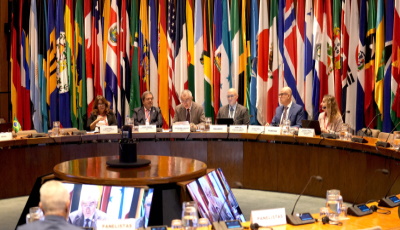
Addressing the inauguration of the 13th meeting of the Presiding Officers of the Regional Councill for Planning (RCP) of the Latin American and Caribbean Institute for Economic and Social Planning (ILPES), Salazar-Xirinach, said that the other tarps are one of high inequality, low social mobility and weak social cohesion as well as a trap of low institutional capacities and ineffective governance, which affects the implementation of public policies and transformation processes in the region.
“In this scenario, I applaud the Regional Council for Planning’s decision to start negotiating a regional agenda on governance of planning and public management for sustainable development in Latin America and the Caribbean,” he said,
 Salazar-Xirinachs said that the negotiations are based on four pillars, namely governance, institutional frameworks and social dialogue, a forward-looking dimension and anticipatory governance as well as coordination to achieve coherence and integrality in public policies and evaluation, public value and the establishment of a culture of continuous learning.
“This process will require more networking, mutual learning and collaborative work among the various stakeholders,” Salazar-Xirinachs said, adding “it is encouraging to see that at least 19 of Latin America and the Caribbean’s 33 countries, along with more than 65 territories, have formulated long-term plans or strategies with time frames that extend to 2030 or even 2050”.
The Presiding Officers of the RCP of ILPES – made up of the Dominican Republic (as Chair), Brazil, Chile, Dominica, Ecuador, Guatemala, Jamaica and Peru – meets every two years to review progress on work and fulfillment of the agreements adopted by the Regional Council for Planning, which is the main intergovernmental body steering the activities of this Institute of ECLAC.
The two-day meeting ends later on Thursday and Salazar-Xirinachs said the Regional Council for Planning of ILPES is an intergovernmental space for technical-political dialogue in which planning authorities exchange experiences and knowledge on how to face development challenges and create a culture of foresight in national and subnational areas, and on how to strengthen public management and bolster state capacities.
Within that framework Salazar-Xirinachs unveiled the main conclusions of the position document prepared by ECLAC for its 40th session, entitled “Development Traps in Latin America and the Caribbean: Vital Transformations and How to Manage Them”.
He stressed the importance of focusing not only on “what to do,” but also on the “hows,” calling specifically for making progress on matters of governance, spaces for social dialogue; and on the political economy of the transformations.
In his address, the Minister of Economy, Planning and Development of the Dominican Republic, Pável Isa said time is running out, all different kinds of time: political, climatic and nature-related.
“We are obligated to respond, for our people and for our planet. Through planning and public policy management, we can contribute to responding effectively. We hope that this two-day meeting will serve as a space for moving towards concrete proposals for intervention that enable us to hasten the forging of an agenda on governance of planning and effective public management for inclusive and sustainable development.”
Isa is expected to present a document for the consideration of the meeting, entitled “Guidelines for the drafting of a regional agenda on governance of planning and public management for sustainable development in Latin America and the Caribbean”, which seeks to take concrete steps in this direction.
CMC/af/ir/2024