
BRIDGETOWN, Barbados, Jan 26, CMC – With only seven years left to deliver on the Sustainable Development Goals, Caribbean Governments and the United Nations have renewed their commitment to intensifying efforts to achieve the vision of the 2030 Agenda, under the new United Nations multi-country Sustainable Development Cooperation Framework (MSDCF) 2022-2026.
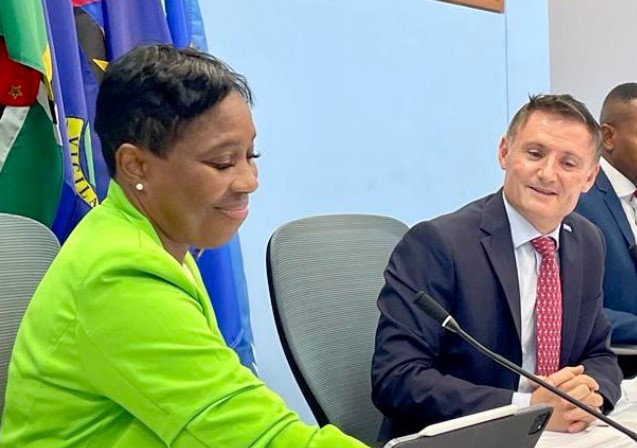
An inaugural meeting of a sub-regional Joint Steering Committee, the governing body charged with strategic oversight for implementation of the regional MSDCF in the Eastern Caribbean, was held on Tuesday at UN House, with robust participation from government leaders. It was co-chaired by UN Resident Coordinator, Didier Trebucq and representative of the Government of Barbados, Minister in the Prime Minister’s Office, Senator Dr. Shantal Munro-Knight.
In delivering opening remarks in his capacity as co-chair, Trebucq said the first Steering Committee meeting was opportune for the Sub-region since it allowed partners to come together after one year under the Cooperation Framework, to continue their partnership in the work started last year.
“High debt burden, already a longstanding concern in this region is increasing its pressure on countries. This year alone global debt service payments skyrocketed to 35 per cent – the largest increase in decades, and food insecurity has risen from 33 per cent to 57 per cent. Coupled with the lingering effects of the pandemic and the acceleration of climate change, people and governments in the sub-region are increasingly facing difficult choices to build resilience. In this context, working together and working effectively is of paramount importance. And that is why we are here today,” the UN Head explained.
Identifying efforts around tackling learning losses following the pandemic, increasing access to financing and strengthening food-security as among the key critical issues delivered for the sub-region in 2022, the UN head said going forward increased attention would be placed on SDG acceleration, digitization across key sectors, and climate change and resilience , with greater emphasis on climate financing.
Senator Munro-Knight, in addressing the gathering, noted the unprecedented challenges that faced the region over the past two to three years in terms of intensity, continuity and impact.
“I don’t think that there’s ever been a time in the history of the globe that we have seen shock, after shock, after shock coming, and particularly for small states,” she maintained, positing that the region is poised to overcome these challenges by virtue of its history of survival, strong partnerships and penchant for innovation.
“In the context of facing a crisis, we always know how to innovate with what we have. I point to the work that is being done in the context of greening our economies, the energy transitions that are happening, the efforts to digitize our economies and to essentially transform our social structures as well as our governance systems. I also point to the work that is taking place in the context of criminal justice reform, and a whole body of work that is happening within the region. We need to ensure that we continue to highlight the efforts that are being made with the assistance of the UN and other partners, to be able to continue to build and instill resilience into our countries,” Munro-Knight added.
She also underscored the importance of having partners like the UN System that are focused on walking beside countries, focused on delivery, listening, being flexible, and ensuring that they are demand-driven.
“Those are the partnerships that are going to define the extent to which as a region, we are going to be able to continue to thrive,” the minister maintained.
The hybrid meeting at UN House followed a series of independent reviews of Country Implementation Plans at the country-level with key stakeholders, and brought together Heads and representatives from 13 UN Agencies, and Ministers and senior Government officials from across nine Eastern Caribbean member states.
The UN said fruitful discussions were held on how governments and the UN Development system will work together to ensure efficiency, UN results for 2022, and priorities for 2023, to build resilience and advance SDG progress.
CMC/ed/2023