
BUENOS AIRES, Argentina, Oct 25, CMC –The Economic Commission for Latin America and the Caribbean (ECLAC) says Latin America and the Caribbean require ambitious public policies to overcome the profound crisis that they have experienced in the last 10 years.
ECLAC said the region mired in a development crisis, in the midst of a lost decade, cannot transform development models by doing the same thing or doing what works on a small scale.
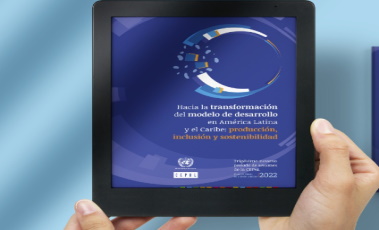 This is not a time for gradual and timid changes, but for bold and transformative policies that really move the needles of development, ECLAC said, noting that for this reason, it proposes 10 priority policy areas to transform the region’s development model, and identifies possible sectors that will promote sustainable and inclusive growth.
The proposal has been presented to ECLAC’s 46 member states and 14 associated countries at the ongoing UN agency’s 39th session, regarded as the most important biennial meeting.
The meeting which ends on Wednesday, has brought together high-ranking authorities from the region, as well as world-renowned researchers, academics, representatives of civil society and international officials.
In his presentation of the document titled “Towards the transformation of the development model in Latin America and the Caribbean: production, inclusion and sustainability,” ECLAC’s executive secretary, José Manuel Salazar-Xirinachs, outlined the proposal for recovery and sustainable development in the new global and regional context.
In its five chapters, the report analyses, among other topics, the present and future of globalization, the region’s own productive heterogeneity, and discusses policies for sustainable productive development.
Likewise, it addresses the dynamics between employment and social protection and the importance of sectoral impulses to reactivate economic growth. It also examines other topics, such as the circular economy, the care economy and digital transformation, and presents a set of policy recommendations for sustainable development in the new international and regional scenario.
According to the document, in 2022 the countries of the region face the effects of a series of cascading crises: climate, health, employment, social, education, food security, energy, and cost of living, all of which impact with different intensity and varied characteristics to many countries, including all of Latin America and the Caribbean.
ECLAC said In the region, the combination of external and internal factors has reduced the capacity for economic growth and the generation of quality jobs and has hindered its fight against poverty and extreme poverty. Their economic and social structures have weakened and they have entered into situations that reinforce the inertia of weak economic performance.
In this regard, ECLAC said the publication indicates that after the low economic growth rate of 0.6 per cent annual average registered in the period between 2014-2019, a historical contraction of 6.9 per cent in 2020 and a recovery of 6.5 per cent in 2021.
ECLAC estimates that the economies of Latin America and the Caribbean will grow by 3.2 per cent in 2022 and a sharp slowdown is expected with projected growth of 1.4 per cent next year.
In addition, recently the lower growth of economic activity has been accompanied by a significant increase in the inflation rate. In June 2022, the regional average was 8.4 per cent, more than twice the value of the average observed between January 2005 and December 2019 (4.1 per cent).
On the other hand, the fiscal situation of the countries of the region has deteriorated as a result of the important fiscal efforts that were made to combat the worst moments of the COVID-19 crisis and its social consequences.
ECLAC said based on the figures, the social situation in the region has also deteriorated, with considerable increases in poverty levels reflecting the effects of the pandemic and the economic recession that accompanied it.
For 2020, ECLAC calculated that poverty and extreme poverty reached, respectively, 33 per cent and 13.1 per cent of the population. By 2021, the incipient recovery of the economies translated into a very modest drop in poverty to 32.1 per cent and a marginal but continuous increase in extreme poverty to 13.8 per cent.
“It is in this context that the countries of the region must adopt policies that allow them to boost sustainable growth, mitigate inflationary pressures, generate quality employment, and mitigate social costs along with reducing poverty and inequality. All of this poses serious challenges for political and governance systems and for the technical, operational and political capacities of public institutions”, the ECLAC document states.
Throughout its history, the Commission has insisted that macroeconomic policies matter a great deal for the dynamics of structural change and productive development, but also that microeconomic and sectoral policies are key. In other words, both transversal and sectoral productive development policies are required.
As a result, ECLAC has proposed to the region a series of driving sectors that can boost productive and structural transformation, as well as investment and job creation. These are: energy (energy transition), electromobility, circular economy, bioeconomy, health manufacturing industry, digital transformation, care economy, sustainable tourism, and micro, small and medium-sized enterprises (MSMEs) and social and solidarity economy.
In its statements, the regional organization of the United Nations emphasizes the urgency of acting to recover investment and growth, recognizes the central role of the State in the design and execution of policies for the transformation of the development model and argues the importance of advancing in the strengthening of public and private alliances.
To articulate such a wide universe of problems and policy alternatives, ECLAC underlines the need to advance in fiscal, productive, social and environmental agreements to overcome the problems of the current situation and move in the long term towards sustainable, cohesive and resilient societies , characteristics that imply advancing towards the realization of welfare states within the framework of a care society.
CMC/gf/ir/2022