
BRUSSELS, May 6, CMC -The United Nations Development Programme (UNDP) Tuesday said that human development progress is experiencing an unprecedented slowdown.
In its latest report, the UNDP shows how Artificial Intelligence (AI) could reignite development.
It sad instead of seeing sustained recovery following the period of exceptional crises of 2020-2021, the report reveals unexpectedly weak progress. Excluding those crisis years, the meagre rise in global human development projected in this year’s report is the smallest increase since 1990.
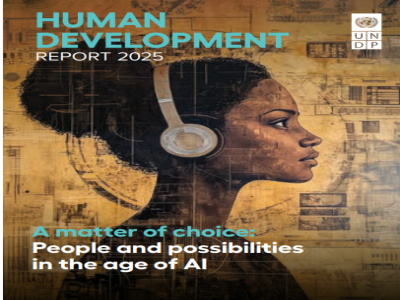 The 2025 Human Development Report -“A matter of choice: people and possibilities in the age of Artificial Intelligence (AI)” analyses development progress across a range of indicators known as the Human Development Index (HDI), which encompasses achievements in health and education, along with levels of income. Projections for 2024 reveal stalled progress on the HDI in all regions across the world.
HDI classifications are based on HDI fixed cutoff
points, which are derived from the quartiles of distributions of the component indicators. The cutoff
points are HDI of less than 0.550 for low human development, 0.550–0.699 for medium human development, 0.700–0.799 for high human development and 0.800 or greater for very high human development
According to the UNDP, Antigua and Barbuda led the Caribbean with a ranking of 53 out of 193 countries worldwide and a HDI of 0.851, followed by St. Kitts-Nevis with a ranking of 58 and a HDI of 0.840. The Bahamas has a ranking of 66 and a HDI of 0.820.
Barbados is ranked at number 69 with a HDI of 0.811 with Trinidad and Tobago at position number 72 with a HDI of 0.807 and followed by St. Vincent and the Grenadines at 76 with a HDI of 0.798.
Grenada has a ranking of 80 with a HDI of 0.791, followed by Guyana at 89 with a HDI of 0.776 and Dominica at 98 with a HDI of 0.761. St. Lucia has a ranking of 103 with a HDI 0.748, while the Dutch-speaking Caribbean Community (CARICOM) country of Suriname is ranked at 114 with a HDI of 0.722, followed by Belize with a ranking of 115 and HDI of 0.721, and Jamaica at 117 with a ranking and a HDI of 0.720.
Haiti is the lowest ranked CARICOM country at 166 with a HDI of 0.554.
According to the UNDP the CARICOM countries HDI’s value changed from 0.001 per cent in 2022 to 0.013 to 2024.
Beyond the alarming rate of deceleration in global development, the report finds widening inequalities between rich and poor countries. As traditional paths to development are squeezed by global pressures, decisive action is needed to move the world away from prolonged stagnation on progress.
“For decades, we have been on track to reach a very high human development world by 2030, but this deceleration signals a very real threat to global progress,” said Achim Steiner, UNDP Administrator.
“If 2024’s sluggish progress becomes ‘the new normal’, that 2030 milestone could slip by decades – making our world less secure, more divided, and more vulnerable to economic and ecological shocks.”
For the fourth year in a row inequality between Low HDI and Very High HDI countries continues to increase, according to the report. This reverses a long-term trend that has seen a reduction in inequalities between wealthy and poor nations.
Development challenges for countries with the lowest HDI scores are especially severe – driven by increasing trade tensions, a worsening debt crisis and the rise of jobless industrialization.
“Amidst this global turmoil, we must urgently explore new ways to drive development,” Steiner said.
“As Artificial Intelligence continues its rapid advance across so many aspects of our lives, we should consider its potential for development. New capabilities are emerging almost daily, and while AI is no panacea, the choices we make hold the potential to reignite human development and open new pathways and possibilities.”
The report contains the results of a new survey that showed people are realistic yet hopeful about the change AI can bring. Half of respondents worldwide think that their jobs could be automated.
An even larger share – six in 10 – expect AI to impact their employment positively, creating opportunities in jobs that may not even exist today.
Only 13 per cent of survey respondents fear AI could lead to job losses. In contrast, in low- and medium-HDI countries, 70 per cent expect AI to increase their productivity, and two thirds anticipate using AI in education, health, or work within the next year.
The report advocates for a human-centered approach to AI, which has the potential to fundamentally redesign approaches to development. The survey results show that across the world people are ready for this kind of ‘reset’.
The report outlines three critical areas for action:, namely building an economy where people collaborate with AI rather than compete against it, embedding human agency across the full AI lifecycle, from design to deployment and modernizing education and health systems to meet 21st-Century demands
UNDP said democratization of AI is already underway.
It said around one in five of survey respondents report already using AI. And two-thirds of respondents across lower human development countries anticipate using AI in education, health, or work within the next year.
That makes closing electricity and internet gaps more urgent than ever, so no one is excluded from emerging possibilities. Yet, access alone is not enough: the real divide will hinge on how effectively AI complements and augments what people do.
“The choices we make in the coming years will define the legacy of this technological transition for human development,” said Pedro Conceição, Director of UNDP’s Human Development Report Office.
“With the right policies and focus on people, AI can be a crucial bridge to new knowledge, skills, and ideas that can empower everyone from farmers to small business owners.”
CMC/fg/ir/2025