
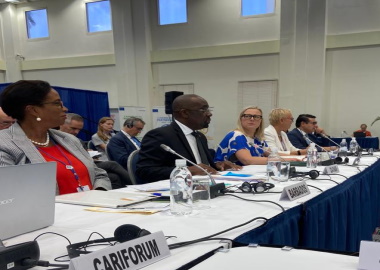
BRIDGETOWN, Barbados, Oct 12, CMC – Antigua and Barbuda Foreign Affairs Minister, E.P Chet Greene, Wednesday said the crisis caused by the coronavirus (COVID-19) pandemic has laid bare the hard reality of digital inequalities in the region.
Addressing the opening of the European Union-CARIFORUM Ministerial Meeting, Greene, who is also chair of the Caribbean Forum (CARIFORUM), said the Caribbean region is considered as one of the most affected in the world by the COVID-19 pandemic and has sparked an economic crisis across the states.
He told the meeting which is being attended by the EU Commissioner for International Partnerships, Jutta Urpilainen, that public and private sector digitalisation, which was already low, impaired the region’s resilience during the pandemic.
“Some of the consequences will be long-term and will be challenging. The crisis laid bare the hard reality of digital inequalities in the region, within our various societies and between men and women,” Greene said, noting that deficiency in the Information Communication and technology (ICT) infrastructure has resulted in our digital development being relatively modest, lagging behind other regions.
“CARIFORUM therefore welcomes the EU’S commitment to address key priorities for digital transformation and innovation.”
Greene said that food security, while a matter of global concern, is also a situation of concern to Caribbean countries given that they are among the most vulnerable to this global crisis.
“The spike in food prices will continue to push the levels of food and nutrition insecurity to new heights. The EU’s actions to address this global food security crisis by supporting the most vulnerable and most affected countries is commendable.”
Greene said that a recent survey showed that food insecurity in the Caribbean is relatively high and growing.
“We are highly food import dependent. CARIFORUM thus welcomes the announcement of the Euro 19 million (One Euro=US$1.29 cents) Caribbean Regional Programme on food production and resilience of food systems. I note my country is eligible.”
Greene said that the successor Agreement to the Cotonou Partnership Agreement with the overall objective of strengthening the political partnership to generate mutually beneficial outcomes on common and intersected areas of interest is a manifestation of the evolving relationship. And that “it is the only negotiated and jointly agreed instrument governing our relationship of recent.
“The increased level of regionalism under the Post-Cotonou Agreement, both of political priorities and political steering of the cooperation with the EU necessitates adjustments and change in the approach to implementation.”
Greene said that the European Development Fund (EDF) has been replaced by the Neighbourhood, Development and International Cooperation Instrument (NDICI-Global Europe) as the source of EU’s development finance support to the region.
“Agreeably, both partners will need to fully understand this new instrument and how it can operate at all levels to ensure the rich historical successes of our cooperation and coordination are not lost.
“We have noted Commissioner that the NDICI has retained some of the important features of the EDF, the main one being allocations to CARIFORUM States – albeit not all CARIFORUM states,” Greene said, noting that some states, including Antigua and Barbuda, “have been graduated from bilateral EU aid on what we consider a flawed basis”.
Greene said undoubtedly, there are also changes brought about by the NDICI which CARIFORUM will have to get used to.
“However…we firmly believe that the principles of aid effectiveness must remain a constant, whatever the aid delivery framework. As a region, we have human, financial and other constraints. We, however, remain committed to working as a united bloc and to further forge our integration. We urge the EU and its member states to continue this journey with us, started almost half a century ago.”
The CARIFORUM chair said the 16-member grouping recognises that the programmable resources for the region under this EU funding cycle is less than under the 11th EDF.
“In this respect …whilst we lament the reduction we have determined as a group to collectively decide the priorities to be financed by the pool of resources the EU is making available to us.
“Commissioner, that pooling extends to technical capacities. CARIFORUM States will not be able, to individually, efficiently and effectively address all the requirements of our evolving partnership. A strong or stronger coordinating arm on behalf of the region is needed now more than ever.
“We have received some informal signals that institutional support is not on the Commission’s radar. Commissioner, the governments and peoples of the region hold out the strong expectation that the hints will not be translated into action. That we will continue to speak in one voice on this issue,” Greene said, adding “let me reiterate, CARIFORUM states acknowledge, with appreciation, the significant economic and developmental support provided by the European Union over the decades”.
CMC/hf/ir/2022