
GEORGETOWN, Guyana, Nov 22, CMC – The second Regional Symposium on Crime and Violence as a Public Health issue began here on Friday allowing for regional countries to address the progress, address the gaps as well as tackling new dimensions of crime in the Caribbean Community (CARICOM).
The one-day event, which has been convened by Barbados, is a follow up to the inaugural summit held in Trinidad and Tobago in April last year and the CARICOM Secretariat said that the programme is structured to provide an opportunity for the regional leaders to interact directly with regional technical expertise.
The Secretariat said that working with the Trinidad-based CARICOM Implementation Agency for Crime and Security (IMPACS) and the Caribbean Public Health Agency (CARPHA), it has developed a tool to capture the engagement in a structured way with the intention of preparing or updating plans for moving forward on the specific areas of concern.
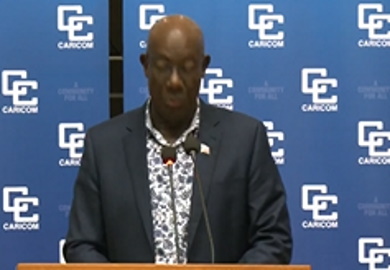
Trinidad and Tobago Prime Minister Dr. Keith Rowley told the opening ceremony that while there has been significant progress in the initiatives outlined from the first symposium, “the facts are we are still being assailed by the rising tide of criminal conduct, influx of firearms and in recent times we have been advised of organised criminal conduct penetrating our region from as far away as Asia.
“Many of us can report violent conduct and the very disturbing presence in our schools among our young people,” Rowley said.
But he told the regional leaders and other stakeholders that having accepted violence as a public health issue “we believe that we are approaching ths issue in the correct and sustainable way”.
Rowley, who has lead responsibility for crime and justice in the quasi CARICOM cabinet, said that since the Port of Spain meeting, there have been significant developments and that regional countries are making a much more meaningful effort at seeking to implement measures to deal with the crime situation.
‘We can say that crucial model legislation has been developed and I am pleased to report today that I have been advised …that the legislation to facilitate the harmonisation of laws across the Community, and notably facilitating the completion of the template legislation for the CARICOM arrest warrant bill.
“I am particularly pleased to hear that we are there,” Rowley said, adding that “our little criminal punks must now know that every CARICOM territory the law applies to them equally…with resect to warrants for their restraint, apprehension in anticipation of successful prosecution that there are no safe harbours in any of our Caribbean territories.”
“It has been ong in coming,” Rowley said, congratulating the legal teams, adding “we would want to have that implemented as quickly as possible”.
He said with respect to the advance passenger information (API) and the passenger name record (PNR) bills both of which provide a foundation for cross border cooperation, Rowley said “significant progress has been made” and that completion can be announced “in anticipation of the work we will be ding with the developments.
“These are tools that will facilitate law enforcement efficiently and allow law enforcement to have a little bit of an upper hand on those who plan crime against our population,” he said, adding that steps have also been taken to strengthen intelligence and information sharing across borders.
“One thing I can add here is that our police management leadership need to cooperate and collaborate across our Caribbean territories , identifying known bad actors before they execute their plans against us so that the police can have a more effective response against those who choose crime as a way of life.”
He said that a Caribbean gang data base has been established at the CARICOM IMPACS “as an important resource for alw enforcement agencies across the region.
“Information is strength in matters of this nature,” Rowley said, adding that research initiatives have been undertaken to inform more policy making.
He said one such policy is aimed at guiding the region on a regional policy on firearms by integrating public health perspectives and security responses.
Earlier, Grenada’s Prime Minister Dickon Mitchell, who is also the CARICM Chairman, told the ceremony that “this vision in bringing the issues related to the high levels violence and crime experienced in our countries into the realm of a public health approach has signaled a strong intent by us as leaders to decisively and collectively treat with this challenge that threatens the development of our Community’s citizens.
“Indeed, it is the aspiration of the Community that every citizen is secure and has the opportunity to realise his or her potential with guaranteed human rights and social justice; and contributes to, and shares in, its economic, social and cultural prosperity. “
Mitchell said that following the first symposium and in keeping with the Secretariat’s Strategic Plan, the CARICOM Secretariat has been actively collaborating with the relevant CARICOM Institutions, member states and developmental partners to implement the Declarations issued last year through several successful inter-sectoral partnerships.
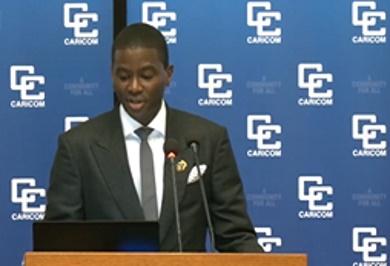
“This culminated recently with a PAHO/CARICOM strategic engagement that delivered components for strengthening the public health approach through capacity building within the community,” he said, adding that the event today will allow for an opportunity to engage with regional technical experts, to discuss and analyse issues related to securing the full developmental potential of the region’s citizens through focussed discussions.
“As with any public health approach, we will need to change behaviours even as we put in place the frameworks for crime prevention. Today we will interrogate the policy prescriptions for addressing the vulnerabilities within specific groups including women, youth and the community, both as victims and partners.
“We will strategise on strengthening the resilience created by positive family, educational and community involvement, and explore approaches to keep safeguarding our cultural expressions as a tool for positive development, whilst mitigating opportunistic negative infringements to make this legacy one that is mired in deceit and violence.”
Mitchell said that the CARICOM Social Development and Crime Prevention Action Plan indicates that in the Caribbean context, there is an enormous potential for the cultural industries to play an important role as sources of jobs, self-employment, build confidence and break down stereotypes between groups at risk, and the police.
“We will also have an opportunity to create stronger networks as we continue to support and learn from each other by exchanging ideas leading to the outcomes and deliverables that are in sync with the Community’s interest, namely, to secure a viable, sustainable, and prosperous Community for all,” he added.
He said the Guyana-based CARCOM Secretariat will be called on after this event to support member states in “unpacking the complex requirements to wrest our community development gains from the hands of transnational criminal organisations and secure the region’s related economic development by ensuring that our culture and our citizens remain safe to engage in positive economic activity and socialize in positive ways.”
He saod this includes maintaining sync with other justice and security related instruments and data strengthening activities.
CMC/gt/ir/2024