
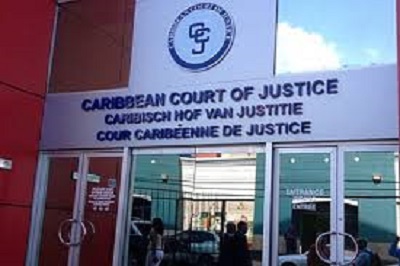
PORT OF SPAIN, Trinidad, Mar 4, CMC – The Caribbean Court of Justice (CCJ) has dismissed an application to annul the decision of the Caribbean Community (CARICOM) Council for Trade and Economic Development (COTED), allowing for an increase in the tariff on “other hydraulic cement” imported into Trinidad and Tobago.
In a ruling, Justices Jacob Wit, Winston Anderson, Maureen Rajnauth-Lee, Denys Barrow and Peter Jamadar also ordered the parties involved to make submissions on costs.
 The parties – The Trinidad and Tobago-based Rock Hard Distributors (RHTT), the St Lucia-based Rock Hard Distribution Ltd (RHDL) and the Trinidad-based Mootilal Ramhit and Sons Contracting Limited – had filed the application against the Trinidad and Tobago government and CARICOM, with the state of Belize, and the Trinidad Cement Limited (TCL) intervening.
In 2020, COTED granted an application by Trinidad and Tobago to suspend the Common External Tariff (CET) of five per cent and substitute a rate of 50 per cent on other hydraulic cement, which was being imported by the claimants.
The higher rate was applicable for all of 2021 But the claimants commenced the proceedings to challenge both the process by which Trinidad and Tobago made the application and the decision by COTED to allow the suspension and increased rate.
The claimants had alleged that the COTED decision was flawed because it was not based on accurate, relevant, sufficient, and timely information provided by Trinidad and Tobago. They also claimed that they were not properly consulted and that correct procedure had not been followed.
The claimants further argued that the COTED decision was disproportionate and jeopardised the expansion of trade and economic relations with states outside of CARICOM, one of the objectives of CARICOM, and that the decision was given for an improper purpose.
They had also argued that COTED had wrongly allowed Trinidad and Tobago to impose a tariff rate for other hydraulic cement far beyond their World Trade Organization (WTO) bound rate of five per cent, which is the maximum rate of duty permitted by the WTO.
But Trinidad and Tobago and CARICOM did not agree and made ample written and oral submissions to this effect. They were assisted in their defence by Belize and TCL.
At the trial, several witnesses and two experts in WTO law were heard and cross-examined.
The CCJ frontally addressed the WTO point, ruling that it had jurisdiction to decide whether and to what extent WTO law is part of Community law, and whether and to what extent CARICOM, upon a proper interpretation of the Revised Treaty of Chaguaramas (RTC), would be bound by WTO law. However, the CCJ ruled that, in relation to the setting of tariff rates, CARICOM was not bound by that law. A pronouncement about the WTO bound rate, and the legality of a tariff duty in violation of that WTO rate, would, therefore, go beyond the limits of the Court’s jurisdiction.
The Court reasoned that, as CARICOM is part of the “WTO universe”, it is expected that COTED will have regard to the WTO bound rate of member states when called to make decisions on the suspension or alteration of the CET as was previously indicated by this Court in 2019.
This, however, did not mean that CARICOM was legally bound by WTO law. Among other things, CARICOM, unlike its member states, was not a member of the WTO, WTO law is not part of customary international law, and it does not cover or restrict the powers of COTED in Caribbean Community law.
The Court also reminded the parties that, in CET matters, COTED has a broad discretion and that the CCJ will only interfere with such a decision if it is manifestly wrong.
As such, the Court found that, on the bases argued by the claimants, the COTED decision could neither be successfully challenged, nor could the annulment of the Decision be justified. The Court did indicate, however, that the consultation process in Trinidad and Tobago could have been more extensive and more transparent.
On the other hand, the fact that COTED was not provided with all of the information that could have aided them to make its decision was to a certain extent, due to the claimants’ own fault, as they had not taken the opportunity to engage with the competent authority of that State while they should have done so.
In relation to the procedure followed by Trinidad and Tobago and COTED, the CCJ noted that there is a procedure provided for in Part C of the Revised Procedure and Forms in support of the Protocol to Amend Article 83 of the RTC.
Although Part C is not formally operative, the Court emphasised an earlier decision that a fair procedure is required. Since the members of COTED themselves had agreed to the procedure contained in Part C, the Court ruled that this Part should be followed in its essence or spirit, if not to the letter.
The Court found, though, that the prescribed procedure was basically followed in this case, although there were some flaws. Given the circumstances, the Court found that these flaws were not sufficient to vitiate the Decision of COTED.
The CCJ rejected the submission that the objective of expansion of trade with states outside of CARICOM had been prejudiced by the COTED decision.
In the Court’s view, this was just one of CARICOM’s objectives. There were others that may conflict with that objective, such as the fundamental objective of CARICOM, to create a protected market for producers and manufacturers in CARICOM.
The Court also pointed out that the provisions in Article 78(2)(c), (2)(d), (3)(b) and (4) of the RTC, for example, make clear that the expansion of trade with third countries specifically focusses on exports and that, where “imports” are mentioned, the reference is limited to the importation of goods or products of CARICOM origin. It does not cover the importation of products from States outside of CARICOM.
None of the submissions of the claimants having been successful, the CCJ dismissed the originating application in its entirety and invited the parties to make submissions on costs within 14 days.
CMC/pr/ir/2022