
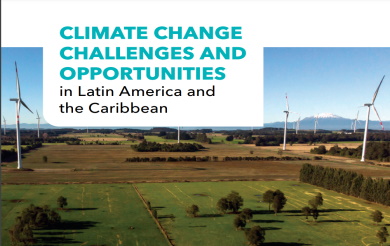
WASHINGTON, Jul 19, CMC – A new publication investigating the policy options for countries that are highly vulnerable to the impact of climate change and natural disasters such as Latin America and the Caribbean (LAC) was released here on Friday, with the authors saying that it also assesses the LAC region’s climate change challenges and opportunities.
In addition, the publication titled “Climate Change Challenges and Opportunities in Latin America and the Caribbean” explores a range of policy options for confronting these challenges and taking advantage of these opportunities.
 “Faced by the climate crisis, we must act with all the force we can muster to change the direction of our societies. For the IMF and our partners in central banks and finance ministries, that means designing policies to cut emissions, increase climate finance, and boost resilience at the scale that is needed.
“There is no time to waste. We are already seeing climate change hit households, businesses, and communities around the world—from droughts, wildfires, and floods to impacts that are less immediately noticeable in areas such as supply chains and insurance markets,” said Kristalina Georgieva, the managing director of the International Monetary Fund (IMF).
“Given domestic resource constraints and the large investment needs, countries in the LAC region will need to attract climate finance from external sources, both public and private. The IMF can play a crucial role by not only providing resources from the Resilience and Sustainability Trust, but also by helping catalyze investment from private, bilateral, and other multilateral sources,” she wrote in the Foreward to the publication.
The publication, which is edited by Anna Ivanova, Juliw Kozack and Sonia Munoz, ntes that for Latin America and the Caribbean, climate change presents both challenges of managing climate-related risks as well as opportunities for economic and social development in the region.
It said that on the challenges side, two broad climate-related risks need to be managed.
It said the physical risks arise from the high vulnerability of some of the economies to the impact of climate-related phenomena such as higher temperatures, weatherrelated natural disasters, sea-level rise, coastal erosion, and loss of biodiversity, as well as risks related to the high reliance on climate-sensitive sectors such as tourism and agriculture.
“Such physical risks can adversely affect both aggregate supply – destruction of physical capital, dislocation of labor markets, and disruption of supply chains – and aggregate demand (reductions in consumption and investment and disruption of trade flows), leading to lower growth and employment and threatening fiscal sustainability and financial stability.”
The authors note that transition risks arise from the significant structural changes in domestic and foreign economies needed to achieve climate sustainability goals by reducing reliance on high greenhouse gas (GHG) activities and improving land-use practices.
They warn that if not managed properly, the global transition to a low-carbon/ low-GHG economy could lead to significant economic dislocations due to sectoral shifts in employment, comparative advantage, and trade patterns with repercussions for short- and long-term growth, fiscal positions, inflation, external positions, and financial systems.
On the opportunities side, the transition to greener and more resilient economies could help achieve economic, social, and environmental sustainability.
The publication notes that mitigation efforts could bring substantial domestic environmental and health benefits even in the short term including reductions in air pollution mortality and morbidity and in road fatalities. They may also yield direct economic savings such as reduced road damage and traffic congestion.
Investment in green technologies and infrastructure could help boost growth and generate new jobs. Efforts to foster green innovation in the energy sector could also generate positive spillovers to the rest of the economy and reduce energy security risks
The authors say sustainable farming can bring benefits by releasing fiscal resources that are currently used for subsidies, although these resources may be partially used to subsidize sustainable farming, at least initially, increasing external resilience by developing sustainable produce for which global demand has been increasing, contributing to food security, and increasing domestic income sources.
A shift away from livestock agriculture could free up land that could be used to grow plant-based proteins or for reforestation, helping to mitigate the risks from transition and contributing further to emissions reduction.
The publication states that the shift to green technologies could benefit some countries in the region due to their natural endowment of metals such as copper, nickel, cobalt, and lithium, which are needed in low-GHG technologies, including renewable energies, electric cars, and hydrogen and carbon capture and storage.
It said that investing in resilient infrastructure and insurance could yield significant growth and fiscal benefits over time in countries vulnerable to climate disasters. Deeper involvement of the private sector will be needed while strengthening financial sector resilience.
“To manage climate-related risks, LAC countries can take actions on three fronts: (1) climate mitigation, which refers to policies that help reduce GHG emissions; (2) climate adaptation, which refers to efforts to adapt to the effects of climate change including through minimizing damages from climate-related natural disasters; and (3) transition management, which refers to policies to adapt to the effects of economic transformations at home and abroad aimed at reducing reliance on carbon-intensive activities.”
CMC/af/ir/2024