
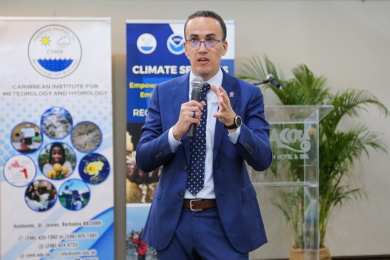
BRIDGETOWN, Barbados, Mar 20, CMC – Barbados is hosting a three-day workshop that began on Wednesday aimed at advancing the development and implementation of National Frameworks for Climate Services (NFCS) in the region.
NFCS function as a coordination mechanism that enables interaction between climate information producers and stakeholders, fostering the co-design and co-development of actionable climate services tailored to meet national and regional needs.
The event has brought together representatives of National Hydrometeorological Services (NHMSs) and stakeholders from key climate sensitive sectors across the Caribbean.
Organized under the Enhancing Climate Resilience in the Caribbean through the Improvement Of Caribbean Climate Outlook Forums (CARICOF) Project, the workshop is being hosted by the Barbados-based Caribbean Institute for Meteorology and Hydrology (CIMH) with support from the U.S. National Oceanic and Atmospheric Administration (NOAA) and the U.S. Department of State.
It is also being supported by the World Meteorological Organization (WMO) through the Climate Services and Related Application (ClimSA) project.
The organsiers said the workshop will provide a regional forum to harness collective expertise to drive sustainable development in the Caribbean.
Director of the Barbados Meteorological Services (BMS), Sabu Best,said the regional workshop on national frameworks for climate services represents an excellent opportunity for Caribbean countries to share experiences and leverage collective expertise to address climate challenges faced by the region.
Principal of the Caribbean Institute for Meteorology and Hydrology (CIMH), Dr. David Farrell, said the workshop will play a crucial role in addressing the complex cascading challenges presented by climate related hazards by ensuring Caribbean Small Island Developing States (SIDS) better manage the risks and opportunities arising from climate variability and change especially for those who are most vulnerable to these hazards.
“This workshop will facilitate the development and implementation of effective NFCS and enable regional governments to integrate science-based climate information along with other information into planning, policy, and practice.,” he added.
WMO director of Climate Services, Professor Christopher Hewitt, underscored the significance of the regional workshop within the Global Framework for Climate Services.
“The climate crisis is affecting society worldwide, but it is often at the national and local scale that decisions need to be taken. Such decisions benefit from access to the best available climate information and knowledge, in the form of climate services.
“The development, delivery and update of such services depends on close collaboration and partnerships involving key organisations and stakeholders within a country. The WMO is keen to support such actors, including NMHSs, as we all work together to build resilience to climate variability and climate change,” he said, adding “we are delighted that CIMH, one of our key Regional Climate Centres, is engaging with NOAA and with important stakeholders across the Caribbean”
NOAA’s Adaptation Sciences Programme Manager at NOAA, Lisa Vaughan, spoke of the the importance of enhancing climate services delivery in the Caribbean.
“This CIMH-led workshop is supported by NOAA through a partnership with the U.S. Department of State and, in combination with other activities, will connect these initiatives, and help shape national scale climate services in the region.”
She also recognized the CIMH as an exemplary regional climate services provider, noting the Institute collaborates closely with NOAA to enhance regional resilience through the development of climate for adaptation and decision-making support.
The organisers said that participants will discuss experiences, lessons learned, and emerging findings from the review of NFCS guidelines and the feasibility assessment of regional frameworks.
They will also engage in peer-to-peer exchanges to foster collaboration and innovation in climate services development and implementation.
The Caribbean is among the most vulnerable regions in the world to the impacts of climate related hazards including temperature change, intense rainfall events, sea-level rise, and increasingly warm oceanic temperatures.
“The workshop’s outcomes are expected to contribute significantly to enabling national governments to better manage the risks associated with these and other climate-related hazards in the Caribbean region,” the organisers added.
Meanwhile, the CIMH is cautioning stakeholders that 2024 is shaping up to be a year of climate extremes for the region.
Climatologist, Dr. Cédric Van Meerbeeck, says based on anticipated climate patterns, these predicted climate extremes are driven by a complex interplay of factors specifically a fading El Niño event in the Pacific and continued, near-record warm Atlantic Ocean temperatures, as well as frequent Sahara dust intrusion.
He said the return of La Niña, coupled with persistently warm Atlantic Ocean temperatures, are two of three main factors poised to influence weather patterns and warns that this combination could intensify hurricane season activity and increase the potential for flooding.
“Understanding the dynamics of El Niño/La Niña, Atlantic Ocean temperatures, and intrusions of Saharan air is crucial in predicting climate extremes,” he added.
The frequency of Saharan dust intrusions, though less predictable, plays a pivotal role in shaping expected weather patterns in coming months. Infrequent intrusions create conditions ripe for extreme rainfall and tropical cyclone development, while frequent intrusions result in hotter but drier weather, which amplify heat-related hazards. Either way, 2024 promises to be a year with excessive heat and the associated heat discomfort.
Reflecting on historical events, Dr. Van Meerbeeck draws parallels to 2010, a year marked by devastating droughts abruptly followed by record-breaking rainfall, and an active hurricane season. He also highlights the escalating threat of heat-related hazards, as evidenced by recent record-warm years in the region.
“The potential scenarios for 2024 range from extremely hot and wet to record hot, but initially drier conditions, each posing unique challenges to key climate-sensitive sectors such as agriculture and food security, water, and health.”
CMC/lr/ir/2024.
CMC/lr/ir/2024.