
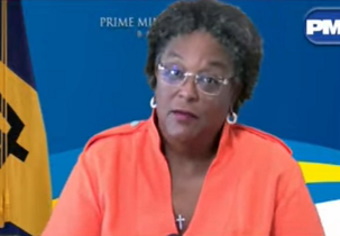
BUENOS AIRES, Argentina, Sept 8, CMC –Barbados Prime Minister, Mia Mottley, Wednesday said the world is standing at the edge of a “moral precipice” as she criticised the international community for not doing much in dealing with climate change and its impact on small island developing countries (SIDS) like those in the Caribbean.
Addressing the virtual High-Level Dialogue on Climate Action in the Americas, Mottley questioned world leaders whether they were prepared to take the action necessary to save lives, livelihood and the planet.
She said if the latest Intergovernmental Panel on Climate Change (IPCC) report on the impacts of global warming of 1.5 °C above pre-industrial levels and related global greenhouse gas emission pathways, “have not prompted us to action, what will prompt us.
She also asked world leaders if at the 26th UN Climate Change Conference (COP26), to be held October 31 to November 12, in Glasgow, “we will not set the world on a 1.5 °C pathway, I ask you when will we do so?
“The future….is ours to determine whether we will make that defining difference to our generation. Let us pray that we do so,” she added.
The conference is being hosted by the government of Argentina, and brings together countries in the Americas to discuss shared commitment to enhancing climate ambition.
The dialogue will build further momentum for climate action ahead of the 26th UN Climate Change Conference (COP26), which will be held October 31 to November 12, 2021, in Glasgow, Scotland.
The virtual conference is being co-organized by the governments of Argentina, Barbados, Chile, Colombia, Costa Rica, the Dominican Republic, and Panama, and will include interventions from governments, the private and financial sectors, development banks, academia, and civil society organizations.
The dialogue will include panel discussions on topics including enhancing climate ambition on the road to Glasgow, accelerating climate action through regional cooperation, and strengthening adaptation and resilience to the impacts of climate change.
Mottley told the conference that the world is at the edge of a moral precipice and as leaders of Latin America and the Caribbean “it is our duty to our people, to our region and to our planet to take the decisions necessary and to follow these decisions with action that will affect positive change in the lives and livelihoods of those people and those nations which are now suffering the worst consequences of climate change.
“It is our moral responsibility to ensure that even with the impact of this COVID-19 pandemic, we must design a green, resilient and inclusive recovery,” she said, noting that her administration remains committed to ensuring a protected environment, a stable society and a sustainable and resilient economy for all Barbadians.
She said that by 2030, Barbados intends to become the first fossil free fuel island in the world and reducing green house gas emissions across all sectors “to as close to zero as possible”.
She told the conference that this would be achieved through accelerated investments to significantly increase the share renewable energy in the electricity generation mix, as well as transiting the public and private sector transportation system int electric or alternative fuel vehicles.
She said the government would also be seeking to reduce fossil fuel consumption and improving energy efficiency across all sectors.
Mottley said through the specially designed roofs to reefs programme, a “model of best practice will be made for small island developing states and developing countries”.
She said Barbados would need to mobilise resources to build further resilience in homes, water supplies, road and sanitation infrastructure as well as the restoration of the coral reef eco-system.
“For many of us small island developing states, as it relates to water, this means literally changing our system put down by previous colonisers more than a century ago. Those colonisers benefitted from the extraction of wealth from our countries and were able to finance ….as individual countries confronted with serious fiscal and debt issues we have greater difficulties in making that transition of our water infrastructure.
“So not only are we seeing a reduce supply of water but we are also seeing a reduce capacity to transmit that water with non-revenue water ranging between 40 to 60 per cent across many of these small island developing states”.
The Barbados prime minister told the conference that while the region understands it is their moral responsibility to deal with the impact of climate change and in the case of Barbados, the measures set the island on the 1.5 °C pathway.
But she said, “we are disappointed and I say disappointed because we had expectation that so many MDC’s (minimal detectable change) submitted to date are way above that 1.5 mark , despite, despite being aware of the dangers in this direction.
“At COP 26 in Glasgow this November, Barbados will be calling for a scaling up in finance for climate action to go beyond the US$100 billion per year, so long promised and so not received and we urge that climate capital should be constituted substantially, likes grants and loan terms favourable to the worst impacted countries”.
Mottley said that she has already raised the matter at other forums and the absence of fiscal space that “many of us, particularly now, as a result of fighting this awful pandemic over the last 18 months”.
She said the Alliance of Small Island States (AOSIS)in the world constitute about 25 per cent of the states in the world “but we believe that given that we are all on the frontline…that there ought to be disproportionate amount of that finance made available to these AOSIS countries and I am calling today for that limit to be at least 40 per cent but with the mix …of grants and loans because it is only through the blended approach that we will not only be able to raise the money but actually spend it”.
She said she was also calling on countries to prioritise access to finance for other vulnerable nations.
CMC/pr/ir/2021