
HAMBURG, Germany, Sept 11, CMC – Caribbean Community (CARICOM) countries are among a group of nine small island developing states (SIDS) that are appearing before the Hamburg-based International Tribunal for the Law of the Sea (ITLOS), hoping to force countries into cutting their carbon emissions that are causing them to sink.
The countries, including Antigua and Barbuda, St. Lucia, Bahamas, St. Vincent and the Grenadines and St. Kitts-Nevis, are asking the ITLOS, which was established by the UN Convention on the Law of the Sea agreement signed in Jamaica in 1982, to decide whether United Nations ocean pollution laws, backed by 176 countries, also apply to planet-warming carbon dioxide emissions.
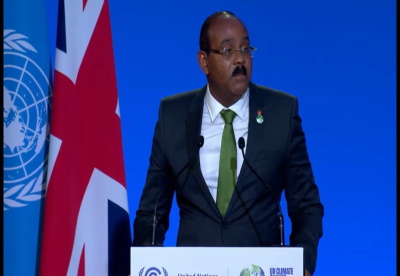
Antigua and Barbuda Prime Minister Gaston Browne, who is also co-chair of the Commission of Small Island States (COSIS) in his oral presentation, said the nine member states of COSIS are scattered across the globe but are united by a deep connection to and dependence on the marine environment and its resources.
Browne told the ITLOS that it is no exaggeration to speak of existential threats, when some of these nations may vanish in the foreseeable future because of rising sea-levels.
“The scientific evidence leaves no doubt that this situation has arisen because of the failure of major polluters to effectively mitigate greenhouse gas emissions. This inaction, this failure of political will, has brought humankind to a perilous juncture with catastrophic consequences.
It is because of this reality that COSIS has brought this vital matter before you.”
He said that in view of this reality, one can scarcely imagine a more compelling reason to establish an inter-governmental organization, noting that as a preamble to the Agreement states, COSIS members are “alarmed by the catastrophic effects of climate change which threaten the survival of Small Island States, and in some cases, their very existence”.
He said that COSIS has also been authorized to submit a written statement for the International Court of Justice (ICJ) advisory opinion on climate change requested by the UN General Assembly on 29 March this year.
“COSIS will also submit a written statement for the advisory opinion proceedings before the Inter-American Court of Human Rights, requested by Chile and Colombia on 9 January 2023,” he said, promisi8ng that there will be yet more initiatives as small island states join forces to protect their rights and very existence by building a rule-oriented international order in which the major polluters are held accountable for the harm they have caused and continue to cause.
“ It cannot be expected that our peoples will remain silent as their homes are irretrievably destroyed,” Browne said, adding that despite these multiple initiatives though, this initial request before ITLOS is particularly significant.
“This is the opening chapter in the struggle to change the conduct of the international community by clarifying the obligation of States to protect the marine environment.
“We are after all peoples of the ocean, whether in the Caribbean or the Pacific, in the Atlantic or Indian Oceans, surrounded by the vast expanses of water that have sustained us from time immemorial.”
Browne said that the COSIS agreement explicitly acknowledges the fundamental importance of oceans as sinks and reservoirs of greenhouse gases, and the direct relevance of the marine environment to the adverse effects of climate change on Small Island States.
“The ocean is fundamental to the climate system of the Earth, so it is befitting that the first in these series of proceedings should be before ITLOS, the guardian of the 1982 UN Convention on the Law of the Sea,” he said, adding “it is befitting no less because in the past weeks this summer we have witnessed the highest ocean temperatures on record”.
The Antigua and Barbuda Prime Minister said that COSIS is before the ITLOS because over a century and a half of anthropogenic greenhouse gas emissions have polluted the precious oceans and devastated the marine environment.
He said those emissions have fundamentally changed earth’s climate and are posing an existential threat to vulnerable communities worldwide.
“My country is one of those communities, and we stand in solidarity with all small island and coastal States facing the devastating consequences of climate change. Despite our negligible emission of greenhouse gases, COSIS’s members have suffered and continue to suffer the overwhelming burden of climate change’s adverse impacts.
“Indeed, the catastrophic effects of climate change threaten the survival, and in some cases, the very existence of COSIS member states. Without rapid and ambitious remedial action, climate change may prevent my children and grandchildren from living on the island of their ancestors, the island that we call home.
“We cannot remain silent in the face of such injustice. We cannot abandon our peoples to such a cruel fate. We have come before this Tribunal in the belief that international law must play a central role in addressing the catastrophe that we witness unfolding before our eyes.
“Your authoritative guidance, on the specific obligations of States Parties to UNCLOS to protect the marine environment, is a much-needed corrective to a process that has manifestly failed to arrest climate change,” Browne said, adding “we cannot simply continue with endless negotiations and empty promises”.
He said that the political process must be informed by existing binding obligations under international law.
“We have not come before you to create new law. All that we ask is for the Tribunal to clarify what UNCLOS requires of States Parties.,” he said.
Browne said that for decades, SIDS have been stating these truths in international gatherings concerning climate change, including at successive Conferences of the Parties to the UNFCCC.
“We have talked ourselves hoarse since the 1990s, pointing to the perilous circumstances into which our people and our countries are being plunged. Year after year, we listened as promises to mitigate climate change were made, and year after year we watched as those promises went unfulfilled.
“We have patiently listened and waited. We have ardently urged and pleaded. But with little avail,” he said, indicating that the at the 27th Conference of the Parties to the UN Framework Convention on Climate change in Sharm el-Sheikh, Egypt, last year, the soliloquy in William Shakespeare’s Macbeth resonates with a hammering significance for SIDS.
“Tomorrow, and tomorrow, and tomorrow. Creeps in this petty pace from day to day. To the last syllable of recorded time. And all our yesterdays have lighted fools. The way to dusty death.”
But he said SIDS are not willing to resign its peoples to this death sentence, occasioned by the continuing failure to take effective action against climate change.
Browne used the occasion to address the ITLOS on the devastating consequences that Antigua and Barbuda has suffered and will continue to suffer in the absence of swift and dramatic reductions in greenhouse gas emissions and robust, comprehensive adaptation efforts.
“In 2017 alone, three major hurricanes—Irma, Harvey, and Maria—battered the Caribbean, displacing three million people in a single month. Our sister island, Barbuda was the first island hit by Hurricane Irma, a Category 5 storm, which damaged an estimated 90 percent of all properties on the island. The damage required the evacuation of all residents from Barbuda to Antigua.”
He said the hurricanes also had a severe economic impact on the island, noting that after Hurricane Irma alone, “our recovery needs totalled US$222.2 million or roughly one sixth of our entire gross domestic product.
“The government incurred heavy debts to borrow the money needed to cover these costs.
However, repayment of those debts has placed a heavy toll on public finances. The government now has extremely limited funds to pay for social services, let alone climate adaptation and mitigation measures.”
Browne told the ITLOS that the impacts of climate change on the members of COSIS are ongoing, devastating, and will continue to worsen in the near future.
“Small Island States may be the first to fall, through no fault of our own, but we will not be the last, for no country on Earth can escape the deadly grasp of climate change. The world is teetering dangerously on the precipice of a climate catastrophe.
“We need your help. We need your guidance. I respectfully request that the honourable members of this Tribunal consider the significance of their advisory opinion, not only for COSIS, but for the protection of our planet and of human civilization,” Browne told the ITLOS.
CMC/pr/ir/2023