
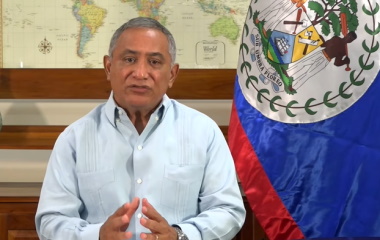
UNITED NATIONS, Sep. 25, CMC – The Prime Minister of Belize, John Briceño declared on Friday that the COVID-19 pandemic has brought the Belizean economy to its “knees”.
In his maiden address to the United Nations General Assembly, Briceño told the 76th Session Debate that his country’s unemployment rate has reached 30 percent, “as thousands of Belizeans lost their jobs.”
 He said the gross domestic product (GDP) declined by 14 percent, the debt has “ballooned to 130 percent of GDP,” and that “many businesses were shuttered, the poverty rate increased to 60 percent, (and) “the impact of the pandemic has been swift, dramatic and devastating.”
The Belize prime minister said the human toll has been “deadly,” disclosing that already 399 Belizeans have lost their lives to COVID-19.
“We have a fatality rate of 2.05 percent,” he said. “Thousands have been hospitalized so far. “Our health facilities are overwhelmed as they were unprepared for the surge in admission of critical patients.”
But Briceño said this is not unique to Belize,” stating that to confront the urgency of the pandemic, governments across the globe have reallocated funds “to meet desperate needs.”
“Loans originally committed for development and climate change were diverted to cover emergency health needs and to mitigate the impact on the unemployed,” he said. “Massive additional borrowings became the new normal as lockdowns were extended.”
The prime minister said the Common Framework and Debt Service Suspension Initiative has “failed to offer forbearance” to most middle-income Small Island Developing States (SIDS), including Belize, “who were ineligible, despite our debt unsustainability.
“At the same time, most of our countries had no recourse to concessionary financing to fund the immediate health response,” he said.
With the advent of the vaccine, Briceño said his government self-financed its acquisition from COVAX and concurrently reached out to bilateral partners to solicit vaccine donations.
“It was vaccines from our south-south partners which allowed government to roll out our national vaccination program,” he said. “The immediate global response was slow and inadequate to the scale and depth of the health crisis.
Disruption of supply chains made access to the much-needed COVID-19 therapeutics, diagnostics and PPEs beyond the reach of many developing countries.”
Briceño said vaccine hoarding has reduced access to COVID-19 vaccines for developing countries, “undermining COVAX and leading to deep and threatening inequalities.”
He said 80 percent of vaccines administered worldwide have been in high and upper middle income countries, and that only 0.4 percent of doses have been administered in low-income countries.
In Latin America and the Caribbean, the region worst hit by the pandemic, the Belize prime minister said only about a fifth of the population has received vaccines.
He said the support of UN member states for Belize’s territorial integrity and respect for its right to self-determination was “critical to the achievement of Belize’s independence.
“For us the multilateral system is indispensable,” he said. “For this reason, Belize supports the Secretary General’s thoughtful and forward looking ‘Our Common Agenda,’ which sets out a concise plan of action to accelerate the implementation of our agreed goals, including Agenda 2030.”
Despite the inclination to retreat towards nationalist tendencies, Briceño said “the truth is that whether it is the health or climate crisis — the scale of the challenge, the magnitude of the impact and the urgency of the action required, cannot be met by any one country alone.”
He said exclusion, inequality and vulnerabilities are also threats to the “rich and strong.”
“Therefore, our common future depends squarely on our solidarity, international cooperation and a strong and effective multilateral system,” the Belizean leader said. “We must commit to finding solutions, together, to the common problems that we confront. Unbridled unilateralism must yield to a settled determination to respond to the major problems of our times with social justice.”
He said Belize is pursuing along with Guatemala the final and peaceful resolution of Guatemala’s Claim to Belizean territory at the International Court of Justice.
“In the meantime, the 2005 Agreement on Confidence Building Measures remains in effect, and our bilateral relations continue to be based on mutual goodwill,” Briceño said. “We count on Guatemala to remain a constructive partner and rely on the international community to support us in addressing the daily challenges along the border that are inevitable between neighbors.”
But he said if the multilateral system is to be its collective lifeline, it must be re-purposed, proposing four areas for the reform and strengthening of the multilateral system.
“We call for a genuine commitment to address the systemic issues, which undermine the achievement of our agreed development goals,” Briceño said. “The continued ineligibility of SIDS from accessing concessional finance leaves us in a vicious cycle of disaster or crisis recovery-borrowing leading to unsustainable levels of debt.
“This must be disrupted,” he declared. “A multidimensional vulnerability index is the indispensable tool for restoring rationality to access affordable financing.”
Briceño said Belize, therefore, welcomes the work of the UN and other development partners, such as the Commonwealth and the Caribbean Development Bank, in developing a Multidimensional Vulnerability Index (MVI) “that does not only consider economic development but also the inherent vulnerabilities of SIDS, scale, geography and limited natural resources.
“We need to adopt an MVI now,” he appealed. “We call upon all the international financial institutions and our development partners to use it. There is no alternative if our countries are to embark on a sustainable and resilient economic development path.”
If the multilateral system is to remain credible, Briceño said it must have the capacity to induce action.
“For far too long, too many global problems have been allowed to fester and become crises,” he said. “The entire world is now experiencing the consequences of our inaction: catastrophic droughts, fires, floods and more frequent and intense hurricanes that continue to affect and set back our small, open and dependent economies.
“The latest scientific assessment of the Intergovernmental Panel on Climate Change lays the blame firmly on human activity,” he added.
Briceño said Belize, like other SIDS, is on the frontline of a climate crisis “for which we are not responsible,” stating that Belize incurs annual losses of close to 4 percent of GDP due to natural disasters.
Therefore, he said “felt an obligation” to put forward an ambitious revised Nationally Determined Contribution (NDC), which covers new targets in both adaptation and mitigation.
The prime minister said the NDC is “naturally aligned” to both national development plans and the Sustainable Development Goals (SDGs).
He said Belize has set some ambitious targets, including forest restoration and expansion of mangroves as well as achieving 75 percent of electricity from renewable sources by 2030.
Briceño said the NDC also pledges to transition to a hybrid and electric public transportation system, increase resilience of coastal communities and strengthen the adaptive capacity of agriculture, health and tourism.
He said Belize is committed to developing a long-term strategy aligned with achieving net zero global emissions by 2050.
“We are doing our part,” he said. “We expect the developed countries and major emitters to do their part. Indeed, ambitious commitments from the G-20 alone, can keep us on the path to limiting global temperature to 1.5 degrees Celcius.
“COP 26 is our last best hope to limit global warming to 1.5 degrees Celsius above the preindustrial level,” Briceño added.
COP26 is the 2021 United Nations climate change conference. For nearly three decades, the UN has been bringing together almost every country on earth for global climate summits – called COPs – which stands for “Conference of the Parties”.
In that time, the UN said climate change has gone from being a fringe issue to a global priority.
This year will be the 26th annual summit – giving it the name COP26. With the United Kingdom as president, COP26 takes place in Glasgow, Scotland.
In the run up to COP26, the UN said the UK is working with every nation to reach agreement on how to tackle climate change.
World leaders will arrive in Scotland, alongside tens of thousands of negotiators, government representatives, businesses and citizens for 12 days of talks, the UN said.
“We call for a ramping up of collective ambition so that by 2030 global emissions are reduced by 50 percent,” Briceño said. “Developed countries and those in a position to do so must provide the financial, technical and capacity building support to enable us to fulfill those pledges.”
He said this includes meeting and exceeding the 100-billion-dollar pledge made in Copenhagen, Denmark 12 years ago.
Briceño said additional support must also be provided for the loss and damage being incurred through the extreme and slow onset climatic events that the world is already experiencing.
He said the multilateral system must be more effective in protecting the rights of all people, noting that “the persistent call” by the General Assembly, for over three decades, “to end the illegal embargo against the Cuban people has been ignored.
“The Cuban people are forced to carve out their sustainable development under the burden of the illegal, unilateral economic, commercial and financial embargo,” Briceño said. “The new measures imposed by the past US administration, and now continued and widened by the present one during a pandemic, are unbelievably cruel and inhumane.
“These measures bring suffering to millions of innocent people and do not reflect the good will of the people of the United States of America,” he added. “Nevertheless, Cuba has made significant sacrifices to help other peoples of the world, including Belizeans.”
Briceño said Belize is also “deeply concerned” about the situation of Haiti and about “the regional and global inaction to offer a genuine and substantive program of support.
“We are alarmed at the inhumane treatment of Haitian refugees who are risking their lives, traversing two continents for a better future,” he said, calling on the UN “to galvanize action of the member states and its development system to support the development of a Haitian-led solution restoring its stability and security.”
Briceño said the multilateral system must also be inclusive, harnessing the capacity of all States to scale up international cooperation, where it is most needed.
He said Belize has benefited greatly from its diplomatic partnership with Taiwan “that is based on the shared values of democracy, freedom, human rights and the rule of law.”
The prime minister said Taiwan has provided “tremendous assistance” to Belize in terms of medical supplies and financial support, “so Belize is better equipped in combating COVID-19 and conducting post- pandemic recovery.
“Belize calls for Taiwan’s inclusion in the United Nations and its specialized agencies, which will not only further enhance global cooperation and partnership but also manifest the United Nation’s enshrined principle of universality,” Briceño said.
CMC/nk/kb/2021