
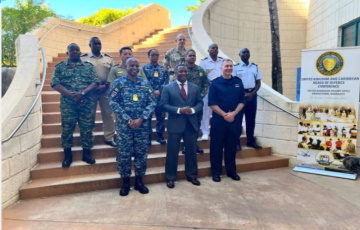
BRIDGETOWN, Barbados, Feb 1, CMC – The third annual United Kingdom- Caribbean Heads of Defence Staff Conference has heard a call for Small Island Developing States (SIDS) to develop effective strategies to deal effectively with trans-national crime and criminal organisations.
The conference is being hosted jointly by the Barbados Defence Force (BDF) and the United Kingdom (UK) Armed Forces.
Chief of Staff, Commodore Errington Shurland and the UK’s Chief of Defence Staff, Admiral Sir Tony Radakin are attending the conference that provides a platform for multilateral discourse on current and emerging threats to the region.
The organisers said that the conference will also allow for an analyses of the issues impacting regional security, including humanitarian assistance disaster response cooperation, and understanding the United Kingdom perspective on providing assistance in the aforementioned areas.
Barbados Home Affairs and Information Minister, Wilfred Abrahams, said while globalisation had strengthened the interconnectivity of the Caribbean, it had also created avenues for criminal networks in the region to thrive.
“What has created several opportunities for economic diversification and advancement has also had a negative, unintended consequence of increasing the complex and multifaceted nature of current and emerging threats,” Abrahams told the two-day conference, which ends later on Wednesday.
“This phenomenon has created avenues for criminal networks to collaborate and, consequently, become more difficult to counter, unfettered by borders or national bureaucracy. Criminal networks and alliances are able to exploit the inconsistencies in our regional security mechanisms and capabilities.”
Abrahams said that these threats had worsened due to a number of factors such as the climate change crisis and the coronavirus (COVID-19) pandemic.
“Regrettably, the trials of the pandemic engaged and diverted the attention of world governments and law enforcement agencies, thus providing the perfect opportunity for transnational criminal organisations, cybercriminals, violent extremist organisations and other threat actors to gain a stronger foothold in the region.
“Global statistics have indicated that separate and apart from intermittent periods of lockdown, crime and violence increased drastically to the detriment of law-abiding citizens,” Abrahams said, noting that constant vigilance, mutual cooperation and the development of effective security strategies were required.
He said the Caribbean’s normally peaceable existence has been marred by the proliferation of trafficking in illegal firearms, illegal drugs and human trafficking, which all enable violent crime.
“Illicit trafficking continues to be the most lucrative economic driver for transnational criminal networks within our region, and the use of the maritime space continues to be a thorn in our collective sides.
“Our resource constraints make it difficult to sustain comprehensive maritime domain awareness and this vulnerability is exploited as a means to traffic illegal firearms, drugs and, most recently, increasingly persons.”
Abrahams said that with the scarcity of maritime assets, coastal surveillance systems and trained personnel, it has become problematic to adequately patrol the region’s sea passages.
He said also that due to other natural and man-made hazards, illegal migration has also become a concern. He added that easy access to drugs, illegal firearms and illegal immigrants is often linked to the escalation of violent crimes.
“The existence of fragile and failed nation states within our hemisphere often means that hundreds of refugees fleeing from conflict and persecution will seek refuge when crossing maritime and land borders into neighbouring states.”
Abrahams said that for the last 10 years, managing these threats have been difficult for the entire region.
“The impacts of these natural hazards are felt for decades afterwards and are not limited to immediate loss of life but extend to economic fallout, which undermines and retards sustainable growth and development. The billions of dollars in damage caused by these events cannot easily be recouped without intervention in many cases with global financial institutions.”
In his address, the Home Affairs Minister urged delegates to conceptualise systems and regional mechanisms that will improve resilience to natural hazards and enhance the efficacy and speed of the response thereafter.
“Regional governments are obligated to work collaboratively to combat a multiplicity of natural and man-made risks and threats to the region. This conference must be the catalyst for developing effective strategies to interdict, disrupt and dismantle criminal organisations and to assist our governments with building resilience against natural hazards.
“Regional integration in its pure sense is essential to achieve the lofty mandate and objectives of this conference. The evidence increasingly indicates that the sustainable solutions to our shared challenges must be deeply rooted in regional cooperation with the state for support of our international partners,” Abrahams said.
CMC/gh/ir/2023