
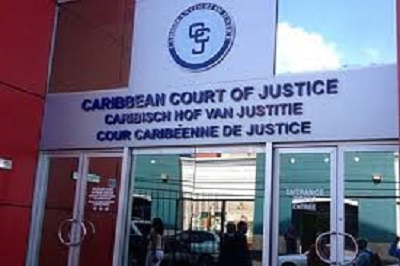
PORT OF SPAIN, Trinidad, Oct 16, CMC – The Trinidad-based Caribbean Court of Justice (CCJ) Monday dismissed an appeal that raised the question of whether the jury was misdirected by the trial judge on how to treat with a witness whom the jury considered may be deliberately lying on oath.
In the case James Fields against the state of Barbados, Fields argued that the jury must be directed on the premise that if the jury finds a witness to be deliberately lying on oath, then they must reject all of that witness’ evidence because if they lied about one matter they would be capable of lying about another.
But the state disagreed arguing that the direction was proper and that issues of credibility and reliability of witnesses are issues for the jury alone.
 On 23 July 2010, Fields was arrested and charged with the common law offence of murder. He was eventually found guilty of manslaughter and was sentenced by the trial judge to serve 16 years in prison. At the trial, an eyewitness to the incident gave evidence in support of the state’s case.
During cross-examination, it was demonstrated that the eyewitness was untruthful in his testimony. In cross-examining the eyewitness, counsel suggested to him that it was he who had shot and killed the deceased, but this was stoutly denied by the eyewitness.
In his summing up, the trial judge directed the jury along the lines that if the jury found a particular witness for the prosecution to be “lying”, they could reject that particular detail of the evidence.
Further, the fact that they did not accept a portion of a witness’ evidence did not mean that they must necessarily reject the whole of the witness’ evidence if they thought that it was worthy of acceptance. Fields was convicted by the jury and subsequently appealed to the Court of Appeal.
The Court of Appeal interpreted the material part of the trial judge’s summation as suggesting that when the judge referred to a witness who was “lying
On this basis, the Court of Appeal did not find it necessary to cast doubt on the direction. The Court found instead that, having regard to all the circumstances, the verdict of the jury was neither unsafe nor unsatisfactory.
Furthermore, even if the direction, taken out of context, may amount to a material misdirection, no miscarriage of justice had occurred. The appeal against conviction was dismissed but the sentence was varied to 11 years.
Fields appealed his conviction to the CCJ on seven grounds. The CCJ allowed Fields to argue one ground, that is the learned Justices of Appeal erred in law when they held that the learned trial judge correctly directed the jury on how to treat the evidence of a witness that the jury believed to be deliberately lying on oath.
Fields contended that the proper direction to the jury should have been the direction approved in Scantlebury and followed both before and since then, by most but not all trial judges.
The CCJ in a majority judgment authored by President Justice Adrian Saunders and Justice Winston Anderson, held that a blanket direction requiring the jury to discard the entirety of the evidence of a sworn witness who is found to have lied in one matter under oath, blurs the role and function of the judge and jury to an unacceptable degree.
Additionally, such a direction makes no attempt to convey to the jury that they may consider the significance of the lie to the issue being determined at the trial, introduces an unwarranted distinction between prosecution and defence witnesses and is not consistent with best practice in directions to juries.
The majority judgment emphasised that the categories of evidence which are admissible are matters of law for the judge; the weight to be placed on admissible evidence is a matter of fact for the jury.
Therefore, the judge is permitted to point out that the fact that a witness has lied under oath or affirmation is relevant to the reliability and credibility of that witness, whilst leaving the ultimate decision on the weight to be given to the evidence, to the jury.
At the same time, the judge is also permitted to direct the jury to guard against assuming that the fact that the witness lied about one matter must mean that the witness must automatically be taken as having lied about something else.
The majority also contended that the CCJ was not bound by any previous ruling on this issue as neither the CCJ nor its predecessor, the Judicial Committee of the Privy Council, have ever examined and pronounced on this direction.
The CCJ clarified that the direction in Scantlebury is not proper and that the direction to the jury regarding a witness deliberately lying on oath, should indicate that they are entitled to disregard so much of the evidence as they found untruthful and accept so much of it as they found to have been truthful and accurate.
On these bases, the appeal was dismissed as it was found that the trial judge did not misdirect the jury. No orders were made as to costs.
But in a dissenting judgment authored by Justice Andrew Burgess, it was opined that the issues in the appeal could be easily decided based on the principle of stare decisis, which is to stand by things decided.
This principle dictates that the judge was bound to follow the standard direction laid down in the Court of Appeal precedents and High Court decisions. Whatever the trial judge’s own view, he had no choice but to do so.
It was opined that this Court should not overrule the Scantlebury direction because to do so could compromise the advantages of the stare decisis doctrine.
Justice Burgess further noted that there was no sufficient basis for overruling the standard direction in this case. Moreover, there is a procedure available to the Director of Public Prosecutions to seek the opinion of this Court on the standard direction which would not require this Court to ignore breaches of the stare decisis doctrine by the Court of Appeal and the trial judge.
CMC/af/ir/2023