
BRIDGETOWN, Barbados, Sept 11, CMC – A University of the West Indies (UWI) scientist involved in the discovery of three micro-organisms in sargassum seaweed says he has been assured that the Barbados government is moving to secure patent protection for the three microorganisms after pharmaceutical companies expressed interest in acquiring them.
Professor Bidyut Mohapatra said that the Mia Mottley administration is seeking to obtain patents for the discoveries rather than allow multinational corporations to buy the organisms outright.
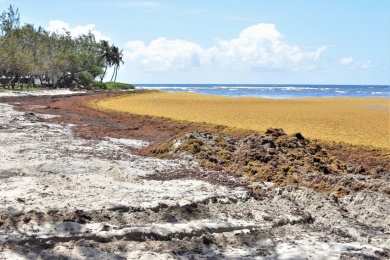 The scientist said that the aim is to retain in Barbados the potential commercial, environmental and financial benefits arising from the research.
Professor Mohapatra said following a presentation of his research at an American Society for Microbiology conference in Washington, DC, he was approached by major pharmaceutical firms interested in acquiring the microbes.
“Three companies were interested in procuring the microorganisms from us, purchasing them and starting industries,” he told the online publication, Barbados TODAY.
“One is a very big multinational pharmaceutical industry. But my interest is to keep this particular intellectual property in Barbados. The prime minister showed strong interest, and we met with the attorney general to decide how to go for the patent so maximum commercialisation stays in Barbados rather than giving it to a multinational company.”
He said selling the rights immediately to foreign corporations would provide a short-term payout while depriving the country of longer-term assets, adding “if we sold it, the company would buy it for some thousands of dollars, and we would keep our mouth shut because we sold out the organisms.
“They would get millions of dollars from it. But if we keep the patents, spending under US$50 000, the government can benefit by almost a million dollars later, managing who we deal with.”
Three novel microorganisms were discovered in sargassum seaweed, two of which were named in honour of Barbados: Chrysobacterium barbadense and Arthrobacter bajanensis.
The third, Streptomyces sargassi, holds significant pharmaceutical potential, according to Professor Mohapatra.
“Streptomyces is the group of microorganisms where pharmaceutical industries put multi-million dollars to find antibiotics, as 70 per cent of our antibiotics come from them,” Professor Mohapatra said.
“Finding a novel one has chances of about 0.001 per cent. Streptomyces sargassi produces 19 novel antibiotics and antivirals. We are lucky enough to find a new species here.”
The microbes may also have environmental and industrial applications. Arthrobacter bajanensis shows potential for cleaning up marine oil spills, while Chrysobacterium barbadense produces enzymes that may be useful in biofuel production, methane remediation and nitrogen fixation.
Prime Minister Mottley has been a prominent advocate for a global treaty to reduce methane emissions, arguing that voluntary industry pledges are insufficient.
She has frequently cited the 1987 Montreal Protocol as a possible model for such an agreement, calling for strict and enforceable international standards for the oil, gas and agricultural sectors rather than voluntary commitments.
Professor Mohapatra said securing a United States patent typically takes three to five years.
CMC/af/ir/2026