
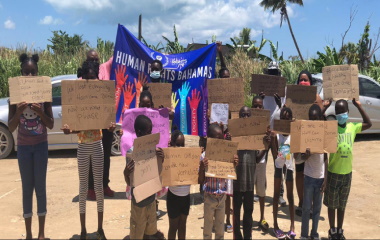
NASSAU, Bahamas, May 31, CMC – Residents of the Abaco shantytown have written to a United Nations delegation urging that the Hubert Minnis government stop its “senseless, heartless and illegal” demolition of shantytowns across The Bahamas.
According to a May 29 letter from the “displaced victims of Hurricane Dorian on Abaco”, at least 1,000 people could be homeless as a result of the decision of the government to demolish the shantytowns.
Media reports said that the residents handed the letter to a UN delegation during a tour of shantytowns on Abaco over the last weekend.
“We are extremely glad that you are able to witness firsthand the treatment and conditions we have suffered ever since being made homeless by the storm in September 2019.
“After losing everything, we tried to re-establish our homes and lives, many of us having lived there lawfully for decades. However, we were intentionally targeted and subjected to systematic persecution at the hands of The Bahamas authorities,” the letter noted.
It said that following the storm, in February 2020 all remaining structures, including those that had been spared extensive damage, “were fenced in to block access by residents, then summarily and arbitrarily demolished and the remains, including all of our personal property, were disposed of against our will.
“Many lost all of their savings, belongings, travel and other documents as a result. Some have no way of proving their identity and may be rendered stateless. Since then, a number of families have sought to rebuild.
“However, the new homes – the only shelter our families, our children, could hope for under the circumstances on an island with a chronic housing shortage – have again been targeted for arbitrary demolition,” the letter noted.
The authorities have so far demolished 45 incomplete and unoccupied structures in The Farm shantytown in Treasure Cay, Abaco on April 22 and another 10 were demolished on May 14 and 15.
But the residents claimed that the demolition left 40 people homeless including 10 children.
“If the government proceeds with its stated plan, up to 1,000 persons will be displaced in further demolition exercises.
“Among them will be hundreds of children and many with disabilities, who will suffer severely if deprived of shelter. In these demolition exercises, we have not been afforded due process as mandated by Bahamas law. Rather, we were collectively accused of various violations of construction regulations without regard to the individual merits of each case.”
But in a statement, the Ministry of Public Works (MOPW) confirmed the demolition of the structures on May 14-15, adding “a total of ten (10) structures on The Farm Shanty Town, near Treasure Cay, Abaco were demolished. Seven (7) out of the ten (10) structures removed had previously been occupied”
It said that the demolition team was accompanied by officers from the Royal Bahamas Police Force (RBPF), Royal Bahamas Defence Force (RBDF) and the Department of Immigration (DOI).
“Debris from the demolition has been safely disposed of. Personal and household items from the structures have been secured.
“The Government of the Commonwealth of The Bahamas remains resolute in moving forward decisively and effectively to protect the health of the Bahamian people in accordance with Bahamian law and the Order of the Court both in New Providence and the Family Islands,” the MOPW added.
In their letter, the residents noted that in public statements, senior officials sought to conflate the home destructions with the issue of undocumented migration, “even though the vast majority of members of our communities are citizens of the Bahamas or have some form of legal status. We believe these to have been tactics aimed at inciting and inflaming public opinion against us.
“We feel that we have been specifically targeted because many of the people in our communities are of Haitian ethnic background. After all, the construction violations and other breaches, which the authorities have alleged (but not proven) against us, exist in abundance in ethnic Bahamian traditional communities as well; however, the latter are not targeted for demolition,” the residents said in the letter, a copy of which was obtained by the media.
Earlier this month, a group of UN human rights experts called on the government to halt further demolitions, noting that “the planned forced evictions and demolitions constitute a serious violation of the human right to adequate housing and will result in arbitrary internal displacement.
“To make things worse, this is scheduled to occur during the COVID-19 pandemic, threatening to expose an already vulnerable minority to all kinds of risks for their health and safety. Most of these people have nowhere else to go. If their homes are destroyed, they are at serious risk of falling into homelessness and extreme poverty.”
In 2018, the Minnis administration announced plans to demolish shantytowns throughout the country, giving residents of most shantytowns on New Providence until August 10, 2018, to leave before demolition.
Residents in Abaco shantytowns were given until the end of July 2019 to leave.
However, in August 2018, Supreme Court Justice Cheryl Grant-Thompson granted an injunction preventing the demolition of shantytowns, but when Dorian made landfall in the Abacos in September 2019, the shantytowns were some of the worst-hit communities – many of them virtually wiped out by the strong winds and storm surge.
CMC/fd/ir/2021