
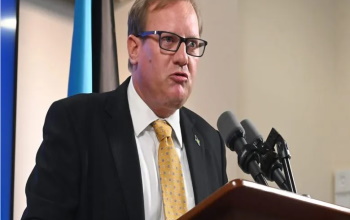
NASSAU, Bahamas, Aug 12, CMC – The Bahamas government says it does not believe it will be appropriate to pass legislation that outright denies bail to people charged with murder given a recent ruling by the London-based Privy Council that the matter “unconstitutional”.
Attorney General Ryan Pinder, who on Thursday outlined the government’s priority for its legislative agenda as it enters its second year in office, was asked to state his position on the matter after Police Commissioner Clayton Fernander and National Security Minister Wayne Munroe both recently expressed support for no bail for persons charged with serious crimes like murder.
Fernander, speaking at a Rotary Club meeting earlier this week, said many of the men who were killed were on bail for murder, armed robberies and other serious crimes.
Munroe told local media that people charged with murder should be kept in custody for their own protection and that more than 30 men who were out on bail this year have been murdered.
Pinder noted that any decision on no-bail made has to fall in line with the Constitution based on “guidance by the Privy Council” the country’s highest and final court.
“You would look at a recent Privy Council decision that was just issued this month or last month, July with respect to Trinidad,” Pinder said while speaking at the weekly press briefing at the Office of the Prime Minister..
“Trinidad had put in law that they would deny bail for murders. Jamaica has a similar law. The Privy Council ruled that that is unconstitutional and throughout that law and Jamaica is now going to be forced to change their law.
“So, anything we do has to be in the purview of the Constitution and guidance by the Privy Council, which is the ultimate court of the land. Now do I think that you know, harsh sentences should be put on murderers and we shouldn’t let them roam the streets? Of course, I do but it has to be done properly,” Pinder said.
Late last month, the Privy Council dismissed an appeal by the Trinidad and Tobago Attorney General that sought to determine whether section 5(1) of the Bail Act 1994 is inconsistent with the country’s Constitution.
The Privy Council, which is also Bahamas highest and final court, noted that under the Bail provision the prohibition of bail occurs as a result of being charged and applies pre-committal, as in this case.
“It may well therefore include people in respect of whom there is insubstantial evidence of guilt. That is vividly illustrated by the facts of the present case in which it was ultimately found that the respondent had no case to answer…
“A person who is eventually acquitted or discharged at a preliminary enquiry may therefore have been deprived of liberty for a substantial period of time, causing serious harm to their life chances, without there ever having been a consideration by a judicial officer whether the denial of bail is suitable in the particular circumstances of their case,” the Privy Council noted.
Pinder also made reference to a recent Court of Appeal judgement that bail could be denied to an alleged “murderer if they thought that releasing him would be a threat to innocent people, not necessarily himself.”
“Now, when you’re looking at going into another level, there’ll be a threat to themselves, because if they’re out on bail, they are a target. We’re not quite there yet. The Court of Appeal hasn’t gone that far yet.
“I’ve had a discussion with the president of the Court of Appeal on that ruling and we’re discussing the legal parameters related to that but given the recent Privy Council decision out of Trinidad, I don’t think that it would be appropriate for us to pass a law that would deny bill outright to murders.”
Pinder said a key priority for the Davis administration in the second year will be enacting legislation dealing with crime prevention and intelligence.
The government intends to make amendments to several crime fighting laws, including the National Crime Intelligence Agency Bill and the Defence Act.
“You would have heard the prime minister say that we have to focus on intelligence, and we have to focus on the reasons for crime, to try to prevent them along with obviously catching the criminals.
“Part of our agenda in framing out crime prevention intelligence, we look to the table the National Crime intelligence agency amendment bill, which strengthens the National Crime intelligence agency in order to better respond to intelligence on criminal matters.
“We’re also looking at amendments of the Defence Act. In that Defence Act amendment, we look to strengthen the scope and provide for a broader influence of the National Security Council of The Bahamas so we can have a broader and more in depth, a security approach by legislation, the legislation empowerment of the National Security Council.”
Pinder said that the government is also looking to launch a criminal law overhaul project through the law reform and Law Review Commission “and what that will do is look at all of our criminal laws, to modernise them, to bring them into international best practices but also to look at certain elements of case law, especially in the Court of Appeal decisions that have been made that we would want to look at from a legislative point of view, to assist with the criminal enforcement and prosecution of criminals in the country”.
He said the government intends to table amendments to the Fiscal Responsibility Act and the Public Finance Management Act, and new public procurement legislation in Parliament when it resumes next month.
“The Public Procurement Bill, initially we looked to amend certain aspects of that that we found troublesome.
“Once we were looking at it in more depth, we figured a full rewrite of that legislation was necessary in order to provide more transparency but ease of administration and ability to govern effectively on that bill and ability to be able to govern with immediate priority in instances that require it.
“A lot of times the portal didn’t function appropriately and the mechanisms that were in place restricts the government from reacting immediately in times of exigency.”
Pinder said the government will also lay a National Investments Fund Bill in Parliament.
CMC/fd/ir/2022