
NASSAU, Bahamas, Oct 30, CMC – Prime Minister Philip Davis says the remains of the Lucayans, the first people of these islands, have closed a chapter that began with their removal by George R. Fox from Watlings Island, now known as San Salvador, nearly a 100 years ago.
Prime Minister Davis said that these bones, resting in a Michigan University storage facility since 1952, “are now reunited with the land and legacy that first gave them life.
“Today, we gather here to witness a moment that is both deeply reflective and profoundly meaningful for our national story. It’s a moment where part of our past, held far from our shores for nearly a century, has finally returned home,” he added.
Prime Minister Davis speaking at the ceremony marking the return of the remans of the Lucayans, said the event is a powerful reminder of the journey of Bahamian people.
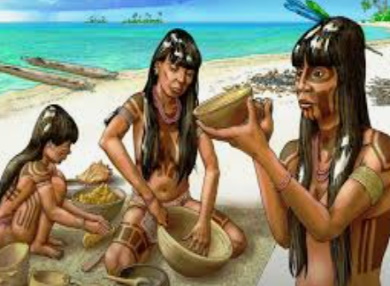
The Lucayan people were the original residents of The Bahamas and the Turks and Caicos Islands before the European colonisation of the Americas.
The Lucayans were the first in the Americas to meet Christopher Columbus, marking a period that would tragically lead to their destruction and the erasure of an entire culture. They had been here for hundreds of years, thriving, celebrating, and burying their loved ones with reverence in the caves of these islands.
But Prime Minister Davis noted that they were also the first to suffer the devastation brought by colonial encounters.
He said while DNA studies show no biological link between them and present-day Bahamians, “their spirit and influence echo through our culture, guiding us in ways that transcend mere lineage.
“Our history is one of resilience, endurance, and adaptation,” he said, adding “from the Lucayans to the enslaved Africans who built Fort Charlotte, to the Bahamians who carved out livelihoods from the sea and the land, each generation has faced its own struggles, yet emerged with strength and dignity”.
He said these stories of courage and survival are more than just history lessons, adding they are the foundation of who we are as a people.
“They remind us that our heritage is not just a collection of events but a testament to the resilience that runs through our blood.”
Prime Minister Davis said the journey to bring the Lucayan remains to the country has been long and filled with complex paths and that it was was made possible through the 1990 Native American Graves Protection and Repatriation Act, a law that mandates institutions to return remains and sacred artifacts to their communities whenever possible.
He praised the collaboration between Michigan State University’s Arts and Collections Department and The Bahamas own Antiquities, Monuments & Museums Corporation, saying “we mark a historic first for The Bahamas: the return of ancestral remains from an international institution”.
Davis said that the act is more than a transaction, it is a restoration of dignity, a healing of wounds, and a recognition of a shared responsibility to honor cultural heritage.
“Our connection to the past doesn’t stop with the Lucayans. Tomorrow, we will bring history to life through a reenactment that honors the service and sacrifices of the West India Regiment — men of African descent who fought for the British Army in the Caribbean and Africa.
“In historic uniforms, our own Royal Bahamas Defence Force, Rangers, and young recruits will perform military drills in Parliament and Rawson Squares, where we’ll be transported back to the 18th century. These reenactments serve as a vivid reminder of the bravery and resilience that have been passed down through generations.”
He said that Fort Charlotte, completed in 1819, stands as a reminder of the dual legacy of the past. Built by both enslaved and freed Africans under Lord Dunmore’s governorship, Fort Charlotte, along with forts Darcy and Stanley, defended the islands and symbolizes the resilience and strength of those who shaped these shores.
Named for Queen Charlotte, it was built as both a fortress and a statement of Bahamas place in the world, even when those who built it had no freedom of their own.
“As we look back on the stories of the Lucayans, the West India Regiment, and the construction of Fort Charlotte, we are reminded of the importance of reclaiming our history, remembering those who came before us, and celebrating their impact on who we are today.
“The resilience and legacy of our ancestors shape our present and inspire us toward a future where we uphold our heritage with pride. Today, we not only witness the return of our ancestors’ remains, but we honour their enduring presence and influence.
“They are part of the spirit that defines us, a spirit that endures and guides our nation forward. Let us embrace this moment with reverence, reflection, and a renewed commitment to preserving our heritage for generations to come,” Davis said, adding “we, Bahamians, carry in our blood the courage of the Lucayans, the strength of the West India Regiment, and the unbreakable spirit of those who laid the stones of our forts”.
CMC/af/ir/2024