
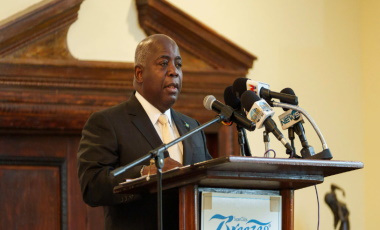
NASSAU, Bahamas, Sept 6, CMC – Prime Minister Phillip Davis says despite signing the United Nations Sustainable Development Goals (SDGs) in 2015, agreeing to a blueprint for global peace and prosperity “there are goals that have remained stagnant or indeed have regressed”.
Davis addressing the 2022 UN/BDB Inaugural SDG Partnership Forum, held under the theme “Transformational Partnerships for a Sustainable Future,” said the SDGs were specific, tangible expressions of what ‘peace and prosperity’ would look like in each signatory country around the world.
He acknowledged that the range and breadth of those goals, “are not easy things to achieve, and even if we suppose that there is sufficient political will to do so, fulfilling the goals will be challenging”.
He told the forum that since 2015, there has been progress in the Bahamas towards fulfilling a number of the SDGs,” but there are goals that have remained stagnant or indeed have regressed”.
He said he hoped the forum, bringing together a number of interested parties, would result in a number of multi stakeholder partnerships being developed, in an effort to advance progress of the SDGs here.
“I wholeheartedly support and endorse this initiative,” Davis said, recalling that soon after receiving his instruments of Office as Prime Minister, “I committed my administration to working in partnership with the Bahamian people.
“This was not an empty promise. Over the course of the past year, many of our achievements in office have only been possible because of that partnership. That said, it is unfortunate that too many of the institutional arrangements of government, are designed for people to work in silos.”
Prime Minister Davis said that while that may encourage specialisation, and reinforce lines of internal accountability, it does not work well when working towards goals that span several ministries or government departments.
“For example, when we articulate our wish to empower young people, we clearly don’t expect that effort to be solely made by the Ministry of Youth. Education, Housing, Transport, Finance,
Immigration, Labour, National Security, for example, will all play key roles in helping to fulfil that goal, Prime Minister Davis said, adding that by formalising and structuring partnerships appropriately, especially when they include the private sector and the non-governmental sector, “we create a better foundation for success.
“The irony is, of course, that the more organisations and people that become involved, the more likely it is that bureaucracies and cultures and personalities will get in the way. This is not to condemn the challenges, merely to observe that this is what human structures are like.
“So what else can we do in order to promote success? A key tool, is to ensure that we are all absolutely clear as to what the priorities are. If we try to do everything all at once, or if we have differing ideas of what they are, then chaos and confusion is the more likely result.
“To be clear, other SDGs are not being abandoned. The priorities are just that: an ordering of the things we currently consider most urgent and most important.”
Prime Minister Davis said his government has set out the eight priorities which his administration would wish to focus on, ranging from Health and National Health Insurance to developing the national infrastructure to make it more resilient.
“I trust that these priorities do not come as a shock to any of you,” he said, reiterating that progress has been made in some areas.
Prime Minister Davis said nonetheless many of them have benefitted from the efforts of sustained partnerships, noting as an example, the economy “a fundamental priority which needs to be addressed is the rescuing and strengthening of the economy”.
He said between 2018 – 2019, there was a serious contraction in the economy, in great part because of the shock rise in value added tax (VAT) and extremely rapid and high growth in government debt.
He said the impact of Hurricane Dorian in 2019, and the COVID-19 pandemic in 2020, brought additional adverse impacts on an economy that was already struggling.
“Since coming into office last year in 2021, through various partnerships we have begun to introduce economic reforms, stabilize the public finances, address fiscal responsibility and debt management issues, and refocus the Bahamas’ Investment Authority.
“We have also begun to revamp the tourism model, as well as enhance the ease of doing business.
Of particular significance is the comprehensive review of the taxation regime of the Bahamas. This follows on from the successful reduction of VAT to 10 per cent.
“These are all essential steps that the government believes are necessary to strengthen the economy,” Davis added.
CMC/fd/ir/2022