
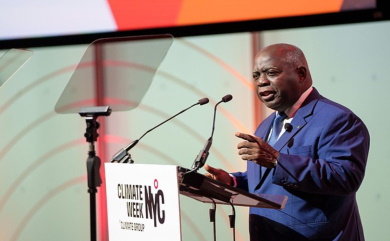
NEW YORK, Sept 23, CMC – Bahamas Prime Minister Phillip Davis says it is time to move past business as usual and urged the international community to rethink their current position regarding climate change, noting that for too long, the global response has been defined by inertia.
Addressing the Climate Week NYC 2024 here, Prime Minister Davis said that as the leader of a nation on the frontlines of climate change, he has watched the tides rise higher each year, felt the storms grow stronger, witnessed firsthand the relentless advance of a warming world.
“But nothing could have prepared me for the news that shook us all: For the first time, global warming has exceeded 1.5°C across an entire year. Not for a day, not for a week, but for an entire year.”
Avis said that the 1.5°C reality dismantles the very notion that incremental change will be enough, adding that the old playbooks, the familiar arguments, no longer hold sway in a world where this threshold has been crossed.
“For too long, the global response has been defined by inertia, by a dangerous insistence on clinging to “business as usual.” But recently we have seen some progress, prompted by the voices of people like my citizens who are facing this crisis daily and the activism of concerned citizens around the world.
“A wave of change is sweeping the globe. More and more nations are recognizing the urgency of the crisis and setting ambitious targets to reduce emissions and transition to a cleaner, more sustainable future. ”
He said that the recent passing of the Inflation Reduction Act was the largest piece of climate legislation in US history and that multilateral development banks, acknowledging the critical role of finance in driving this transformation, have tripled their climate investments over the past decade.
“This momentum is undeniable, a testament to the growing global consensus that climate action is not just enlightened self-interest, but an economic and strategic necessity,” Prime Minister Davis said, adding “global leaders have a choice; listen to their people or face being replaced by others who will”.
He said he is excited about all the developments and progress he has seen, specifically, advances in renewable energy technology, carbon capture, technology sharing, the development of drought-and-climate resilient crops, the use of artificial intelligence (AI) in climate forecasting and risk assessments, and clean transportation solutions.
Prime Minister Davis said he understands that tackling climate change presents a unique challenge, adding “it requires us to make decisions today that may not yield immediate benefits.
“This can be difficult for leaders who are often judged by immediate results, by quarterly profits, by election cycles. But this is precisely why we, as global leaders, need to reframe the narrative.
“We need to demonstrate that climate action is not about sacrifice. It is about opportunity. It is about creating new industries, new jobs, new pathways toward prosperity and security. It’s developing an evolved world where sustainability and economic growth go hand in hand.
“With that, we must acknowledge that our current efforts are not enough. The reality is that climate crises do not stay inside a country’s borders. What happens in one nation impacts us all, particularly those of us in Small Island Developing States like mine. ”
Prime Minister Davis said that “we need a global response that matches the scale of the crisis, one that recognizes our interconnectedness and embraces a shared responsibility for building on shared sustainability.
“It must be an international effort that transcends national interests and embraces the power of collective action. This is not the time for despair, but an opportunity to show up better for ourselves and for one another.”
Davis said the moment has arrived where climate action can and will drive innovation, economic growth, and a more just and equitable world for all.
He said this September marks five years since Hurricane Dorian, a category five hurricane made landfall on The Bahamas and that in addition to the devastating loss of life and property Dorian brought, the national debt was increased significantly due to the fact the country has a continued cycle of borrowing to rebuild and recover.
“What we need now is a radical shift in our thinking, a structural reset of our priorities, and the courage to pursue bold, transformative action at a scale never seen before. The time for complacency is over. This must end now!
“The 1.5°C threshold is not a line in the sand; it is a siren. It is a clarion call for a global awakening, a collective rejection of complacency, and for a new era of climate action defined by innovation, accelerated change and a firm commitment to justice.
“For the leaders of the world, particularly in the countries that have contributed the most to this crisis, it is time to restructure the incentives for change,” Prime Minister Davis said, adding one powerful tool in this effort is climate litigation.
“By holding fossil fuel companies accountable for the true costs of their actions – the externalities they have long imposed on our planet and on our communities, we can shift the economic calculus of energy markets without burdening taxpayers with new taxes.
“This approach not only advances climate justice but also creates a more level playing field for clean energy solutions to compete and thrive. Let us make climate action a prerequisite for security partnerships. Nations seeking to participate in and benefit from security cooperation must demonstrate tangible commitments to creating resilience. Trade agreements must be tied to emissions targets.”
Prime Minister Davis urged the audience to imagine a world where their children inherit, not a planet in peril, but one brimming with possibility.
“Picture cities designed with nature in mind, powered by clean energy, and where innovation is driven by the quest for harmony between human progress and planetary health. Imagine a global economy built on the principles of stewardship, where the value of our natural resources is paramount and where the pursuit of profit is aligned with the preservation of our shared home. This is the course correction that history demands of us.
“Because here’s the truth: this challenge demands that we come together and act with conviction. It’s a chance to redefine our relationship with the natural world, to forge economies that are not just profitable, but also sustainable and just. We can embrace a new path, one where we harness our collective ingenuity – it does not have to be a distant aspiration, but the very foundation upon which we engineer a brighter future,” Davis said.
CMC/af/ir/2024