
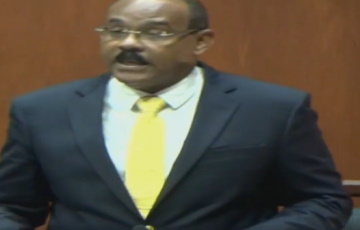
ST. JOHN’S, Antigua, Sept 10, CMC – Prime Minister Gaston Browne stopped just short of announcing that his government would be implementing a mandatory vaccination policy for Antigua and Barbuda, but warned that time had come to take tougher and more unpopular measures to deal with the spread of the coronavirus (COVID-19) that has so far killed 47 people and infected 2.047 others since March last year.
“This is a very serious issue .I have signalled to the people of Antigua and Barbuda months ago that if we have to make vaccination mandatory in this country we will do it. We are not afraid to do it,” Browne told Parliament.
‘We recognise however, that as leaders we must be tolerant and I am satisfied that we have exercised sufficient tolerance in this country and the time has come for us to act,” he said, warning opposition legislators “we cannot put our political value…or interest above that of the national interest.
“There comes a time when we have to stand alone and make decisions in the national interest and the time has come,: Browne said, reminding Parliament that Cabinet had earlier this week approved of a measure that all public servants “must get vaccinated or get tested at least twice monthly otherwise you will not be eligible to enter into the workplace.
“And if you don’t come to work, you cannot justify getting paid. And if you don’t come to work after a period of time, you abandon your job and you lose your employment,” Browne said, adding that his administration is not seeking to “threaten people’s jobs”.
Information Minister Melford Nicholas, speaking at the post-Cabinet media, briefing said that the new policy would come into effect from October 1.
The government had earlier indicated that only frontlines workers would be required to be vaccinated or to produce a twice-monthly COVID-19 tests, and Nicholas defended the change in policy telling reporters that the primary reason is to increase the protection against the virus.
“Prior to this period, we had really focused on frontline workers, [but] given the fact that we have seen multiplication of persons with vaccinations across the board, we have taken the position that as of October 1st, the policy will become applicable to all public sector workers in all of the agencies and all of the formats of the government, to include the statutory bodies as well,” Nicholas said.
“The reason why we have gone to the first of October is that we will give permanent secretaries and other senior public officials sufficient time to put regimes in place.”
An estimated 14,000 employees are set to be subject to the policy change, but they won’t be expected to ‘empty their pockets’, as both the vaccinations and the testing remain free of charge.
Browne told Parliament that as the largest employer in Antigua and Barbuda, the government has an obligation “to provide a safe working environment for workers in this country, certainly those in the public sector.
“I hope others in the private sector would follow. We cannot continue to play with this debilitating and deadly disease. Time has come for us to call a spade a spade and those who want to go and protest, fine, go and protest, but respect the laws.
“The laws are very clear. No more than 10 people supposed to congregate and if you break the laws there are consequences. I know there will be a lot of hate speeches after this, but I will take the hatred. All I know is that I was elected to serve in this Honourable House, the members on this side has shown enough confidence in me to serve as prime minister, I have taken an oath in this Honourable House to lead without fear or favour.
‘I have an obligation to stand in this Honourable House to tell the people of Antigua and Barbuda about the risks they are faced with if we don’t act on this now. How many more people must die? “Another 100 another 200 before we act. And the irony about it colleagues, if we don’t act they will still blame us, so let us act , do what we are required to do and protect the citizenry, to protect lives and livelihoods and I am saying here to my people you need to cooperate,” Browne said, adding that his government is not trying to be aggressive or antagonistic.
“But there comes a time when we have to stand up and take a very firm position and we are here now,” Browne told legislators.
Browne’s statement to Parliament comes in the wake of a report that leaders of the Organisation of Eastern Caribbean States (OECS) have been told that there is “ample provision” in their constitutions to support mandatory vaccination laws as the sub-region continues the battle to curb the spread of the coronavirus.
In addition, the governments of Antigua and Barbuda, Dominica, Grenada, St. Lucia, St. Vincent and the Grenadines, St. Kitts-Nevis and Montserrat, have been informed that there are corresponding jurisprudence and medical data to support the position of mandatory vaccination.
The position to the OECS governments has been outlined in a 16-page confidential brief, titled “The Legal Dimensions of Mandatory/Compulsory Requirements for COVID-10 Vaccinations, August 2021” undertaken by two prominent Caribbean-born internationally respected jurists.
The document submitted to the OECS leaders, a copy of which has been obtained by the Caribbean Media Corporation (CMC), notes that the sub-regional countries would be on firm legal grounds in pursuing mandatory vaccination laws even in the face of counter-arguments alleging violations of rights.
“Having demonstrated …that mandatory vaccination is constitutionally appropriate given the leeway granted in favour of public health imperatives, it is submitted that employers could justify a requirement in a pandemic context, at minimum where the workplace is a high-risk environment, such as health-care, or essential services, or for workers more at risk at the workplace, such as frontline workers interacting with the public.
“It is unlikely that employers would be held to a higher standard than a constitutional standard. This is reasonable both to protect other employees, the interacting public and even the employee himself or herself,” according to the document. “
CMC/ad/ir/2021