
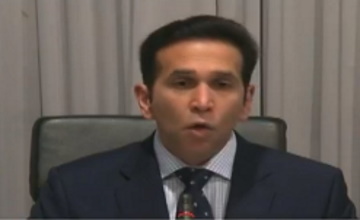
PORT OF SPAIN, Trinidad, Feb 18, CMC – Attorney General Faris Al-Rawi Friday said that the state will appeal to the London-based Privy Council, the country’s highest court, a ruling by the Court of Appeal here that persons accused of murder can now apply for bail.
Al-Rawi told a news conference that following the Court of Appeal ruling on Thursday, the Office of the Director of Public Prosecutions (DPP) and the Trinidad and Tobago Police Service (TTPS) “have already reached out and the Attorney General’s office is being asked whether we will appeal the matter and I wish to indicate that we are bound to appeal the Akilii Charles judgement.
“We are bound to take it to the Privy Council. These were plainly stated to the Court of Appeal and the Court of Appeal recognised that and indeed gave directions for the fast tracking of the application for leave to go to the Privy Council. All parties agreed with that approach.”
The Court of Appeal, headed by Chief Justice Ivor Archie, Thursday said that while bail could be extended to persons charged with murder, it would not be automatic.
In its landmark ruling, the three-member panel, said that the courts will now have to hear an application to determine the merits of each individual case before deciding if the bail should be granted or denied.
The Appeal Court, comprising Justices Archie, Mira Dean-Armorer and Malcolm Holdip, ruled in the matter in which a former murder accused represented by former attorney general Anand Ramlogan, asked for a declaration that anyone charged with the capital offence should have the opportunity to apply for bail.
Charles had filed the motion after High Court judge, Justice Joan Charles dismissed his constitutional claim. Charles spent nine years on remand before the murder charge against him was dismissed in May 2019 by Chief Magistrate Maria Busby-Earle Caddle who upheld a no-case submission, agreeing with his attorneys there was insufficient evidence for the matter to proceed to trial.
Justice Charles had refused to declare section five of the Bail Act, which makes murder a non-bailable offence, noting that the former murder accused failed to establish that the legislation directly interfered with judicial proceedings, or breached the doctrine of the separation of powers, to make it unconstitutional.
She had been asked to strike down the specific portion of the Bail Act to allow people charged with murder to apply for bail. But in her decision, Justice Charles said she could not depart from previous decisions of the Privy Council on separation of powers, nor did she agree that the effect of the legislation removed all judicial input on the issue of granting, or refusing, bail for murder.
She noted that judges of the High Court, in the past, did not grant bail for murder, either at common law or by statute.
But the Appeal Court declared that section 5(1) of the Bail Act 1994 was not reasonably justifiable in a society that had a proper respect for the rights and freedoms of the individual and that the particular section was unconstitutional as its effect removed the jurisdiction of judges to grant bail for murder.
Justice Archie, who delivered a summary of the Court’s written decision, said prior to the amendment of the Bail Act there was no general prohibition to the grant of bail to persons charged with murder.
He said the court had the jurisdiction to do so and that the court considered whether Section 5 was saved law but held the “unanimous view” it was not but reserved making further pronouncements on the effects of the clause as this particular point of law is being reconsidered by the Privy Council.
Justice Archie said it was the court’s unanimous decision that the issue of granting bail was a core judicial function and, as it agreed a breach of the separation of powers was not a stand-alone reason for striking down a statute, held that “by removing the jurisdiction of High Court judges to grant bail to persons charged with murder, section 5 has trespassed on a core judicial function.
“In this way section 5 offends a critical aspect of the rule of law and is not reasonably justifiable in a society having respect for the rights and freedoms of the individuals,” Justice Archie said, acknowledging it was not a justification and the court was aware of the ramifications its decision would have, not just for the parties, but also the entire population.
Al-Rawi told reporters that “numerous entities have already reported that persons are prepared to move to the local courts now to seek bail applications for persons who are in remand.
“Now I should tell the nation statistically that there are 2, 410 people in remand and of that number, roughly 1, 200 persons are there for the charge of murder,” he said, adding 446 are at the Magistrate’s Court, 695 at the High Court with remainder bein either at the Court of Appeal or the Privy Council.
He said considering the number of questions that have already been sent to the Office of the Attorney General “it is imperative for me to indicate that we have asked the Court of Appeal to suspend its order” which he described as a “very unusual” request.
He said it is unusual to ask a court which has determined a constitutional issue to suspend its order, and Al-Rawi said an order had been issued on Thursday “effectively suspending the effect of that judgement given yesterday.
“In respect of the number of applications, the number of enquires that the Office of the Attorney General, the DPP’s Office, the TTPS …have been receiving in respect to the fact that we have close to 1, 200 people in remand on the charge of murder, I am obliged to inform that the order of the Court of Appeal has been suspended until March 3, 2022.
‘That means that no person can apply to the court in light of the bridging suspension until the court considers the matter and indeed makes a determination after the hearing on March 3, 2022.
“I am obliged to inform that the state will be inviting the judiciary to consider the further suspension of its declaration on the constitutional issues surrounding the Bail Act…because the logistics of an application for bail require a number of administrative steps”.
He said while the administrative steps are complicated and very important steps that the state has to be ready for and that the Trinidad and Tobago Constitution allows for habeas corpus “where you are brought before the court and you are presented by an application with the parties…saying tell me why I should be further detained…let me go.
“So we not only contemplate the administrative steps in a bail application under the Bail Act, we must also contemplate the constitutional claims that can arise and in that regard we must contemplate the writ of habeas corpus,” Al-Rawi said.
CMC/ad/ir/2022