
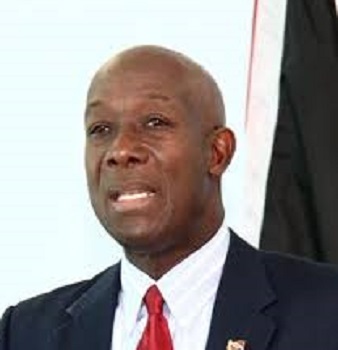
PORT OF SPAIN, Trinidad, Jan 31, CMC –Prime Minister Dr. Keith Rowwley Monday said he wants to see in the future, a Trinidad and Tobago where the benefits of digital technology is fully utilized in the public and private sector in such a way that there is greater ease of doing business, in keeping and easily using databases that are secure in the everyday life.
Addressing a Public Sector Leadership for Digital Transformation Workshop, Rowley told the participants he was also has a vision of a transformed, digitalized public service with features that would include an integrated system for management of data to allow for the development of relevant and impactful solutions while underpinning data driven policy making in the country as well as a unique identifier for every citizen so that they can be assured of equitable access to public benefits and services.
He told the workshop being held in collaboration between the Ministry of Public Administration and the Inter-American Development Bank (IDB0 that he also envisions government services that are provided quickly and cost-efficiently, minimizing waste and duplication and in an environmentally responsible manner;
He said the new vision should also allow for an assault on white colour criminal conduct ,which currently flourishes with impunity, but which will wither if access is digitally controlled and recorded and information in the form of evidence identifies who did what, where, when, how and under what authority.
“I want us to envision a service that is designed and driven to develop the capacity of its workers and offers personal growth and professional fulfilment, which will lead to the creation of a cadre of elite professionals in their respective fields;
“A service with institutions which are consistently learning and adapting their service delivery models to meet the changing demands of citizens (and) a service which is a source of pride for its members and where leaders, especially managers are decisive, goal-oriented and future-focused,” Rowley said.
He said that he regards the leaders of the public service as the drivers of change who can bring this vision to reality for their fellow citizens, colleagues and stakeholders in the national community.
“That is why we are starting this conversation with you. We need you to understand, embrace, lead and champion this evolution. Our goal will be to support your continued development. Given the rapidly evolving digital environment, we will all need to constantly embrace learning and capacity building, new knowledge, as well as critical thinking and listening skills in order to ensure we are agile and responsive to the needs of the citizens.”
He said it is in this context that he views the workshop as a pivotal opportunity to open a new chapter in shaping the future of the Trinidad and Tobago Public Service and the country at large.
“I want to challenge every leader in this room to dream and envision what we can offer to our fellow citizens, to make their lives easier and your lives easier too. Don’t be afraid that you might make mistakes. We need to learn from our mistakes and successes, and we need to grow.
“We know this is a thankless job in an environment where achievements and high-impact solutions are rarely recognized, and failures are readily highlighted and publicized. But this is the work that needs to be done. This is the work that we are called at this moment to do. Adopt a “can do” attitude in order to positively impact the quality of life of the many thousands who depend on you and your department.”
Rowley said he believes that the opportunity to leverage technology has the potential to be a game changer than can fundamentally transform the local economy and the way that public services are provided to citizens.
In his address, Rowley said that Trinidad and Tobago, like all others countries at this time, is confronted with more and more complex challenges of governance.
He said as a small open economy, the country is not immune to the devastating effects of the coronavirus (COVID-19) pandemic which “we are still battling today on the economy, public health, education, business, citizen security and even on our cultural identity and the very social fabric of our nation.
“Within the context of these challenges, which are global in nature but affect us acutely here at home, sound leadership is necessary to navigate in circumstances of limited resources, legacy systems and rigid structures developed for a colonial model of operations.”
He said the pandemic had also allowed for people to begin adopting new ways of working, new ways of collaborating and new ways of delivering services.
“How many of us here adjusted seamlessly to virtual meetings,” he asked making reference to various initiatives adopted throughout the public and private sectors.
“Indeed, we have seen some of the benefits of harnessing technology in our ministries and in our ability to serve the public. While much remains to be done, we have clearly demonstrated in many arms of the State, that we can in fact do it,” he added.
CMC/gf/ir/2022