
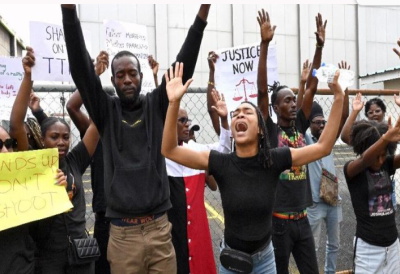
PORT OF SPAIN, Trinidad, Jun 3, CMC -Prime Minister Kamla Persad-Bissessar has blanked calls by at least 11 trade unions that have threatened legal action against the Trinidad and Tobago government demanding the immediate withdrawal of State of Emergency (SoE) regulations that establish 15 “no-protest zones” nationwide.
“I suggest that the unions should focus on working with the government on issues that would actually benefit their members. Every citizen can protest anywhere in the country besides these 15 places,” Prime Minister Persad-Bissessar told the Trinidad Express newspaper.
“The (Director of Public Prosecutions’) office, the two airports, the Port, Defence Force headquarters, Trinidad and Tobago Police Service headquarters, Ministry of Finance, President’s House, etc, are high-security areas so you can’t have large gatherings in front of these places that gangs may infiltrate. It’s just common sense,” she added.
Last week, a legal notice signed by Police Commissioner, Allister Guevarro, indicated that the 15 no-protest zones includes the Parliament and Parliamentary Complex, the Office of the President, the Office of the Prime Minister, the Diplomatic Centre, the Office of the Attorney General, the Ministry of Finance, the Ministry of Defence and the Ministry of Homeland Security.
The notice came amidst the protests there in recent weeks over the police involved killing of a 31-year -old man on January 20 this year.
Last week, President General of the National Trade Union Center (NATUC), Michael Annisette, described as a “sad day” in the country when the rights of citizens and unions are being taken away.
“It has no place in a democratic society. We must allow peaceful protestation. It has nothing to do with the institution. If the institution is wrong, the right to protest is more fundamental than anything in my humble view,” Annisette said.
Speaking at a news conference on Tuesday, President of the Trinidad and Tobago Unified teachers Association (TTUTA), Crystal Ashe said the unions’ immediate concern is what they describe as sweeping limitations on citizens’ constitutional right to protest.
“Our main focus here today would be the 15 identifiable locations that we are prohibited from protesting, and that is why we’re here,” Ashe said, with the unions maintaining that there remains broad consensus across the labour movement on the need to protect workers’ rights and democratic freedoms.
Absent from Tuesday’s news conference was the president of the Joint Trade Union Movement (JTUM),Ancel Roget.
Persad-Bissessar told the Express newspaper that her government, which came to office in April last year, remains focused on governance and that “citizens are free to protest, free to shut down the country or free to turn up to work on any day.
“In our society citizens are allowed to pursue their individual choices within the law. At the end of each month, every individual has to pay their bills and therefore they should make choices that best suit them,” she said.
She told the newspaper that she is “not going to allow gang members to infiltrate legitimate protests and congregate in front high-security buildings like the airports and DPP offices”.
She said that the National Security Council will make a decision shortly based on the available data as to whether or not the existing SoE, which was declared on March 3, 2026 after the authorities said that intelligence reports had warned of criminal and gang networks operating both within and outside correctional facilities.
The SoE is due to end this month.
CMC/af/ir/2026