
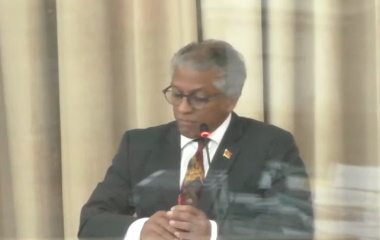
PORT OF SPAIN, Trinidad, May 10, CMC – Attorney General Reginald Armour Wednesday said the state would be filing an application for an urgent hearing of its appeal in the matter in which a High Court judge here said a Trinidad and Tobago national had been “abducted” in Barbados and brought back to Port of Spain to face criminal charges.
He told the Parliament that application is asking the Court of Appeal to hear this appeal
“urgently in priority over all other appeals, for national security reasons and, to correct the grave errors made by the trial judge so as to permit the Trinidad and Tobago Police Service (TTPS) to continue to do their work to protect and serve the citizens of this Republic”.
Armour said that for the record, he gave the Parliament a brief summary only of that appeal but no more.
“Beyond that I will not comment on the arguments which will be made by Counsel representing the Attorney General before the Court of Appeal, except to say that, so urgent is the need for a definitive final appellate adjudication in this matter, that I have already given instructions to London Solicitors to retain English Counsel from the outset so that that that Counsel may become immediately and fully apprised of this matter.”
He said this is to allow them “to become fully up to speed, ensuring that howsoever
this appeal is determined by our Court of Appeal, we are ready immediately to protect the State of Trinidad and Tobago by urgent access to our final court of appeal, the Judicial Committee of the Privy Council.”
The announcement by Armour follows Tuesday’s statement in the Barbados Parliament by that country’s Attorney General, Dale Marshall that no request had been made for the extradition of firearms dealer, Brent Thomas, whom a Trinidad and Tobago judge said had been “abducted” by police in the neighbouring Caribbean country.
Marshall, in a lengthy statement to his Parliament described as “unfortunate language” the Trinidad and Tobago High Court characterization of what transpired in Barbados on October 5 last year in relation to Thomas.
“I can confirm that no request was made for the extradition of Mr. Thomas,” he told legislators, adding “from the reports that I have received, I am satisfied that the actions of the Barbados Police Service have fallen short of applicable legal norms, such as acting under an extradition request.
“I, however, cannot associate myself with the description of the actions of the Barbados Police officers as an abduction or as has been elsewhere been described as a kidnapping,” Marshall added.
He said it is evident that the Barbados Police Service sought to assist a sister Police service in a matter “which appeared to them to be of a grave and important nature, and especially so, given the scourge of firearm violence that is a feature in Barbados and across the Caribbean. “It is my view that they rendered that assistance without any mental element of criminality that would be associated with an abduction.”
In his ruling Justice Devindra Rampersad found that the detention and transporting of Thomas from Barbados to Trinidad and Tobago via a non-commercial aircraft constituted an “abduction”, and ruled that Thomas’ constitutional rights had been breached and that his arrest and detention were therefore “unconstitutional, unlawful, arbitrary, unnecessary and disproportionate”.
But the state in its appeal is arguing that constitutional protection offered by the Constitution does not extend extra-territorially, and is therefore not applicable to events taking place in Barbados and to the Barbados police.
Thomas was first arrested on September 29, 2022, and later released. He was re-arrested in Barbados, from where he said he intended to travel to Miami to meet his cardiologist, and returned forcibly to Trinidad and Tobago.
He was later charged with possession of a series of weapons, including grenades and rifles.
Thomas had in a constitutional motion challenged his detention and the procurement of search warrants for his home and his dealership.
Armour told Parliament the main ground of appeal is that the trial judge did “not conduct a fair, dispassionate, proper and correct analysis of the evidence and the applicable law”.
He said the state is arguing that the judge failed to “properly consider or disregarding a
proper construction of the Constitution of Trinidad and Tobago and having regard to the
sovereignty of other nations.
He said the judge also failed to properly apply and interpret the law contained in the Firearms Act and that there was judicial overreach and breach by the judge of the separation of powers;
The state is arguing that the judge also failed to properly take into account and/or
disregarding material evidence.
Armour said that there was also a “beach of the principles of fairness and natural justice by prematurely making findings of fact and drawing adverse inferences against the police officers in respect of their conduct and motive when there were conflicts of fact between what the Respondents said and what the police officers said and which were not tested or resolved by cross-examination.”
Armour said that on more than one occasion in his judgement the judge found, both as a matter of fact and law, that Thomas was “abducted” through the agency of the TTPS and the Royal Barbados Police Force from Barbados.
“There can be no criminal offence of abduction, involving criminal intent, unless such
criminal intent was shown, beyond reasonable doubt to have been present in the minds of the
officers of the Trinidad and Tobago Police Service.
“Criminal intent is necessary to justify a conclusion of the criminal offence of “abduction,” Armour said, telling Parliament the evidence was to the contrary.
He said also there is the “undisputed evidence of the Director of Public Prosecutions, Roger Gaspard,” who swore an affidavit on oath in the proceedings before the judge on January 6 this year.
Quoting from what he termed to be the “undisputed, uncontradicted affidavit evidence” of the DPP, Armour said the TTPS sought legal advice from Office of the Director of Public Prosecution (OPDD) on October 2 and 4 last year.
“Further ASP [blank] has at paragraph 77 of his affidavit disclosed that advice was
sought from the ODPP concerning charges and Mr.Thomas’ returning to Trinidad and Tobago on the 5 October 2022.
“Officers of the Professional Standards Bureau of the TTPS sought legal advice in relation to some of the contemplated charges and arrest warrants. On both occasions I was out of the jurisdiction. As a result, Mr. George Busby, in his capacity as then Acting Director of Public Prosecutions met with officers of the TTPS.”
Armour quoting from the affidavit noted that the DDP had indicated that “after each meeting, Mr. Busby contacted me relaying in summary the information which was presented to him and informing me of the advice which he intended to give.”
““Further in relation to the issue of charges, Mr. Busby informed me, and I verily believe that he was unable to render an opinion on the basis that he did not have sufficient information presented to him in the meeting on 2 October 2022 to so do.
“It is important to note the fact that Mr. Busby did not have sufficient information from his
conversation with the officers to advise on charges does not mean that there was not sufficient cause and/or evidence to support charges.
“It was within the discretion of the TTPS who had all the information and who had conduct of the investigation to decide that they had sufficient information and evidence within their possession to charge,” the DPP said in his affidavit.
In the affidavit, the DPP said that Busby was able to advise on the issue of the arrest
warrants.
“Mr. Busby informed me, and I very believe that the advice given in respect of the arrest warrant did not touch on the issue of how those arrest warrants ought to be effected or executed.
“Further, I am informed by Mr. Busby and very believe that his advice, in this regard, was for the TTPS to communicate the existence of those arrest warrants to the Barbados authorities, so as to have Mr. Thomas arrested.
“No advice was given as to how the rest was to be done in Barbados or how, if arrested, Mr. Thomas was to be returned to this jurisdiction”
Armour told Parliament that “at this stage I say no more on this.
“No doubt, this affidavit of the Director of Public Prosecutions will be considered by the Commissioner of Police as she concludes her investigation into the actions of members of the Trinidad and Tobago Police Service,” he added.
CMC/gh/ir/2023