
PORT OF SPAIN, Trinidad, May 25, CMC – Several groups say they are concerned over the decision of the police to charge the common law wife wife of 31-year-old man, who was shot and killed during a police shootout in January
The groups including the Caribbean Association for Feminist Research and Action Trinidad and Tobago (CAFRA TT), the Emancipation Support Committee Trinidad and Tobago (ESCTT), The Caribbean Freedom Project, Caribbean Feminist, The Woven Foundation, Feminitt Caribbean and Artists’ Coalition Trinidad and Tobago (ACTT) said that the video footage of the incident, which has been circulated publicly, has raised serious questions about accountability, transparency and public confidence in the justice system.
In a joint statement, the groups said in the absence of a clear explanation as to how Kaia Sealy is being accused of causing Joshua Samaroo’s death, the public may reasonably suspect a cover-up.
“To avoid this conclusion and in the interest of public trust, the Police Service and/or the Office of the Director of Public Prosecutions from whom the police reported that they took advice, owe the public an explanation of why she is being held accountable,” the statement said.
Last weekend, the lawyer representing the 31-year-old woman, said her client “is shocked and deeply distressed “ at the decision of the police to issue warrants for her arrest on charges including manslaughter.
Attorney Fayola Sandy in a statement issued on behalf of Kaia Sealy had become aware of the police statement indicating that warrants have been obtained for her arrest arising out of the tragic events in January.
The Trinidad and Tobago Police Service (TTPS) said warrants had been issued for the arrest of Sealy, following the January 20 when police fired upon a vehicle in which they were travelling in Valsayn, east of here.
She has been charged with three counts of shooting with intent to cause grievous bodily harm at the police, manslaughter with police alleging that Sealy, who was shot multiple times during the incident and left paralysed, unlawfully killed Samaroo, in addition to other related charges.
“At this time, the warrants have not yet been executed. Further updates will be provided as developments occur,” the police said in the statement.
CCTV video had captured the January 20 incident showing police officers opening fire on a car following a crash, killing Samaroo, 31, and leaving Sealy, who was seated in the front passenger seats, critically injured and paralysed
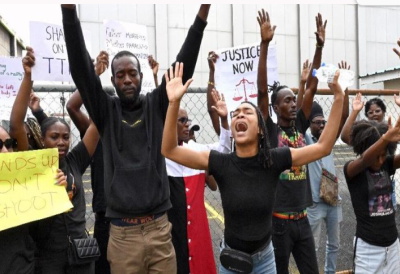
On Sunday, several protesters gathered outside the police headquarters in the capital, calling for the resignation of Police Commissioner Allister Guevarro and Homeland Security Minister Roger Alexander.
The protest organiser, Allyssa Phillip, said Sealy was being used as a “scapegoat”.
“They want Kaia Sealy to be responsible for their damages. The Commissioner of Police said from inception that he would be protecting his officers. This means to me that he will go to any length to defend his officers whether they are right or wrong,” Phillip said, adding that the protest was the 15th in a planned series of 19 protests, representing each bullet that struck that struck Samaroo.
The protesters, shouting “Shame on the TTPS”, “Shame, Shame”, “Guevarro must go” and “Alexander must go”, carried placards that read “We saw the video”, “Injustice anywhere is a threat to justice everywhere”, “We demand truth, not cover up”, and “The next Joshua could be you”.
In their joint statement, the civil society groups where civilian injury or death occurs during police operations, there must be a heightened obligation on the state to ensure a transparent and impartial investigation capable of withstanding public scrutiny.
They called for a series of measures, including a transparent and independent investigation into the incident; timely public communication explaining the basis on which charges were or are to be laid, strengthening the role of the Police Complaints Authority in cases of alleged extrajudicial killings and the immediate protections for the rights and dignity of survivors and affected families.
Deputy Commissioner of Police, Operations, Suzette Martin, said that the police had acknowledged the presence of the protesters and that ‘while protests are not expressly prohibited under the current State of Emergency (SoE), all public gatherings must strictly comply with the Emergency Powers Regulations.
“The TTPS has a statutory responsibility to maintain public safety and preserve public order. Where any gathering presents a potential risk to either, officers are duly empowered to take appropriate and proportionate action, including the lawful dispersal of such assemblies.”
She said in this instance, officers engaged the individuals present and issued “clear, lawful instructions in accordance with the Emergency Powers Regulations.
“The decision to disperse the gathering was based on assessed concerns relating to public safety and the maintenance of order. Members of the public are reminded that the Emergency Powers Regulations confer broad authority on law enforcement to regulate, restrict, or disperse assemblies where necessary”.
She said that key provisions include the Commissioner of Police may restrict the association or communication of individuals and prohibit entry into specified areas adding that any location may be designated a “protected place,” rendering unauthorized entry an offence and permitting police to search or remove persons from such areas.
“Public speech, organizing, or advocacy activities connected to protests may fall within offences where such actions are deemed capable of influencing public opinion in a manner detrimental to public safety,” she said, adding “protest activity, particularly in the vicinity of police stations or other sensitive locations, must comply strictly with public order laws and SoE regulations.
“The public is further advised that breaches of the Emergency Powers Regulations carry significant penalties, including fines of up to TT$100,000 (One TT dollar=US$0.16 cents) and imprisonment for up to five years.”
Meanwhile, former police commissioner, Gary Griffith, said there were several questions to be answered in relation to the shooting incident.
“To be clear, I am not here to adjudicate the case or pronounce guilt or innocence one way or the other…I have the utmost respect and confidence in the DPP, after working with him as a Security Minister and Police Commissioner,” Griffith said, outlining 10 points for the public to consider.
“Seeing that the suspect is being charged with weapon possession and firing, was Gunshot Residue [GSR] tested on her hand whilst she was in the hospital for six days after the incident?
This would verify the statements by the officers, and this matter would end.
“If it was not done, then this means either incompetence at the highest level, or they knew very well that there was no GSR to be found on her hand,” Griffith said.
“ If a weapon was discovered in the vehicle and she is accused of firing that weapon, the question must be asked as to whether fingerprint extraction was carried out on the said weapon, and whether it was similar to Miss Sealy’s fingerprints,” Griffith wrote, adding “the reason I ask is that I have been advised that no fingerprints were taken from Miss Sealy”.
He also asked Police Commissioner Guevarro to answer whether Sealy was advised that “ she was a suspect for weapon possession and the use of a weapon when initially held for six days?”
CM/fh/ir/2026