
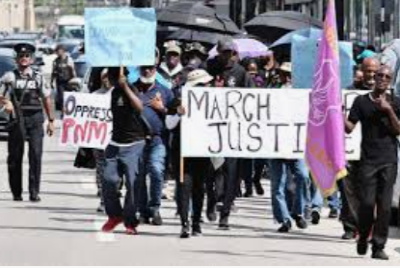
PORT OF SPAIN, Trinidad, Jun 12, CMC – The National Trade Union Center (NATUC) says it remains “deeply troubled” by statements made in Parliament earlier this week by Prime Minister Kamla Persad-Bissessar defending the decision regarding the restrictions on public demonstrations and the constitutional rights of citizens to “peacefully assemble”.
“With respect, the Prime Minister’s argument that citizens retain access to 99.77 per cent of the nation’s land misses he fundamental issue entirely. Democracy is not measures in kilometers.
“It is measured by the ability of citizens to exercise their rights in a meaningful and effective manner. The question before Trinidad and Tobago is not how much land remains available for protest. The question is whether citizens are free to peacefully to assembly within sight and sound of those who hold political power and make decisions that directly affect their lives,” NATUC said in a two-page statement.
Prime Minister Persad-Bissessar, whose government enjoys a significant majority in the Parliament, had this week received support to extend the existing state of emergency (SoE) by a further three months”.
During her contribution to the debate, Persad-Bissessar dismissed claims that the regulations banning protest action outside a number of government buildings including the Parliament, the official residence of the Prime Minister, the Ministry of Finance and the Office of the Director of Public Prosecution (DPP) infringe upon the rights of citizens to protest.
She told legislators that the restrictions affect only a fraction of the country’s land area and that while Trinidad and Tobago comprises approximately 5,131 square kilometres, the exclusion zones surrounding the 15 protected sites total an estimated 11.77 square kilometres, or 0.23 per cent of the entire territory.
“Any lawyer doing Law 101 knows that no rights are absolute. Constitutional rights are never absolute,” the senior counsel told Parliament on Wednesday night, adding that freedoms such as speech, assembly and association are all subject to regulation, particularly during a State of Emergency authorised under Sections 8, 9 and 10 of the Constitution..
“So when you speak about freedom of assembly, it could never be that everybody will assemble in the same place at the same time. There are regulations. These are regulated. There’s no absolute freedom,” she said.
“The Constitution itself provides for when these rights can be overshadowed or regulated. So we are working within the confines of the Constitution,” Persad-Bissessar said.
In its statement, NATUC said a protest relegated to distant locations where it cannot be “seen, heard or felt by decision makers defeats the very purpose of democratic expression.
“The right to peaceful assembly is not simply a right to occupy physical space; it is a right to communicate dissent, advocate for change, and hold authority accountable,” NATUC said, adding “throughout history, progress has never been achieved through silence”.
The umbrella trade union body reminded the government that the real issues facing the country “are rising crime, economic uncertainty, job insecurity, growing inequality, declining public confidence in institutions, and the widening disconnect between decision-makers and the people they serve.
“These are the concerns driving people into the streets,’ NATUC said, adding that “strong democracies do not fear public dissent”.
Meanwhile, a coalition of13 trade unions has expressed disappointment with the response of Prime Minister Persad-Bissessar to a letter in which they sought to get the government to re-think its policy.
“These people delivered a letter to my office yesterday and a response will be forthcoming,” she said. “You’re outside the Office of the Prime Minister and you’re saying you cannot protest, but you’re out there.”
But the coalition accused the government of being dismissive of concerns about civil liberties and democratic participation.
“It is quite unfortunate that the Prime Minister and her Government continue to be dismissive of this intentional erosion of our civil liberties,” the group said in a statemen, adding that the issue is not the amount of physical space available for demonstrations, but whether citizens can effectively communicate their concerns to decision-makers.
The coalition also defended the historic significance of Woodford Square in the heart of the capital and one of the locations affected by the restrictions.
“Woodford Square is not just a location. It is a symbol of our democratic history,” the statement said, citing its role in the labour uprisings of the 1930s and the Black Power movement of 1970.
CMC/cjm/ir/2026