
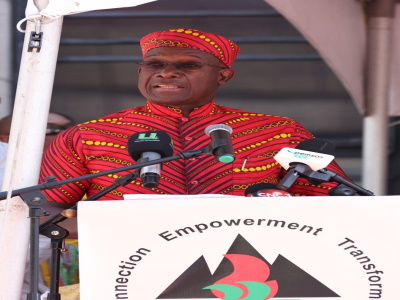
PORT OF SPAIN, Trinidad, Aug 1, CMC – Trinidad and Tobago is observing the 185th anniversary of the abolition of slavery with Prime Minister Dr. Keith Rowley urging Europe to meet its commitment to paying reparation and saying Port of Spain is appreciative of the visit of the Ghanaian Ashanti King, the Asantehene Otumfuo Osei Tutu II for the occasion.
The King is taking part in a series of events here until August 4, including a lecture on Thursday at the St. Augustine campus of the University of the West Indies (UWI).
Rowley, speaking at the Emancipation Day Celebrations, said the slave trade had resulted in sending “forcefully…millions of African people to this side of the globe…disconnecting us from our African ancestry.
“For us, the concept of History was Europe’s; History was theirs, and it was ours. We were told and taught, for many years, that Africa was a “dark” continent; its people primitive, for some, even subhuman; its civilization, also dark, foreign, and in many references, it did not even exist. In the eyes of some, even today, the melanin in our skin condemned us to derision and discrimination.”
He said the celebrations today are significant “particularly, to our younger generation, many of whom are witnessing and discovering, for the first time, the presence, stature and majesty of African royalty in our midst.
“Hopefully, from today, the word “their” which implies something foreign, other, or of distant ownership, will be changed and we will begin to share, and embrace every aspect of both our lives as “Ours” — meaning that on both sides of the Atlantic, African people will see the “one-ness” that we carry within us. Then, we will be separated only by the narrowing waters of the Atlantic.”
Rowley said historians on both sides of the Atlantic have written volumes on the tortuous experiences of our ancestors, who, in some parts of the Americas, were equated with animals in the fields, to be flogged, bought and sold and the idea of family was erased with extreme brutality.
“Enslavement over some four hundred years, meant not only dawn to dusk work in those fields, but a destruction of all of a slave’s cultural support – his or her personhood, their family systems, religion, music, art, language, etc. this being our lot, the concepts of ownership, asset and wealth were clearly not for us.”
But he told the visiting King that he would no doubt, be familiar with the continuing efforts and appeals to the former European colonisers regarding reparation for the slave trade.
“Some, the direct beneficiaries of this holocaust, prefer to write new revisionist history to pretend that it didn’t happen, some pats us on the shoulder to say “let’s just move on, it couldn’t be all that bad” and most recently, boldfaced morons are now even suggesting that we should be grateful for the “benefits that were bestowed” upon us by slavery through language and aculturisation.
“But, in spite of Europe’s calculated attempts at de-humanising us, there was always resistance. As C.L.R. James, one of Trinidad and Tobago’s foremost literary figures concluded, African slaves fought back, powerfully, with the contents of their minds … the memories, the logic and resilience of their people.”
Rowley said that Trinidad and Tobago created, and given the world various cultural forms, including the steel pan and calypso that “have gone on to influence other musical forms, even in Africa.
“We have done so, creating the world’s first gas-based economy, developed innovations in the oil industry; established the world-class Point Lisas Industrial Estate. We can cite our achievements in sport, literature, education, and many other fields, with our scholars occupying major positions around the world.
“We are also proud that, after serving on the UN Security Council at an earlier time, this September our country will assume the Presidency of the United Nations General Assembly.”
But he told the King that he is “personally interested” in Trinidad and Tobago and Ghana further developing the hydrocarbon business, that had been discussed earlier, adding “there could be some measure of continuous collaboration and exchange between your University, and our University of the West Indies, and the University of Trinidad and Tobago, as both of our regions continue to focus on the advancing technologies and other disciplines, in this, the 21st century”.
CMC/ag/ir/2023