
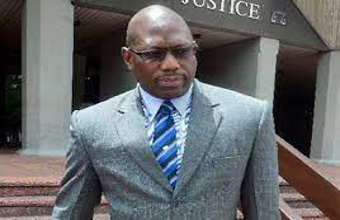
PORT OF SPAIN, Trinidad, Jun 27, CMC – The Director of Public Prosecutions, (DPP), Roger Gaspard, says he will take the public’s interest into consideration before making a decision on the future of the state’s two-decade-old corruption case against former government ministers and public officials and several businessmen and companies that had been thrown out by the Privy Council.
The cases against the accused stemmed from the construction of the Piarco International Airport, and the Privy Council, the country’s highest and final court, in a 26-page ruling noted that the January 2008 decision of the now-deceased Chief Magistrate Sherman McNicolls to commit the accused to stand trial was tainted by apparent political bias.
According to Privy Council, McNicolls should have recused himself from what is known as the Piarco 1 inquiry – one of four inquiries related to the development and construction of the Piarco International Airport between 1997 and 2000.
Gaspard is quoted by the NEWSDAY newspaper on Tuesday as saying “this is not an automatic decision, this is something that requires more mature consideration.
“Whatever decision is made, fairness must be the touchstone,” he said, noting that the decision had only been handed down on Monday.
The DPP said he will have to take into consideration to proceed in the public’s interest, according to the code for prosecutors. These are whether there is sufficient cogent evidence available, after the passage of so much time; the availability of witnesses; the fading memory of witnesses; the death of some state witnesses; the severity of the crime; the age of the matter; the parties involved; the breach of trust; and the allegations that directly affect public funds.
If the DPP feels the evidence meets that threshold, he can direct the matter to restart, But if he does not, the matter ends there, the newspaper reported.
Section 90 (3)(c) of the Constitution gives him the sole discretion “to discontinue at any stage before judgment is delivered any such criminal proceedings instituted or undertaken by himself or any other person or authority.”
The Caribbean Media Corporation (CMC) has so far been unable to get a comment from Gaspard on the Privy Council ruling.
In its ruling on Monday, the Privy Council linked McNiolls’ conviction of former prime minister Basdeo Panday on corruption charges, the move to impeach former chief justice Satnarine Sharma, McNicolls’ corruption claims against Sharma and the intervention of former attorney general John Jeremie, and contended that there was sufficient information in the public domain to support a claim of apparent bias.
“When all the various sources of concern are considered together, the observer would be likely to agree with the appellants’ submission that by January 2008 the Chief Magistrate was hopelessly compromised,” the Privy Council said.
The charges in the Piarco 1 case stemmed from a multi-million-dollar investigation by Canadian forensic investigator Robert Lindquist in 2000. Two years after that probe, former finance minister Brian Kuei Tung; former national security minister Russell Huggins; the now-deceased former National Insurance Property Development Company Limited (NIPDEC) chairman Edward Bayley; maritime executives John Smith (deceased), Steve Ferguson and Barbara Gomes; Ishwar Galbaransingh and Amrith Maharaj, chairman and financial director of Northern Construction Ltd, respectively; and Northern Construction Ltd. businesswoman Renee Pierre who was Kuei Tung’s girlfriend at the time were charged in connection with the alleged theft of TT$19 million (One T dollar=US$0.6 cents) related to the airport construction.
Piarco 2 concerns similar allegations against Kuei Tung and another former United National Congress (UNC) Minister along with a number of UNC supporters. The inquiry is still to be concluded. In Piarco 3, Panday was alleged to have received a corrupt payment. Piarco 4 involves Kuei Tung’s partner. No trials relative to those proceedings have taken place.
In December 2007, Smith, Gomes and other defendants in the Piarco 1 inquiry applied to the Chief Magistrate to recuse himself by reason of the appearance of bias, or alternatively, to refer the matter to the High Court for constitutional relief.
The Chief Magistrate refused the applications and committed them to stand trial in January 2008. The appellants challenged the Chief Magistrate’s ruling on the recusal applications and other aspects of his conduct of the preliminary inquiry by way of judicial review and constitutional motion. Those proceedings were rejected by the High Court in 2009. They subsequently appealed to the Court of Appeal, which rejected their appeal in 2017 before the matter was taken to the Privy Council which is Trinidad and Tobago’s highest appeal court.
In allowing the appeals and quashing the decisions of the Court of Appeal, the Privy Council said: “In each case, it erred by failing to hold that the test for apparent bias was satisfied and that recusal should have followed. Both the application for judicial review and the claim for constitutional relief are granted with the consequence that the Piarco 1 committal decision of 7 January 2008 falls to be quashed. Any other consequential matters are remitted to the High Court.”
CMC/ed/2022