
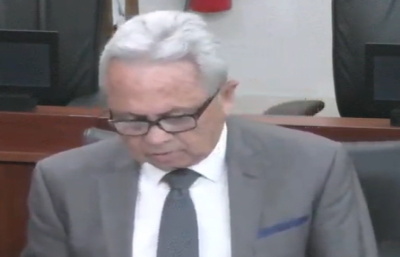
PORT OF SPAIN, Trinidad, Jun 15, CMC- Former finance minister Colm Imbert Monday warned Trinidad and Tobago to be prepared for increased hardships in the coming months as the United States and Iran have reached a deal to end their war in the Middle East.
Imbert told the Parliament during the debate on the TT$2.93 billion (One TT dollar=US$0.16 cents) supplementary budget presented by Finance Minister Davendranath Tancoo that the government-socio-economic policies had been based on the high energy prices associated with the war.
Imbert said that while Tancoo spent very little time talking about the latest actual report of the US-based ratings agency, Moody’s, in effect the agency was indicating that Trinidad and Tobago is “at the same place that we were in May of 2025.
“I have in my possession the rating action from Moody’s dated 12 June 2026, and it reads as follows, the change in outlook to stable from negative reflects improved near-term external prospects driven by higher projected oil and gas prices.
“That’s all it is. America decided to attack Iran together with Israel, oil prices went up and as and as a result of oil prices going up and the uncertainty of that particular war, the prediction for enhanced revenues caused by the war has led Moody’s to upgrade or revise, not even upgrade because the credit rating remains the same.
“Now let’s look at the situation with respect to what’s happening in the world. Let’s look at what was happening in the world before the attack on Iran. What did the U.S. Energy Information Administration predict for the price of oil in 2025?
“The prediction at the end of 2025…they predicted that for 2025 and 2026, oil prices would be in the US$60 range. What are they saying now? Because the Strait of Hormuz is now blockaded, because tankers are not getting through, because 20 per cent of the world’s oil goes through that particular strait, oil prices have risen to US$90, US$95”.
But Imbert said that the increase has nothing to do with the government fiscal policies.
“I’m glad for the country, I mean, I’m not glad for the people in the Middle East, I can’t be, but I’m glad for the country that a war that broke out in the Middle East will help us to get increased revenues.”
But Imbert reminded legislators that Tancoo had earlier indicated that the increase in revenue will be $381 million, adding “I suspect he’s understating the numbers deliberately…He claims that the fiscal deficit will now rise from $3.8 billion to seven billion dollars. We told him that in October of 2025.”
Imbert said that he had predicted that the government would say that a supplementation bill is abnormal.
“That’s not what’s abnormal, Mr Speaker. What’s abnormal is that a government cooks the books, projects a false deficit, knowing fully well that they had to come back later in the year and supplement the appropriation by billions of dollars. That is abnormal. That is abnormal.
“The Minister is now confessing that the deficit this year will be at least seven billion dollars. I suspect it will be more…I suspect, because the non-energy sector is simply not generating the revenue that it should.”
Imbert said that the non-energy sector, and contrary to everything Tancoo has said “ this government is laying the foundation for economic resilience”.
Imbert said that an examination of the report by the Central Bank of Trinidad and Tobago in its latest review of the economy published in March this year the index of retail sales fell year on year in fiscal 2025, “a third straight negative quarter”.
“This is what they are saying. Retail sales are down, cement sales are down, construction has slowed down…and what you are seeing is a contraction in the non-energy sector. You have a situation where the non-energy sector is contracting by as much as 10 per cent.
“So all this old talk, if that war did not occur in Iran, what would be the government telling us today? They would probably be telling us there would be a deficit of TT$20 billion in fiscal 2026. They would probably be telling us that they can’t manage.
“They would probably be telling us they come to impose new taxes. You see, it is easy to talk, but when you go through the Moody’s report, you see that the worst performing sector of our economy…is the non-energy sector.
“The worst performing sector of our economy is the non-energy sector. Credit and money are decelerating,” Imbert said, adding that the Central bank report also indicated that private sector growth is slowing.
“It has slowed from eight to five per cent. The local equity market, which is an indication of confidence in the economy, the stock exchange, the stock exchange has dropped 12.5per cent in total value year on year under them.
“Look at bank shares, look at shares of conglomerates, look at shares of manufacturing companies. They have all collapsed under this government over the last 12 months. These are facts that I notice the Minister did not talk about.
“That credit growth has slowed down, that the non-energy sector has collapsed, that the stock exchange has collapsed…and all of us who have share…would have seen the loss in value of our portfolios over the last 12 months under this government.”
He said that the foreign reserves have dropped to $4.7 billion towards the end of the year.
“They had a little bump when they went on the international market and raised one billion US dollars in a bond, but they have a payment coming up in August where they will have to pay US$400 million.
“That will come out of our reserves. It will depress our foreign reserves even more. Our reserves are now the lowest they have been for more than 15 years, The import cover is now the lowest that it has been for more than 15 years,” Imbert told legislators.
He said that one of the more astonishing things in this supplementation and variation legislation, is that in October last year, Tancoo came with “a lot of gusto, a lot of energy” in announcing the creation of an employment fund in the amount of TT$475 million.
He said this employment fund was supposed to in some way counteract the devastation that the government has unleashed on over 30,000 workers that were dismissed since April last year.
“That unemployment fund of $475 million was supposed to deal with that, even though it was inadequate. Wait, what have we seen? A whole nine months has elapsed and the excuse for not mobilising that $475 million is that it required legislation,” he said, adding that no such legislation has been brought to the Parliament even at this time.
CMC/a/h/ir/2026