
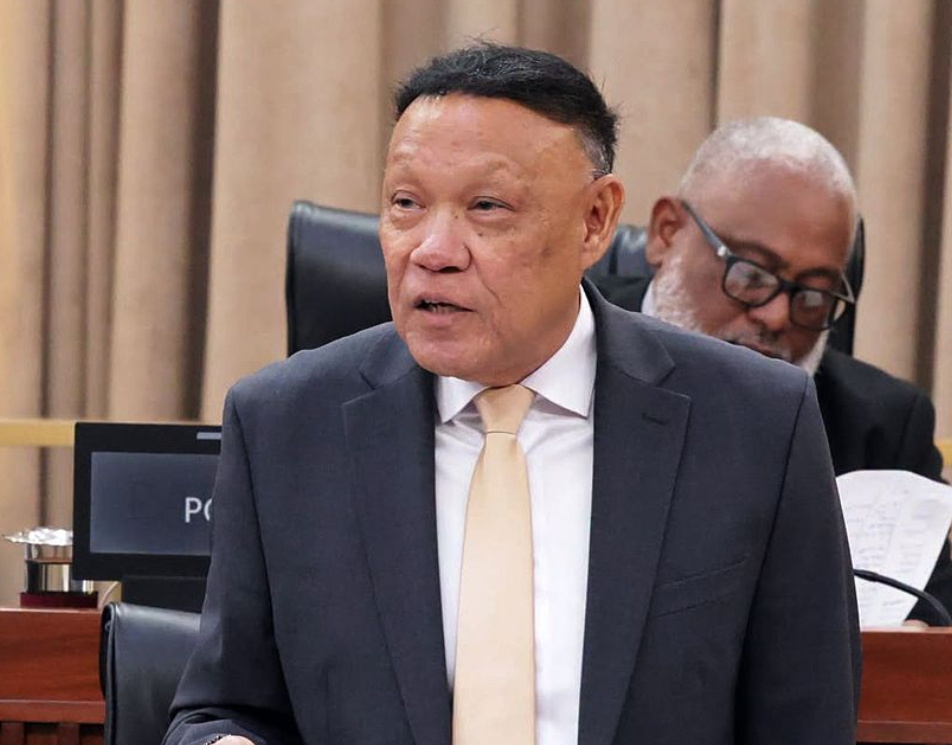
PORT OF SPAIN, Trinidad, Nov 6, CMC – A High Court judge has dismissed a challenge filed by Housing Minister David Lee over the method used by the Office of the Director of Public Prosecutions (DPP) to reinstate fraud charges against him in relation to the vehicle tax exemption as a legislator.
Justice Westmin James rejected Lee’s judicial review and constitutional claim against the DPP’s Office and the Office of the Attorney General in the civil lawsuit that is related to a criminal case brought against Lee and businessman Hugh Leong Poi in September 2022.
The duo had been accused of conspiring to defraud the State ofTT$1.4 million (One TT dollar=US$0.16 cents) in tax revenue, related to the importation of a vehicle valued at over two million dollars.
The taxes in the case include TT$293,094.02 in Value Added Tax (VAT), TT$298,650 in motor vehicle tax and TT$824,548.62 in customs duty. Lee was accused of falsely claiming the vehicle was his in order to claim tax exemptions entitled to him as a legislator.
The offences were alleged to have occurred between March 24 and June 8, 2019. Lee and Leong Poi elected to have a preliminary inquiry in the case before a magistrate instead of a sufficiency hearing before a High Court Master, after the Administration of Justice (Indictable Offences) Act (AJIPA) was proclaimed in December 2023.
In April last year, acting Chief Magistrate Christine Charles dismissed the charges against the duo, after their lawyers pursued a no-case submission claiming that there was insufficient evidence to sustain the charges and warrant a trial.
But several months later, the DPP’s Office successfully applied under the Indictable Offences (Preliminary Enquiry) Act (PE Act) for a High Court Judge to review the magistrate’s decision and reinstate the case.
In the lawsuit, Lee claimed that the DPP’s Office was not permitted to utilise the PE Act, as it was repealed by AJIPA. He also contended that his constitutional rights to equality before the law and protection of the law were breached by the DPP’s Office and the committing judge, as they cited “exceptional” circumstances, which he claimed did not exist, to resuscitate the case.
Lee argued that he should have been consulted before the DPP’s Office sought to challenge his discharge.
But the DPP’s Office denied any wrongdoing, noting that the PE Act still applied to cases such as Lee’s that were instituted before AJIPA was proclaimed.
In his ruling, Justice James agreed with the DPP’s Office that the proceedings against Lee did not automatically come to an end when he was discharged.
“Parliament plainly does not regard a discharge as ending the proceedings in either regime,” Justice James said, noting that Lee’s decision to elect a preliminary inquiry did not constitute a waiver of his rights.
However, he noted that it showed that both legislative regimes could work side by side during a period of transition, as intended by Parliament.
“And it answers the complaint of unfairness, since the applicant chose, with the advice of experienced counsel, the regime whose incidents he now criticises and enjoyed its advantages, including a no-case submission informed by the cross-examination of witnesses,” Justice James said, rejecting also complaint alleging that the actions of the DPP’s Office and the judge constituted an abuse of process.
“The presumption of regularity applies with particular force to the acts of a judge and the applicant’s suggestion that the judge treated his task as a “rubber-stamping exercise” is speculation, not evidence,” the judge said, noting that the DPP’s Office presented a complete transcript of the proceedings before the magistrate for the judge to consider.
The judge also found that Lee did not have a right to be consulted before the judge issued the warrant resuscitating the charges, and while he dismissed Lee’s challenge, Justice James still noted that the legislator can still take further legal action.
“Nothing in this judgment affects the applicant’s right to apply to the trial judge to stay the proceedings as an abuse of process, or to make any submission at trial,” Justice James said.
He did not order Lee to pay the State’s legal costs for the lawsuit based on its novelty and its potential impact on other similar cases.
CMC/jh/ir/2026