
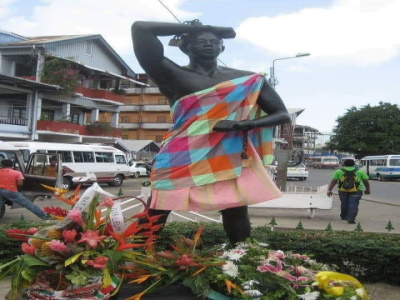
PARAMARIBO, Suriname, Jul 1, CMC – Suriname Saturday marked the 160th anniversary of the abolition of slavery with King of the Netherlands, Willem Alexander, apologizing for this very traumatic part of the colonial history of the European country.
“Ten kon draai, times have changed. The chains are truly broken”, said the Dutch monarch during the national commemoration marking the abolition of slavery in Oosterpark in Amsterdam to loud applause from those in attendance.
The address, which was carried live here, follows a similar apology made last December by Dutch Prime Minister, Mark Rutte, regarding the treatment of African nationals during the salve trade.
Deputy Prime Minister and Minister of Foreign Affairs, Wopke Hoekstra, represented the Dutch government during the commemoration here on Saturday.
In his address, King Alexander said the populations of Suriname and the Netherlands carry with them the horror of the slavery past.
“The consequences of this can still be felt today in racism in our society. On December 19 last year, the Prime Minister apologized on behalf of the Dutch government for the fact that people have been made commodities in the name of the Dutch state for centuries, were exploited and mistreated.
“Today I stand before you. As your King and as part of the government, I make these apologies myself today. They are intensely lived by my heart and soul. But for me there is also another personal dimension.”
The head of state said that the slave trade and slavery are recognized as a crime against humanity.
“The stadthouders and kings of the House of Oranje-Nassau have done nothing against this.
They acted within the framework of what was considered legal at the time. But the slavery system illustrated the injustice of those laws.
“The Second World War taught us that you can’t hide behind laws to the limit when fellow human beings are reduced to beasts and left to the the arbitrariness of those in power. At a certain point, the moral obligation to act grows.
“All the more so since slavery was strictly forbidden here in the European Netherlands. What was considered normal in the colonies and in overseas trade and was practiced and encouraged on a large scale, was not allowed here. That hurts,” King Alexander said, recalling also the struggle that Surinamese in the Netherlands have waged to enforce an apology from the Dutch state
“It is 60 years ago today that a group of Surinamese Dutch people went through the center of Amsterdam with banners that read ‘Ketie Kotie fri moe de (The chains are broken, freedom must reign)’. They lit the memorial fire that we keep burning today.
“This is an important day for everyone who has a connection with Suriname, including those whose ancestors came to the colony as indentured workers,” said the King, adding that he hopes the descendants of enslaved and forced labourers in other parts of the world would feel included in the commemoration ceremonies.
“That they also feel heard. People from the Caribbean part of the Kingdom. And the many Dutch people who have a connection with Indonesia and who carry the pain of gross injustice in the past with them.”
In a nation-wide address, President Chandrikapersad Santokhi welcomed the apologies made by the Dutch King.
“These apologies are a good start to the healing process and also provide opportunities to restart the relationship between our countries that will remain connected for a long time to come. We must use these apologies as a stepping stone to bring our peoples closer together. “We must also ensure that we act together to challenge economic inequality, to eliminate poverty, to meet the challenges of climate change and to ensure the elimination of every modern form of slavery, not only in Suriname or the Netherlands, but all over the world,” Santokhi said.
He said that Suriname’s national response to the apology is yet to come, and that the entire Surinamese population will have to work together in the near future on a widely supported answer.
Chairman of the National Assembly, Marinus Bee, noted that although actual freedom was only a fait accompli 10 years later, this important milestone in Surinamese history marks a turning point, on which various foundations of equality were laid.
“Today I would like not only to reflect on the abolition of slavery, but also to make the connection with the many migrations that have shaped our country into the multicultural society it is today. July 1, 1863 the chain of four hundred years of crime was broken, which was an important turning point, because at the same time the struggle for equality, justice and inclusion started,” said Bee.
He said the massive migratory movement following the abolition of slavery was unprecedented and testifies to the resilience and determination that the descendants of the enslaved Africans have inherited from their ancestors.
Bee said in the years shortly before and after July 1, 1863, these migrants brought with them a diversity of cultures, traditions and perspectives that enriched our country and shaped it into the melting pot it is today.
CMC/ic/ir/2023