
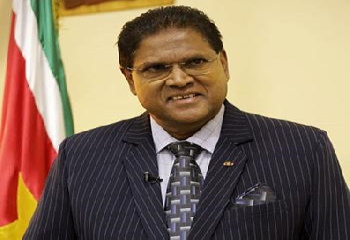
PARAMARIBO, Suriname, Apr 21, CMC – Chandrikapersad “Chan” Santokhi Friday urged the Surinamese population to put aside their various differences and work towards the further socio-economic development of the Dutch-speaking Caribbean Community (CARICOM) country.
In an address to the country marking Eid al-Fitr, which is one of two major holidays celebrated by Muslims around the world, Santokhi said the coincidence of the month of Ramadan, with the fasting period Navrati, in Hinduism, and the Easter of Christianity, gives an extra dimension to the month of Ramadan.
“After all, is this the best way to deal with our religious diversity? And we can proudly say that in nurturing religious diversity, we are an example to the rest of the world,” he said, noting that Suriname is not a country of polarization, and the various religious holidays make an essential contribution to appreciation, acceptance and tolerance for each other.
“As citizens of this country, we should be thankful to the Almighty for so much goodness to us. Because of this, we can better work on the spiritual and moral upliftment of the Surinamese people. Because differences in conviction should not be a barrier to living together as one people. And this is what makes our Suriname so unique among all the countries of the world,” he added.
He said that the Eid-ul-Fitr day, popularly known as ‘Bodo’ allows for people to be visiting family, friends and acquaintances that “will continue for days, regardless of ethnic or religious background.
“This is how we know the Eid-ul-Fitr; it contributes to the unity of our religious and cultural diversity. The feeling of togetherness at the Eid-ul-Fitr celebrations arises from fasting, which one has performed for a month, coupled with sincere reflection on the meaning of life.
“Our Muslim brothers and sisters, and many others with them, have been spending nights together over the past month, in prayer, in order to withstand the many challenges that grip us as a country and as a world.
”Indeed, as a people it is necessary to reflect on where we want to go. How do we want to leave our country, for our posterity. Without the efforts and sacrifices of our ancestors, we would not be what we are today. In the same way, the situation of our children, and grandchildren, will depend on how much effort and sacrifice we have made.”
Santokhi said fasting in the month of Ramadan symbolizes the difficult times “we are experiencing” and that the fasting “teaches us, collectively, to defy hunger and show solidarity with those who can hardly start the day with a good meal.
“The moral, which is of interest to the whole nation, is that the difficult situation is not the natural state. Together, we will return to enlightenment as we celebrate Eid-ul-Fitr together today.
“It does require all of us, just like fasting, to cultivate patience and perseverance, as well as steadfastness. Life will seem tough to the individual. But together, as one people, any social problem can be solved. Not only the government, but every part of society will have to make a contribution: consumers, traders, producers, service providers and financial institutions,” Santokhi added.
CMC/ag/ir/2023