
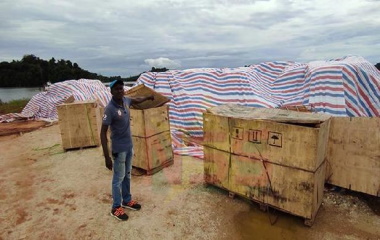
by Ivan Cairo
PARAMARIBO, Suriname, May 22, CMC – The Suriname government has banned the use of cyanide with immediate effect in small scale gold mining following a suspected boat accident in which a large amount of cyanide ended up in the Van Blommestein reservoir, about 85 kilometers south of the capital.
There have been concerns here in recent days regarding the use of the highly toxic cyanide in small-scale gold mining. Residents of the hinterlands where the gold fields are located have demanded that the use of cyanide be stopped immediately, including by the multinational Zijin Mining, which earlier this year took over the Rosebel gold mine from Iamgold.
The concerns have increased especially after information began to circulate that a boat carrying a large amount of cyanide had overturned on the Van Blommestein reservoir and the cargo has disappeared into the depths.
The inhabitants of the villages around the lake largely depend on that water for their drinking water supply.
Minister of Spatial Planning and the Environment, Marciano Dasai, told Parliament that samples have been taken from the reservoir and that the result shows that in certain locations the water is contaminated by cyanide.
He said the results show that the water contaimination is between 334 mg/l and 424 mg/l, at least1,600 times more than the allowed by international standards.
The National Coordination Center for Disaster Management (NCCR) is also conducting an investigation to determine whether there are reasons to declare the area a disaster area. The National Institute for Environment and Development in Suriname (Nimos) will also conduct investigations.
Economic Affairs Minister, Reshma Kuldipsingh said that from 2019 to April this year, more than 13.6 million kilos of cyanide was legally imported into Suriname, mainly by the two multi-national companies.
He said that an investigation is underway to determine whether the cyanide was imported illegally.
Acting Commissioner of Police, Ruben Kensen, told reporters that at least one suspect has been identified with regards to the contamination of the reservoir. But he said no arrest can yet be made as the investigators are still collecting evidence.
Kensen said that the police have also forwarded a file to the Public Prosecutor’s Office that will determine the way forward.
On Sunday, representatives of the various communities around the lake held a meeting to discuss the situation as resident fear for their lives.
“We demand an immediate cessation of cyanide transport to Brokopondo,” said Jolanda Leidsman, the head of a local foundation. The residents are also demanding that the government provide safe drinking water and compensate the for damage already suffered.
CMC/ic/ir/2023