
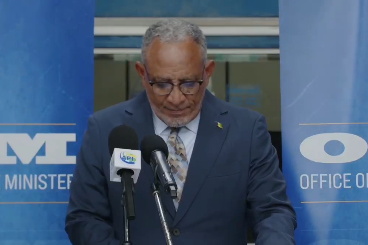
KINGSTOWN, St. Vincent, May 27, CMC – The St. Vincent and the Grenadines government Wednesday outlined a raft of new measures aimed at cushioning the impact of increased the global prices on basic commodities even as it acknowledged that it had inherited an economy in shambles six months ago.
“This 90-day emergency package is a fiscally responsible shield against extraordinary global pressures,” Prime Minister Dr. Godwin Friday, said in a 30 minute national broadcast, adding that he has also directed the National Cost of Living Task Force to monitor prices weekly to ensure that tax reductions actually benefit the consumers.
He said the new measures must “reach the people, not simply improve business profit margins” acknowledging that his government understands that many Vincentians are anxious about the future.
“But I want you to know this. We are not powerless in the face of global challenges. And you will not face these challenges alone. Together, we will move from pressure to progress, from uncertainty to stability, and from rescue to resilience. ”
Friday told the nation that he is announcing a set of urgent cost-of-living measures designed to cushion the blow for the average family while protecting jobs and businesses and promoting economic stability.
He said these are targeted, responsible measures aimed at helping people through a difficult time that has resulted from circumstances beyond their control.
He said that the government has worked hard to maintain price stability despite growing international pressures even as “the global market pressures have persisted longer than we had hoped, and we must now respond carefully and effectively.”
Prime Minister Friday said that the global oil market currently demands an increase of approximately EC$5.60 (One EC dollar=US$0.37 cents) on gasoline and over five dollars on diesel.
“Without government action, gasoline would rise from what it is now of $13.22 a gallon to approximately $18.82 per gallon. Diesel would increase from $12.56 a gallon to roughly $17.71, while low-sulphur diesel would climb from $12.93 to nearly $17.85 per gallon.
“ Therefore, effective immediately, we are implementing a three-month intervention measure to suppress the effects of high fuel prices by, one, reducing excise tax, and also by reducing the custom service charge by 50 per cent on imported petroleum products,” Friday said, adding that those reductions represent real savings for ordinary people.
“Without this intervention, a standard vehicle owner would have seen fuel costs jump higher in a single month. Instead, this measure puts meaningful savings back into household budgets so people can shop for groceries.”
He said that without intervention, St. Vincent and the Grenadines would have become one of the most expensive Eastern Caribbean countries for fuel.
He said with respect to electricity costs, “we are also seeing serious pressure in electricity generation costs” with VINLEC fuel expenses continuing to rise steadily, ”and without intervention, the fuel surcharge would continue climbing beyond the approximately 29 per cent increase already recorded in the first quarter of this year.
“We cannot allow electricity bills to become unbearable for households and small businesses,” Friday said, announcing a two-pronged intervention.
“First, the government will completely remove the customs service charge and excise taxes on diesel purchased for electricity generation. This measure alone represents approximately EC$1.65 million in foregone government revenue over the next three months, and this savings will be passed on to consumers.”
Friday said that under the second intervention, VINLEC will also be required to contribute to creating the cushion for the future generation.
“This is, after all, about partnership and shared responsibility. So, where the fuel surcharge exceeds $0.71 per kilowatt hour, VINLEC will provide a 50 per cent matching discount on the fuel cost formula.”
Friday said when the surcharge rises to above $0.77 per kilowatt hour, VINLEC will provide a full 100 matching contribution.
“For households, this intervention means relief on utility bills and protection against runaway increases. It means the difference between a bill that remains unmanageable and one that forces families to choose, that remains manageable, and one that forces families to choose between electricity and groceries, both essential.
“And for small businesses, for the barbers, tailors, shop owners, restaurants, bakeries and small manufacturers and processors, it means protection for jobs, maintaining operating margins, and maintaining affordable prices for their customers. ”
Prime Minister Friday said that the government is absorbing part of the blow so that ordinary Vincentians do not have to absorb them all by themselves.
He said with respect to cooking gas, it is not a luxury, but a necessity and that since January, the international benchmark price for liquefied petroleum gas has increased from approximately US$0.70 to over US$0.90 per gallon, a 27 percent increase in just four months.
Prime Minister Friday said without intervention, these costs would inevitably push up the price of cooking gas locally and that a family already paying approximately EC$40.30 for a 20-pound cylinder would soon face significantly higher prices.
“That is why today I am announcing a 100 per cent removal of custom service charge on all liquefied petroleum gas. By removing this tax entirely, the government of St. Vincent and the Grenadines will absorb approximately EC$504,368 in lost revenue over the period of the 90 days of these measures.”
Friday said that the government will continue to monitor international markets carefully, noting “but our position is clear. We will protect the dinner table of Vincentian families”.
Friday also said that freight and import costs have contributed significantly to inflation and that earlier this year, a standard 20-foot container shipping essential goods from the United States to Kingstown cost between EC$2,200 and EC$3,000.
“Today, that same container can cost between EC$3,300 and EC$4,800. Under the current system, taxes are calculated not just on the goods inside the container but also on the inflated freight charges.
“In other words, when shipping companies raise prices, the taxes paid by importers rise automatically as well. That cost eventually reaches the supermarket shelf and therefore consumers. We are therefore moving to decouple domestic taxation from global logistics volatility through two important measures.
“First, we will remove shippers’ surcharges, including fuel and congestion fees, from the tax calculation. Second, we will benchmark freight rates used for tax purposes, that is for calculating government’s share. We will benchmark freight rates used for tax purposes to January 2026 levels”
He said that even if a shipping company charges EC$4,800 for a container, the government will calculate the taxes as if the freight rates were still at January levels and that this intervention will lower the landing costs of imported goods, reduce imported inflation, and help businesses avoid passing on every international price increase directly to consumers.
“These measures are immediate interventions, but we are also focused on long-term resilience. We will provide subsidised seeds and a 30 percent discount on fertilisers to support local farmers to increase food production and reduce our dependence on imported food.
“We are also monitoring construction costs closely, and if cement prices cross a critical threshold, we are prepared to introduce a value added tax (VAT) waiver on cement to protect jobs and housing projects.”
Prime Minister Friday said that the government is continuing discussions with regional partners through the Caribbean Community (CARICOM) to secure more stable government-to-government energy arrangements.
“And we will maintain our 100 per cent tax waiver on solar voltaic systems to help move Vincentians in the transition towards renewable energy, and lower electricity costs over time,” Friday said, adding “this is a very serious push that our government is engaging in.
“We want to use this new oil crisis as an opportunity forced upon us to move aggressively towards renewable energy production, especially solar,” he added.
CMC/kj/ir/2026