
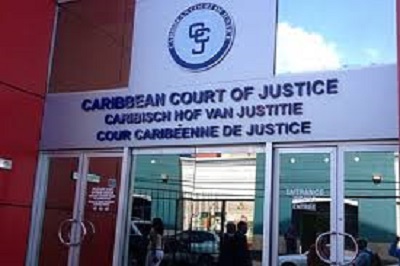
PORT OF SPAIN, Trinidad, Aug 1, CMC -The Trinidad-based Caribbean Court of Justice (CCJ) has upheld the decision of the Eastern Caribbean Supreme Court of Appeal in a matter involving the former opposition leader in St. Lucia, Marius Wilson.
Wilson, an attorney, was in 2021 sentenced to five years in prison by a high court judge for an incident dating back to 2012. The court heard that on June 7, 2012, Wilson discharged his licensed firearm in a public space and injured a male individual in the process.
 He was charged for discharging his firearm in a public space and for injuring an individual. A nine-member jury unanimously found Wilson guilty on both counts.
High Court judge, Justice Patrick Thomson sentenced Wilson to four and five years respectively for the two charges to run concurrently.
Wilson had appealed against his conviction and sentence for the offences of intentionally causing dangerous harm to Winsbert Alexander and using a deadly instrument with intent to cause grievous harm to Alexander.
Wilson admitted to shooting Alexander during the early morning of June 7, 2012, while at a nightclub, claiming this was after he observed Alexander running towards him with an object in his hand that appeared to be a firearm.
At the trial, only one of the prosecution’s eyewitnesses gave evidence of what occurred. All other eyewitnesses, including Alexander, claimed that they could not remember their statements given to the police after the incident, although they had been shown their statements before testifying.
Critically, other than Wilson’s firearm, no other firearm was found at the scene.
On 30 July 2021, Wilson was convicted of the two offences for which he was later sentenced to five years on the first count and four years on the second count, both sentences to run concurrently.
On 25 July 2023, the Court of Appeal upheld the conviction but allowed the appeal against the sentence, varying the sentences of five years and four years to three years and two years respectively, to run concurrently. Wilson appealed further to the CCJ against the Court of Appeal’s decision.
During the appeal before the CCJ, the attorneys for Wilson argued that the Court of Appeal was wrong in law whenit upheld the trial judge’s dismissal of the no case submission made at the trial; it did not agree with the submission that the trial judge had misdirected the jury on the evidential nature of hostile witnesses; it approved the trial judge’s direction to the jury on the issue of good character given Wilson’s profile; and it disregarded the written submissions that the defence of self-defence which was advanced at trial was not negated by the prosecution.
As a result, the lawyers argued that Wilson suffered a miscarriage of justice.
But in an unanimous ruling read out by Justice Denys Barrow , the CCJ noted that the challenged direction to the jury on the ‘evidence’ of hostile witnesses could not have misled the jury because nothing that was said by the hostile witnesses prejudiced Wilson. Additionally, the trial judge repeatedly directed the jury that what the witnesses did not accept from prosecution suggestions as to what they had previously stated was not evidence to be considered in the case.
Wilson’s attorneys submitted that the trial judge’s direction on good character was too broad and invited the jury to consider irrelevant, inadmissible, and prejudicial matters given Wilson’s profile in St. Lucia.
The CCJ held that this submission could not withstand scrutiny given the effect of the trial judge’s full directions on good character taken together with the earlier cautions given to the jury when they were selected: to consider only what took place in court.
The CCJ also held that there was sufficient evidence to disprove the claim of self-defence and that there had been adequate evidence to establish an unlawful shooting.
As a result, the CCJ dismissed the appeal, and the decision of the Court of Appeal was upheld.
CMC/af/ir/2024