
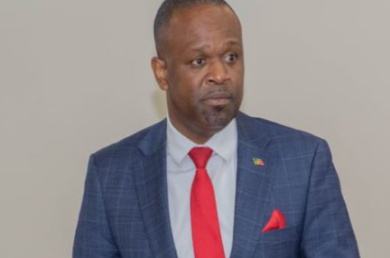
BASSETERRE, St. Kitts, Dec 22, CMC -The St. Kitts and Nevis government says it will launch in January next year, two projects aimed at accelerating the twin island Federation’s shift toward greater use of clean and renewable energy sources.
Energy Minister, Konris Maynard, said that the two initiatives, namely DRIVE and SOLARISE, which he unveiled during the budget on the national debate last week, will be launched next month.
Cabinet recently approved the Decarbonised Roadway Initiative for Vehicle Electrification (DRIVE) that establishes a clear national vision that sets manageable objectives for electric vehicle (EV) adoption. The policy is in line with international best practices and local realities and provides an actionable road map for implementation.
“This policy aligns our transportation, energy, climate, and economic planning to a single, coherent direction. That is how serious transitions are done,” said Maynard, adding that the Cabinet has approved concessions for EV and hybrid vehicles as part of this initiative.
He said additional details will be shared next month during the DRIVE launch party.
The second initiative, the SOLAR Integration for Sustainable Energy (SOLARISE) programme introduces small-scale distributed renewable energy regulations.
Under this programme, for the first time, individuals and businesses will be incentivised to install rooftop solar systems. A fair compensation rate will be introduced to pay for excess energy returned to the national power grid.
“The SOLARISE programme serves as a national operational framework for approval, installation, licensing, grid interconnection and operation of small-scale photovoltaic systems, which may also incorporate battery energy storage systems,” said Maynard.
He said that the goal is to safely integrate a cumulative total of five megawatts of distributed solar PV generation capacity on or before the year 2030. Households or businesses that feed excess power into the grid will be compensated at a rate of 11 cents per kilowatt hour.
SOLARISE will also launch in January.
CMC/ag/ir/2025