
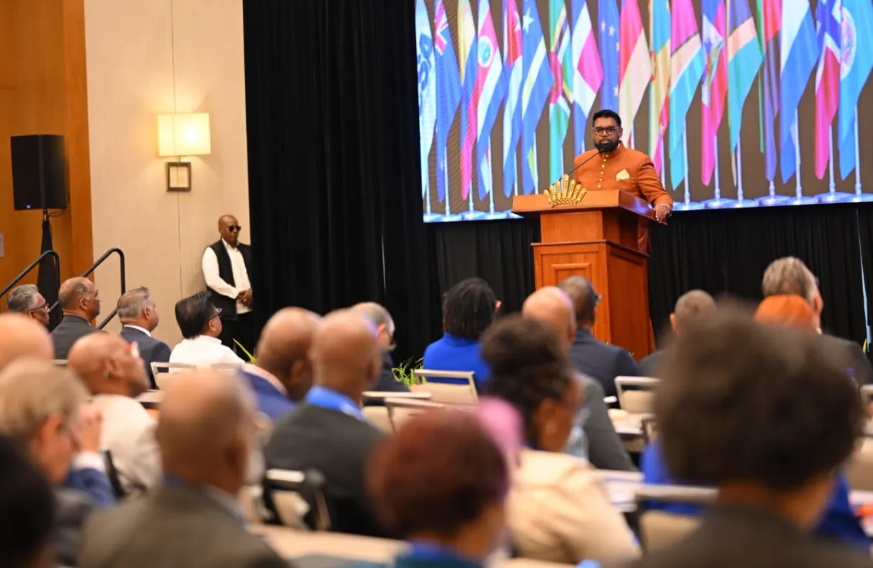
GEORGETOWN, Guyana, Oct 27, CMC -President Irfaan Ali has called on the Caribbean shipping industry to develop an urgent policy document backed by regional and international lenders to unlock investment in Caribbean ports.
“We need to come up with a plan that allows private capital to merge with a public good,” President Ali the opening of the 56th annual general meeting, conference and exhibition of the Caribbean Shipping Association (CSA) which ends here on Wednesday.
He said that the plan could be backed by the Barbados-based Caribbean Development Bank (CDB), the Inter-American Development Bank (IDB) and IDB Invest and that it should set out the fiscal incentives, banking support and public-private partnership models needed to speed up port modernisation.
Ali told the conference, which is being held under the theme “Building a More Connected, Resilient, and Competitive Caribbean,” that the proposal responds to five challenges the region must confront.
He said these challenges were high shipping costs and the expense of regional connectivity, uneven port infrastructure, weak inter-Caribbean trade, the threat of climate-related disasters, and geopolitical instability.
Ali said together they reveal the urgent need for a more coordinated, forward-looking and investment-driven approach to Caribbean shipping.
He said critical investment has been delayed across the region, leaving many ports unable to meet today’s demands, pointing to a 2018 IDB study which found that most Caribbean ports are 50 years or older.
“If we look at budgets across the region, you will see that this is not a priority at the moment,” he said, noting that this has a direct cost for Caribbean people.
He cited a May 2026 International Monetary Fund (IMF) working paper which found that every Caribbean country except Jamaica pays shipping costs above the global average, costs that eventually show up in the price of food, construction and other goods.
“Ultimately, high shipping costs become a cost-of-living problem for our people and a competitiveness problem for our businesses,” he said, offering Guyana as an example of the investment model at work.
Ali said private investment in shore bases, laydown yards and port facilities on the Demerara River over the last four to five years is close to or more than one billion US dollars, and the government is working with Bechtel on the deepwater port. It is also in talks with investors including US EXIM and the Qatar Investment Authority.
“You have to be aggressive. You have to be willing to open up the market. You have to be willing to bring partners together. But we can only do so if we create the model,” Ali told the conference, questioning whether financing agencies had been invited to the conference.
“Are we speaking to ourselves or are we speaking to a system that can help each other?” he asked, calling also for the Caribbean to independently assess the cost of decarbonising global shipping, warning that relying on external assessments could lead to policies that hinder regional growth.
“This net zero conversation must not just be a sexy conversation for a room. It must be a practical conversation,” President Ali said, adding “Guyana speaks on the issue with authority.We know about net zero because we are one of the greatest contributors to net zero in the world”.
Ali said that the global shipping industry will require an estimated two trillion US dollars by 2050, not to build new vessels, but strictly to land, store, and deliver clean fuel.
Questioning how these costs will be distributed, he cautioned that the Caribbean could end up bearing a disproportionate share of the financial burden.
Citing figures from the United Nations Conference on Trade and Development (UNCTAD), he said decarbonising vessels will require between US$8 billion and US$28 billion each year up to 2050. Full decarbonisation, he added, could initially raise annual marine fuel spending by 70 to 100 per cent.
“No one is taking that cost as a social good. That cost has to be passed on to someone,” he said, adding that his reservations pertain not to the ultimate goal of decarbonisation, but to the necessity of the region thoroughly evaluating the operational and financial impact on its maritime sector.
He pointed to uncertainty over which fuel will power the transition, with options including biofuel, green methanol, green ammonia, hydrogen, battery electricity and LNG. Shipowners will not spend billions retooling their vessels without knowing where future fuel supply will come from or what it will cost. .
CMC/gt/ir/2026