
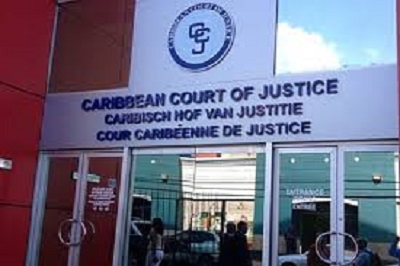
PORT OF SPAIN, Trinidad, Jul 5, CMC – The Trinidad-based Caribbean Court of Justice (CCJ) Tuesday dismissed an application for special leave to appeal against a decision of the Eastern Caribbean Court of Appeal that it had the jurisdiction to entertain appeals against the decision of the High Court judge in Dominica striking out elections petitions for not disclosing a cause of action.
“The application for special leave is dismissed and the orders of the Court of Appeal dated 21 May 2021 are upheld. No order is made in this Court as to costs,” said Justice Adrian Saunders, the CCJ President on behalf of the five-panel of judges.
 Senior Counsel Anthony Astaphan told the Caribbean Media Corporation (CMC) that the ruling “is a very important decision because the basis of the decision is that whether the judge was right or wrong the CCJ was clearly of the view that it was within the competence of the High Court judge …to strike out petition which in his opinion after consideration of the allegations made in the petition to strike them out and not disclosing the cause of action.
“That’s the basis upon which the petitions were struck out, that the basis upon which the Court of Appeal said it had no jurisdiction to hear an appeal on the judgement on the petitions and that’s the basis upon which the CCJ held that it was not a final decision,” said Astaphan who led a battery of lawyers on behalf of the respondents.
He said as a result, the petitions filed after the 2019 general elections are “dead as are the election petitions filed in 2005, 2009 and the criminal complaints that were filed in the Magistrate’s Court…all of which are now dead as a result of the decision by the CCJ”.
The issue before the CCJ was whether the Court of Appeal had the jurisdiction to entertain appeals against the decision of the High Court judge striking out elections petitions for not disclosing a cause of action. The determination of this issue turns on whether the High Court judge’s order was final or interlocutory.
The application had been filed by members of the main opposition United Workers’ Party (UWP) that lost the December 6, 2019 general election to the ruling Dominica Labour Party (DLP) by an 18-3 margin.
In January 2020, the UWP through Glenroy Cuffy and others, filed election petitions against Melissa Skerrit and others, including Prime Minister Roosevelt Skerrit, the Chief Elections Officer and the Police Commissioner, alleging several irregularities in the election process and sought to have the court overturn the results in St. Joseph, Mahaut, Morne Jaune, La Plaine, Castle Bruce, Salybia, Roseau Valley, Roseau Central, Roseau South, and Wesley constituencies.
The government, in turn, filed applications to strike out the petitions on the basis, inter alia, that the petitions did not disclose causes of action against them and were abusing the process of the court.
The application to strike out the matter before trial was heard and granted by Justice Glasgow in October 2020.
In his ruling, Justice Glasgow said the election petitions were struck out on the basis that the petitions lacked the necessary details or specificity to disclose causes of action against any of the respondents.
But in November 2020, the UWP appealed the decision claiming that the judge had erred in law.
It also appealed against the order of cost stating that “the Order fails to consider that the Petitioner’s/Appellants summary for direction application in January 2020 requested that the petitions be dealt with as one petition and for further directions of the court.”
The judgement was further appealed to the CCJ that in a December 9, ruling said it had the jurisdiction to entertain the Notice of Application for Special Leave to appeal.
In its 45 page ruling on Tuesday, the CCJ noted that the petitioners argued that the petitions disclosed matters that were of considerable public importance, and it was therefore in the public interest for the Court of Appeal to hear their appeal.
“We agree with the Chief Justice and the Court of Appeal that the public importance attached to election petitions could not form the basis for the assumption of jurisdiction to hear an appeal from a decision to strike out an election petition.
“Once the trial judge’s decision was interlocutory, subject to what we shall later say, the Court of Appeal was not permitted to exercise any such jurisdiction,” the CCJ ruled.
Further, the CCJ also ruled that the petitioners must be denied permission to appeal the judgment of the Court of Appeal, adding “an appeal to this Court has no reasonable prospects of success.
“The trial judge’s judgment was interlocutory, not final, and the Court of Appeal was right to decline jurisdiction to hear an appeal against that judgment. Even if the judge made errors, and we do not in the slightest determine the question whether the judge did or did not, any such errors cannot convert what is clearly an interlocutory order into a final order. Interlocutory decisions are un-appealable, save for the narrow exception to which reference was earlier made.”
The CCJ said that it would be remiss if the Court did not, however, offer the following observations.
It said “some of the allegations raised by the appellants are serious and, if true, would be troubling. “Periodic elections that are free and fair are the lifeblood of a country’s democracy. Every effort must be made by a State scrupulously to adhere to the legislative provisions governing elections and, in particular, to those that relate to the integrity of the lists of electors.
“We would hope that the relevant authorities would seriously reflect on the allegations made in these proceedings and consider whether there are steps that can or should be taken to improve the elections machinery so that, as far as possible, the occasion for the making of such allegations as were made here would not arise in the future.”
The CCJ said that efforts by the citizenry, in good faith, to call attention to perceived deficiencies in the electoral process should not be discouraged.
“Such efforts conduce to a healthy democracy. Since the trial judge had determined that the defendants were properly joined as parties, in the exercise of our discretion in this case, we would order that each party should bear their own costs in this Court,” the CCJ added.
CMC//fr/ir/2022