
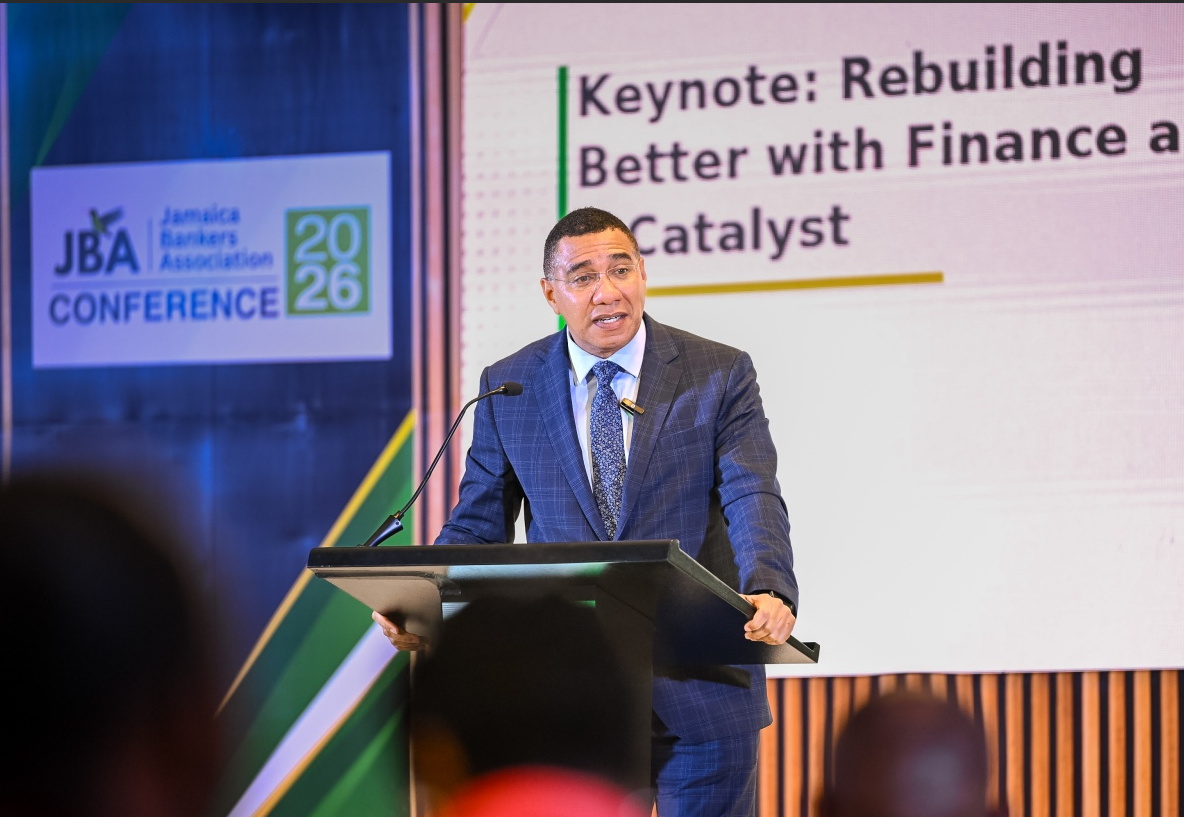
KINGSTON, Jamaica, Nov 24, CMC – The Jamaica government has defended its decision to suspend the fiscal rules, with Prime Minister Andrew Holness saying his administration remains resolute to preserving fiscal discipline.
He told the inaugural Jamaica Bankers Association (JBA) conference that the suspension of the fiscal rules is to accommodate reconstruction and not to support wanton spending.
“Hurricane Melissa will not change the government’s stance on its fiscal discipline posture. We will not change our stance on fiscal discipline. Now, we have asked Parliament to extend, temporarily, the suspension of the fiscal rules to accommodate reconstruction…
“…that’s just an additional one year… . So, it’s a temporary suspension but I want to be clear the suspension of the fiscal rules, it is not to support wanton spending. It is not to support politically motivated spending,” he added.
Holness told the conference being held under the theme ‘Trust and Resilience by Design: Securing Caribbean Finance for Recovery and Future Growth’ that the government has taken a decision that the increase in debt that will be taken on to fund the recovery must be for things that support growth and build resilience.
“So, even though we have suspended the fiscal rules, we are going to become even more surgical in the projects that we select… . the government will not depart from fiscal discipline, even though we have suspended the fiscal rules temporarily;
“We are enforcing on ourselves as a government a strategic direction that will ensure that the additional spending delivers results, transformation, and revenues that will, in the near term, help us to quickly reduce debt and expand our GDP (gross domestic product),” he said.
Holness noted that previous governments faced with similar challenges, take the increased expenditure and spend it on things that gave a high political multiplier, rather than spending it on things that give high growth, revenue, and transformational multipliers, which are not always aligned.
“The fiscal economics of it is that you could spend on things that have high political multipliers, give you a lot of political benefits, make everybody feel good about the Government. But you could spend on things that have high revenue multipliers. You could spend it on things that have high transformational multipliers, that after you have spent the funds, you see a distinct change in the state of either your infrastructure or your human resources.
“So, governments have to decide, am I going to spend it on things with a high political multiplier, or am I going to spend it on things that give you high revenue generation and are transformational, which may not in the short term give you a high political multiplier,” Holness said, telling the conference that it can be certain that his government’s fiscal policy will not change.
Furthermore, he said the country was able to secure loan package following the devastation caused by Hurricane Melissa, essentially as a result of fiscal discipline, fiscal consolidation, and good management of public financing.
Holness said some of it will be directed to the private sector, noting that the exact mechanism will be explained later.
“In this room are the very entities that will be able to access some of this financing, to onlend on projects to support the recovery. Now, even though the disaster was of an exceptional nature, the Government still has a duty to preserve fiscal discipline,” he said.
Meanwhile, he said the government will advance a review of investment restrictions and the capital and liquidity requirements applicable across the financial sector, “working with the Bank of Jamaica, the Financial Services Commission, and industry stakeholders, and respecting the statutory responsibilities of our regulators”.
Holness noted that the purpose is to remove barriers that unnecessarily constrain sound lending and productive investments.
“So, we are going to support you in the redirection of your resources to the productive efforts and the strategic direction that the Government is taking,” he said, adding this includes examining the asset pension funds and insurers that may hold them, the treatment of suitable infrastructure and corporate investments, and whether regulatory requirements properly distinguish between different risks.
“Banks, insurers, pension funds, and security dealers have different obligations, and so our approach must recognise those differences and ensure that long-term investments are financed in ways consistent with institutions’ funding and responsibilities to their customers,” Holness said.
“Depositors, pensioners, and policyholders must remain protected. Capital must be adequate, liquidity dependable, and risks properly assessed. Within those safeguards, our framework must give financial institutions the scope to finance viable enterprises and projects,” he added.
Holness said Jamaica’s savings must have greater opportunities to finance Jamaica’s growth, noting that as government addresses regulatory barriers, he expects financial institutions to examine their own practices, how they assess borrowers, how long decisions take, what collateral they require, how they price products, and how effectively they serve growing businesses.
“We acknowledge that on our side, the regulatory side, there are some things we need to tweak, to change, but we are also saying that on your side, there are some things you need to do as well,” he said.
CMC/gk/ir/2026