
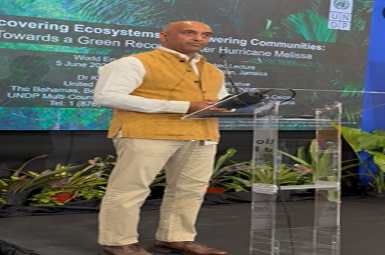
KINGSTON, Jamaica, Jun 10, CMC – The United National Development Programme (UNDP) Resident Representative, Dr Kishan Khoday is calling for Jamaica to act now to place nature-based, green solutions at the heart of current and upcoming planning as well as recovery and reconstruction efforts in the post Hurricane Melissa era.
Delivering the 25th Anniversary World Environment Day Distinguished Lecture, Khoday said the current phase of the rebuild effort presented an important opportunity to aim for a stronger, greener recovery.
Hurricane Melissa slammed into Jamaica on October 28 last year, leaving damages estimated at US$9.9 billion and Khoday said that the green recovery should prioritise the most vulnerable communities recovering from the hurricane to strengthen their climate resilience to potential crises on the horizon, he outlined.
“As the climate emergency accelerates, a need exists to view nature as an Ecological Security System, with ecosystems and the assets they provide at the base of livelihoods and other dimensions of social cohesion,” Khoday said.
“As Jamaica advances on its national recovery frameworks and planning, an opportunity exists to address root causes of local vulnerability, by embedding green recovery solutions into emerging investments.
“This includes emerging national reforestation, coral and mangrove restoration initiatives, and measures to reduce coastal erosion and soil erosion in watershed ecosystems. All are critical for securing vulnerable livelihoods in fisheries, forestry and tourism sectors,” Khoday added.
The UNDP official point red out other opportunities could be leveraged to further expand and decentralize solar solutions for community resilience, to integrate climate-resilient design and technology solutions into new infrastructure build-back, water system restoration, and tourism sector recovery.
“This green trajectory can go a long way in restoring both ecosystems and communities”, he explained.
He said UNDP was supporting and reinforcing this green recovery approach through its Jamaica Resilient Recovery Initiative (JARRI), which is supporting national spatial land use planning and local spatial plans in the most affected impact zones in Western Jamaica, as well as critical debris management and recycling initiatives.
Khody said that UNDP is initiating a series of new projects with US$15 million of grants and over US$50 million of co-financing from the public and private sectors to support the green transition.
He said Caribbean Small Island Developing States (SIDS) must be supported by global partners to scale up green recovery and ecosystem restoration to reverse ecosystem loss and damage from climatic events.
Khoday explained that ecosystem-based solutions can help to reduce future disaster risks, protect livelihoods, and support a more resilient and sustainable path to development. The recently issued Damage and Assessment supported by the UN notes that impacts on ecosystems across Jamaica account for approximately 30 per cent of overall national losses suffered following Hurricane Melissa.
He promised that as UNDP is this year marking the 50th anniversary of its Multi-Country Office in Jamaica, the team will “build on our successful cooperation on this agenda over the years and stand shoulder to shoulder with Jamaica as together we chart the path forward for more resilient ecosystems and communities”.
The NEPA Distinguished Lecture was convened under the theme “Recover Stronger, Recover Greener: Integrating Ecosystem Solutions In Post-Disaster Planning”.
CMC/jh/ir/2026