
KINGSTON, Jamaica, Jun 11, CMC – The United Nations Development Programme (UNDP) is to launch a new Disaster Risk Resilience (DRR) for the Caribbean with estimates showing that from 1980-2020, loss and damage (L&D) as a percentage of gross domestic product (GDP) were the highest in the Caribbean small island developing states (SIDS).
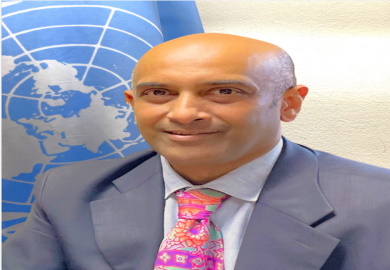
UNDP Resident Representative, Dr. Kishan Khoday, said that this was at an average of 2.5 per cent compared to two per cent for the Pacific SIDS, 0.2 per cent for the rest of Latin America, and 0.1 per cent for Africa.
Speaking at the UNDP’s Hurricane-Ready and Resilient Forum on Loss and Damage for Micro, Small and Medium Enterprises (MSME), Khoday, the Resident Representative for The Bahamas, Belize, Bermuda, Cayman Islands, Jamaica and the Turks and Caicos Islands, said the UNDP has been prioritising support to countries on the loss and damage agenda, “and in that regard we are now open for business in terms of discussing possible new L&D projects in Jamaica, Bahamas and elsewhere in the sub-region.
He said climate damages alone are forecast to increase in the Caribbean from five per cent of GDP in 2025, to 20 per cent by 2100 representing US$22 billion of annual losses.
“This has implications for key sectors in SIDS economies, such as tourism and agriculture, the former of which could see GDP reduced by 38-47 perc ent by 2100. A particular concern are the impacts to emerge for high-risk communities, and MSMEs which are at the base of key sectors and community livelihoods. “
The UNDP official said this vulnerability became more evident with the passage of hurricane Beryl in 2024, especially among MSMEs. He said they constitute 97 per cent of all enterprises in Jamaica, and 98 per cent of all enterprises in The Bahamas.
They contribute 28 per cent to Jamaica’s GDP and provide 80 per cent of jobs. These enterprises employ 47 per cent of the workforce in the Bahamas and contribute anywhere between 20 to 30 per cent of GDP.
Khoday said micro enterprises, in particular, are tiny, mighty but largely informal and yet the power of MSMEs is easily felled by a hurricane.
“MSMEs are disproportionately vulnerable to hurricane impacts because of their informality especially in the micro enterprise sector; size, limited resources, inadequate access to financing, insurance and disaster preparedness resources.
“MSME operated by women and persons with disabilities contend with added layers of vulnerabilities traced to gender norms, and stereotypes, family responsibilities and inadequate access to capital. There are also nuanced requirements related specifically to the needs of women and persons with disabilities that tend to be overlooked.”
“MSMEs are simply put, too significant to national economic wellbeing to fail or to sustain lengthy closures after a disaster. We must redouble efforts to secure their disaster resilience and accelerated recovery. “
Khoday said UNDP’s 2021 Socio-Economic Impact Assessment of Hurricane Dorian and the COVID-19 Pandemic on MSMEs in The Bahamas for example showed that 63 per cent of MSMEs were affected with more than 55 per cent permanently closing in Abaco and 11 per cent in Grand Bahama.
“We need comprehensive disaster preparedness plans tailored for MSMEs and allocation of resources to enhance their resilience and disaster recovery capabilities. And, by enhancing financial support mechanisms for disaster-impacted MSMEs, including possible via the new L&D Fund, we can expand relief beyond grants to accessible insurance schemes and public private partnerships.”
Khoday said Disaster Risk Resilience and Recovery (DRRR) remains a cornerstone of UNDP’s offer and over the years it has allocated US$100 million annually to these efforts. He said that this is coupled with the ongoing portfolio of over four billion US dollars of grants for climate action in over 140 countries.
He said through UNDPs current Country Programme in Jamaica, Bahamas, Bermuda, Cayman and TCI, support for climate adaptation, disaster risk reduction and recovery interventions is a centre piece.
“Most recently in Jamaica, following last year’s hurricane Beryl, UNDP’s support for the livelihoods recovery of 54 enterprises led by women and persons with disabilities included grants for restoration of small businesses as well as gender sensitive climate-smart DRR training.”
He said that over the years, the UNDP has extended similar support to impacted MSMEs in The Bahamas and Turks and Caicos Islands.
The post hurricane Dorian package of interventions in The Bahamas, bolstered by a UNDP grant allocation supported Resilient Recovery regulatory frameworks and strategies approved by Cabinet; Housing Building and Damage Assessments of more than 4000 structures, Marine Debris studies and cleanups, and cash for work programmes targeting the poorest and most impacted residents.
“We also support a climate resilient multipurpose shelter on Abaco in The Bahamas capable of withstanding 200 mile per hour winds. Supported by the government of India and UNDP, this will stand as a model lesson in infrastructural resilience.”
Khoday said he wanted to commend the governments of Jamaica and The Bahamas for their “leadership and dynamism” in developing and sustaining fit for purpose national disaster management governance arrangements, and no less the partners in Cayman, Bermuda and TCI for their examples of being resilient to increasingly severe hurricanes in recent years. “Your example models the kind of leadership that is critical for shaping resilient economies, and we look to your leadership in further strengthening support for MSME resilience and recovery.
“To further advance our support, UNDP, UNDRR, UNICEF and WFP, with the invaluable support of the EU, will soon launch a new DRR programme for the Caribbean, with important region-wide results in focus as well as dedicated country grants of up to US$500,000 for example in Jamaica aimed at capacity development to scale up policy, institutional and financing mechanisms for resilience recovery. Options for embracing loss and damage finance can be a key outcome.
“As Small Island Developing States of the Caribbean you are well positioned and qualified to model a resilient future where no one is left behind, one that embraces new financing options, technology and governance solutions.
“It is clear that resilience must become our first line of defence against unpredictable weather patterns and the means by which we accelerate recovery from loss and damage,” Khoday said.
CMC/ah/ir/2025