
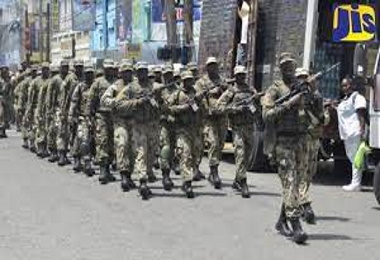
GEORGETOWN, Guyana, Aug 4, CMC – The Caribbean Community (CARICOM) grouping Friday welcomed the announcement by two of its members that they are willing to join Kenya in sending a multi-national force to deal with the security situation in Haiti.
The Bahamas and Jamaica said they are willing to send up to 350 personnel to he French-speaking CARICOM nation after Kenya’s Foreign Minister, Alfred Mutua, said last weekend that his country’s commitment is to deploy a contingent of 1,000 police officers to help train and assist Haitian police restore normalcy in the country and protect strategic installations.
“The Caribbean Community hopes that the establishment of the multi-national force will be given full endorsement by the United Nations Security Council as a demonstration of the commitment of the international community to improve the security and humanitarian conditions of the people of Haiti and support restoration of law and order,” the 15-member regional integration movement said in a statement.
It recalled that regional leaders at their summit in Trinidad and Tobago last month, had “underscored their grave concern over the severe humanitarian, security and governance crises facing their sister member state.
“The Caribbean Community reiterates its pledge to continue efforts to collaborate with the Haitian Government and all stakeholders to find a Haitian-led solution to the plight facing their nation,’ the statement added.
A statement issued from the Office of the Jamaica Prime Minister on Friday, quoted him as
Informing the President of the Kenya, William Ruto, that Kingston and Nassau are committed to providing 350 personnel.
Holness expressed hope that more countries, whether in the region of the Americas, the continent of Africa, or elsewhere, would also step forward with personnel commitments, and that the requisite UN Security Council Resolution will be adopted in order to provide the appropriate jurisdictional framework for the security force.
Regarding CARICOM, Prime MInister Andrew Holness said that the ‘Good Offices’ efforts currently led by three former prime ministers from CARICOM member states must continue to be supported towards facilitating a political consensus in Haiti.
He also expressed gratitude to members of the international community, in particular the United States, Canada, and the UN Secretary-General, who have been advocating strongly for more partners to support peace and stability in Haiti.
Meanwhile, the United States Friday said it expects several countries within the Eastern Caribbean to send translators to Haiti as part of a Kenya-led United Nations-backed multinational force.
US Deputy Assistant Secretary of State for Caribbean Affairs and Haiti, Barbara A. Feinstein, told a news conference that “there has been mentioned, for example, that in the Eastern Caribbean, there are certain countries that have the same or a very similar Creole to Haitian Creole, to the extent that they might be able to provide translators or interpreters is something that could also be of use”.
St. Lucia and Dominica are two countries within the 15-member CARICOM grouping, capable of communicating in the French creole or patois language widely spoken in Haiti.
Feinstein told a virtual news conference that the deployment of a multinational force to Haiti, with material support from the US as well as other countries, depended on an assessment that would be conducted by Kenya in another few weeks.
Last year, Haiti’s Prime Minister Dr. Ariel Henry, sent an urgent appeal to the UN asking for “the immediate deployment of a specialized armed force, in sufficient quantity” to stop gang warfare.
Last month, United Nations Secretary-General Antonio Guterres appealed to the UN Security Council and major potential contribution countries to act fast to create the conditions for the deployment of multinational force to Haiti.
Guterres said that a UN expert’s estimate that Haiti needs up to 2,000 additional anti-gang police officers is no exaggeration.
CMC/hg/ir/2023