
PORT AU PRINCE, Haiti, Sept , CMC – The United Nations Integrated Office in Haiti (BINUH) says between April and June this year, more than 1, 860 people were killed, injured or kidnapped in the French-speaking Caribbean Community (CARICOM) country.
In its latest quarterly report on the human rights situation in Haiti, BINUH said its Human Rights Service (HRS) said that men accounted for 79 per cent of the victims, women 19 per cent, and children two per cent.
It said that the number of incidents reported during the second quarter of 2023 represents an increase of almost 14 per cent compared with the previous quarter.
“However, violence levels were not linear throughout the period under review. The highest number of incidents took place in April and May driven by an increase in gang and “self-defense groups” activity,” the report noted.
BINUH said that in the metropolitan area of Port-au-Prince, gangs continued to target residents living in areas under rival gang control.
For example, in Cité Soleil, at least 288 men, women and children were killed or injured by sniper fire when they tried to access or exit their neighborhoods. In late April, Canaan, Kraze Baryè and Village de Dieu gangs, all members of the G-Pèp coalition of gangs, coordinated simultaneous violent attacks,’ the report noted.
As it relates to kidnapping, BINUH said at least 298 persons were kidnapped nationwide during the second quarter of 2023, representing a decrease of 24 per cent compared to the previous quarter.
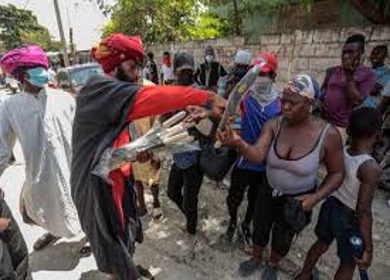
It said while the areas affected by the “Bwa Kalé” movement, a vigilante group that targets gang members, notably Pétion Ville and Port-au-Prince, saw a drop in kidnappings, other neighbourhoods continued to be affected by this criminal practice.
“For example, in Tabarre, at least four people linked to the political, economic and journalistic elites were kidnapped in June. All were kidnapped inside or near their residences and business premises.
“The incidents occurred days after the gang leader controlling the area threatened to retaliate against his “political allies” for not having protected “his men” during police operations.”
BINUH said that48 per cent of kidnappings took place in the Artibonite department, notably along the main roads of the L’Estère, Liancourt and Petite-Rivière-de-l’Artibonite.
“Most persons were kidnapped while traveling on common transportation vehicles. Some of the female victims were also raped during their captivity. Such was the case, on 15 May of 15 women who were kidnapped and raped in the area of Savien by members of the G”
BINUH said that gangs continued to use sexual violence, notably collective rape and mutilation, to spread fear and punish populations under the control of rivals.
It said in mid-April, during an attack carried out against the population of Brooklyn (Cité Soleil), at least 49 women were raped by G-9 and allied gangs in an area known as “Dèyè Mi” when trying to escape the armed violence.
“After being raped, seven of the victims were killed and their bodies dumped in an abandon site. In this zone, women and girls continued to be daily exposed to the risk of being raped by gang elements when they tried to cross it to go to work or reach services.
“ While gangs use sexual violence as a weapon against populations living under the control of rival gangs, they also commit similar acts against women and girls living in neighborhoods under their influence,” BINUH added.
BINUH said the HRS continued working closely with Haitian civil society organizations, international NGOs and UN agencies to refer survivors of sexual violence to available medical, psychological and socio-economic services.
“Unfortunately, these services are largely insufficient in the Portau-Prince metropolitan area, and are almost non-existent in the Artibonite department, where gangs are increasingly resorting to this type of violence to terrorize the population, despite the authorities’ firm commitment to improving them.”
The recruitment of children into the rank of gangs remains of particular concern. In April, the HRS was able to interview boys associated with gangs. Aged between 15 and 17, they described in detail their daily lives within the gangs, including their involvement in monitoring the gangs’ operational environments, kidnappings and robberies.
“Some boys are forcibly recruited and threatened with reprisals against themselves or their families if they refuse to join the gangs. However, the lack of socio-economic prospects, access to a life perceived as more attractive (money and other material benefits) and difficulties in attending school are the main reasons why children join gangs.”
BINUH said that in addition to the violations of the right to life and physical and mental integrity, gang violence continued to have a detrimental impact on economic, social and cultural rights.
It said between April and June 2023, almost 100 residences were vandalized, looted and/or set on fire by gangs, “self-defense groups” or the police during anti-gang operations.
Access to healthcare services in Cité Soleil was severely limited when Doctors Without Borders’ hospital was forced to suspend all its emergency services on 19 April due to security risks linked to gang attacks.
“Gang violence continued to disrupt freedom of movement, limiting economic activities. At least 13 commercial trucks transporting fuel, food and other merchandise were hijacked in the communes of Croix-desBouquets and Port-au-Prince, and in the Artibonite department, during the period under consideration.
“Common transportation drivers and passengers were systematically intercepted and threatened by the gangs along the main arteries linking the capital with the southern and northern regions. Those who refused to stop or to pay “circulation taxes” were shot or burned alive inside the vehicles,” BINUH said in its report.
CMC/pf/ir/2023